






AI Agent Development Services

AI can handle individual tasks, but your processes still break down at the handoffs between people, systems, and decisions. And most AI agents that look good in a demo struggle once they meet your business rules, your data access limits, and the systems you already run.

Cyntexa delivers custom AI agent development services that connect to your data, tools, and business systems, so your agents can reason through multi-step tasks and execute them within your defined processes. We build across LLMs, RAG, APIs, agent frameworks, and enterprise integrations, with permissions, human approval points, and audit trails designed in from the start, so you stay in control of what your agents do.

Start Your AI Project


500+

certified experts

14+

industries served

900+

projects delivered

710+

Happy Customers

Business Challenges We Solve

Repetitive tasks keep taking up team time

Data entry, ticket handling, approvals, and follow-ups grow with the business, while headcount rarely grows at the same pace. AI agents can handle this repetitive workload through the same systems and permissions your team already uses, keeping processes consistent at scale.

AI can respond, but not complete the task

AI can draft a response or surface the information someone needs, but the task often still has to be completed by a person. AI agents can access the tools, data, and permissions required to update records, check information, or trigger the next step, taking the task from request to completion.

Most businesses don't know where to start with agents

With dozens of possible use cases, it's hard to know which process is actually worth automating first. We help you choose the right one so your first agent delivers value faster.

Complex processes need more than one agent

Processes that span multiple systems, decisions, and handoffs can be difficult for a single agent to manage reliably. Multi-agent systems divide the process across specialized agents, with each handling a defined part and handing it off to the next.

Our AI Agent Development Services

Custom AI Agent Development

Multi-Agent Orchestration

Agent Tool & Action Integration

Agent Guardrails and Governance

AgentOps Monitoring and Drift Detection

Custom AI Agent Development

Custom AI Agent Development

There is no one-size-fits-all approach to agent development, as each agent is designed around the task, systems, and specific business rules you follow. Whether you need a single-task agent or an enterprise-wide agentic workflow, we scope each agent to the job it needs to do, defining its reasoning logic, tool access, and decision boundaries around your actual workflows.

Build Your Custom Agent

Multi-Agent Orchestration

Multi-Agent Orchestration

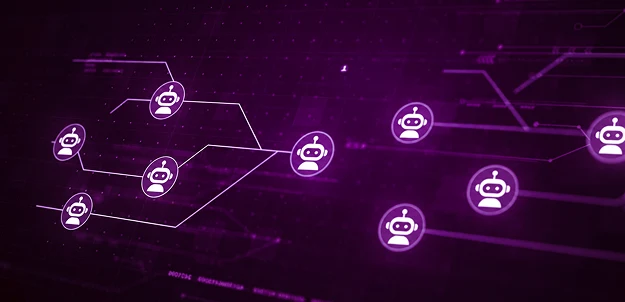
Some processes are far too complex to be handled by a single agent. We design multi-agent systems where each agent owns a defined piece of the task and hands off to the next without losing context.

Design Your Agent Team

Agent Tool & Action Integration

Agent Tool & Action Integration

AI agents cannot accomplish tasks without access to the necessary tools and systems. We connect agents to your CRM, ERP, and internal tools through authenticated APIs, so they can go beyond answering questions to update records, trigger actions, and complete transactions.

Connect Agents to Your Stack

Agent Guardrails and Governance

Agent Guardrails and Governance

Giving an AI agent access without clear boundaries can turn a small mistake into a business risk. We define what each agent can access and execute, with audit trails, escalation rules, and access controls built in from the start.

Set Your Agent’s Limits

AgentOps Monitoring and Drift Detection

AgentOps Monitoring and Drift Detection

Agent behavior can change as models, data, tools, and business conditions evolve after deployment. Our AgentOps approach monitors performance, evaluates outcomes, and identifies drift or issues that require intervention.

Keep Your Agents Reliable

AI Agents We Build for Every Business Function

Customer Support Agent

Increasing volume of support tickets can quickly overwhelm teams with repetitive questions, status checks, and follow-ups. We build support agents that connect with your CRM and support systems to resolve routine queries using customer context and escalate cases that need human attention.

IT Service Desk Agent

IT teams lose time to routine requests such as password resets, access approvals, and basic troubleshooting. Our IT service desk agents integrate with your ticketing platform to resolve common requests and route complex issues to the right technician.

Sales / SDR Agent

Sales teams often rely on reps to research prospects, qualify leads, and maintain CRM records manually. We build SDR agents that connect to your CRM and sales integrations to automate these workflows and keep prospect data up to date.

Data Analyst Agent

Routine data questions can create a queue for analysts when teams need answers quickly. Our data analyst agents connect to approved data sources to query information, analyze it, and return answers without waiting for a scheduled report.

HR & Onboarding Agent

As companies expand, HR teams play a crucial role in managing increased policy inquiries, documentation, and onboarding requests. We build HR agents around your policies and workflows to streamline routine employee requests.

Finance / Procurement Agent

Finance teams have to reconcile data across invoices, purchase orders, vendor records, and payment systems before completing a transaction. We build finance and procurement agents that connect your systems, check data, route requests, and flag exceptions for review.

AI Is Only Useful When It Can Reach Your Data

Don't see your function?

Every agent we build is scoped to a specific job, so if you have a process in mind, we can design for it.

Discuss Your Agent Idea

Capabilities Built Into Every AI Agent

Reasoning and Planning

Break complex tasks into steps, determine what needs to happen next, and adjust the plan based on results. If a step fails or the result isn’t what was expected, the agent changes its approach and tries the step again.

Your Data Stays Yours

Autonomous Tool Use

Call APIs, query databases, retrieve information, and use business applications to perform actions rather than only generate responses. The agent can update a CRM record or create a ticket using only the access you give it.

Context Retrieval and Grounding

Retrieve relevant, up-to-date context from enterprise data sources such as knowledge bases, vector databases, and RAG pipelines before generating a response or taking action. It answers from your documents and data.

Every Action Is Tracked Answers

Human-in-the-Loop Checkpoints

Route actions to a human for approval when they require authorization, business judgment, or exception handling before execution. The agent stops and asks before it acts, then carries on once someone approves the action.

Memory and Context Retention

Maintain relevant information across business interactions so agents can use previous actions, user preferences, and task context. The agent remembers what was already done, so users don’t have to explain things twice.

Multi-Agent Collaboration

Coordinate multiple specialized agents, allowing each agent to handle a specific part of a larger workflow and pass context between them. One agent can take the request, another checks it, and a third closes it out.

Safety Built In From the Start

Decision-Making and Conditional Actions

Evaluate inputs against business rules, policies, or predefined conditions and choose the appropriate next action or escalation path. Simple requests are handled automatically. Anything unusual goes to someone on your team.

Guardrails and Policy Enforcement

Set policies and permissions around what an agent can access, what actions it can perform, and when it must escalate tasks to human agents. Every action the agent takes is recorded, so you can check what it did and why.

Every Action Is Tracked Answers
AI Is Only Useful When It Can Reach Your Data

Your team shouldn't do what an agent can.

Connect agents to your data, tools, and workflows with the controls your business needs

Schedule a Consultation Call
star-mid-left
star-bottom-right

AI Technologies and Platforms We Work With

We stay model-agnostic and framework-flexible, selecting the orchestration frameworks, models, tools, and infrastructure based on each agent's requirements.

LangGraph Logo

LangGraph

CrewAI Logo

CrewAI

NVIDIA Logo

Microsoft Agent Framework

OpenAI Logo

OpenAI (GPT)

Claude Logo

Anthropic (Claude)

Gemini Logo

Google (Gemini)

Llama Logo

Llama

Mistral Logo

Mistral

Qwen Logo

Qwen

Salesforce (Agentforce)

Salesforce (Agentforce)

ServiceNow

ServiceNow (Now Assist)

REST Logo

Databricks Mosaic AI (Agent Bricks)

AWS Logo

MCP (Model Context Protocol)

Retrieval-Augmented Generation (RAG)

Retrieval-Augmented Generation (RAG)

LangChain Logo

LangChain

AWS Logo

Amazon Web Services (AWS)

Microsoft Azure logo

Azure

Google Cloud logo

Google Cloud/Vertex AI

Kubernetes logo

Kubernetes

MLOps Logo

MLOps

Multi-cloud infrastructure logo

Multi-cloud

Model-agnostic

Model-agnostic Architecture

Industries We Serve

Healthcare & Life Sciences
Retail & Consumer Goods
Insurance
Manufacturing
Energy & Utilities
Technology
Non Profit
Professional Services

Healthcare

Our AI agents retrieve relevant patient history and clinical context from connected systems, helping care teams access information faster while working within defined access and compliance controls.

Retail & eCommerce

AI agents analyze real-time customer behavior and connected product data to personalize recommendations, outreach, and shopping experiences as customer intent changes.

BFSI

AI agents continuously analyze transaction patterns against defined risk rules, flag suspicious activity, and trigger appropriate workflows for investigation or review.

Manufacturing

Our agents monitor equipment and sensor data in real time, identify patterns that indicate potential failures, and trigger maintenance workflows before downtime occurs.

Logistics & Supply Chain

AI agents track shipments, inventory, and operational data to detect delays or disruptions and trigger the next steps across connected logistics workflows.

Software & Technology

AI coding agents integrate with development workflows to generate and review code, run tests, investigate issues, and automate routine engineering tasks.

Education

AI agents connect to institutional knowledge bases and systems to answer student and staff questions, retrieve information, and automate routine administrative workflows.

HR & People Operations

AI agents use your policies and employee data to handle onboarding, answer HR questions, manage routine requests, and route sensitive cases to HR teams.

Know More

How We Build AI Agents

01

Discovery

We define the agent's job, required outcomes, systems, data sources, and level of autonomy it requires before development begins. We map the workflows the agent will handle and define where human decisions are required.

02

Framework and Architecture Selection

We select the orchestration framework based on the agent's requirements, using LangGraph for stateful multi-step workflows, CrewAI for coordinated multi-agent systems, or AutoGen for dynamic agent-to-agent collaboration. We then design the architecture around the agent's memory, tool access, data sources, APIs, and enterprise integrations.

03

Agent Development

Our team develops the agent's reasoning, planning, memory, tool use, and action workflows around the defined business process. We connect the agent to required APIs, databases, applications, and other tools.

04

Evaluation and Guardrails

We evaluate agent behavior across expected workflows, use cases, and failure scenarios before deployment. Our developers establish clear boundaries around what an agent can access, such as action limits, permissions, access controls, escalation logic, human-in-the-loop checkpoints, and audit trails.

05

Deployment

We deploy the tested agent into your production environment and connect it to the live systems, tools, and data sources required to perform its assigned tasks. After this, our team validates permission scopes, integrations, and execution workflows.

06

Monitoring and Optimization

We continuously monitor agent performance, actions, tool usage, and outcomes after deployment. Our AgentOps approach helps identify performance changes, model or data drift, failed actions, and other issues so we can evaluate and improve the agent as your business and usage evolve.

Every agent we build starts with discovery.

Bring one process and the systems behind it. We’ll map the agent’s job and its limits.

Why Enterprises Choose Cyntexa as Their AI Agent Development Partner

0+
Projects
0+
Happy Customers
0+
Salesforce Experts

Built-In Governance

Every agent has defined permissions, escalation rules, and audit trails established during design rather than added after deployment.

Diagnose Before We Build

We assess the process, data, constraints, and expected outcomes before defining the right AI agent development solution and architecture.

Built for Enterprise Systems

Our enterprise AI agent development services connect agents to authenticated CRM, ERP, and internal systems so they can execute tasks end-to-end.

Agents Built for Specific Jobs

Each agent is designed around a defined function, with only the tools, data, and decision boundaries required for that job.

Experience Across Agent Functions

Our teams have built agents for support, IT, sales, HR, finance, and data workflows, applying agent development to specific business functions.

Continuous Agent Evaluation

As an AI agent development company, we evaluate agent behavior and performance after deployment to detect drift and identify changes before they affect business operations.
AI Is Only Useful When It Can Reach Your Data

Want a number for your project?.

Share your use case, and we’ll send an estimate covering scope, timeline, and team.

Get a Free Estimate

Explore the Latest in Agentic AI

Insights on AI agents, multi-agent systems, and the controls that keep them reliable in production.

Frequently Asked Questions

AI agent development services involve designing and building AI agents that can understand a goal, reason through tasks, use connected tools, and take actions within defined business processes.

Chatbots are mainly designed for conversations, while RPA bots typically follow predefined, rule-based workflows. AI agents can reason through changing inputs, choose between available actions, and adapt their steps within defined boundaries.

The cost depends on the agent's complexity, number of systems and tools involved, model choice, data requirements, security controls, and deployment environment. A single-purpose agent connected to one system will generally require a different investment than a multi-agent system working across multiple enterprise applications.

Yes. Cyntexa provides AI agent development services for businesses in the USA and works with organizations to design, integrate, deploy, and maintain production AI agents around their existing systems and workflows.

Yes. AI agents can be deployed in a company’s private cloud environment and can use open-source models such as Llama, Mistral, or Qwen. This is particularly useful when the use case requires greater control over deployment, data handling, or model customization.

Agents should be designed to handle errors rather than operate without safeguards. Depending on the workflow, an agent can stop execution, retry an action, follow a fallback path, or escalate the decision to a human for review.

The time taken to build and deploy an agent depends on its scope, integrations, data requirements, and level of autonomy. A focused AI agent with limited integrations can be developed faster, while enterprise agents involving multiple systems, complex workflows, and extensive evaluation require more time.

You retain ownership of your business data, while ownership of the custom agent code is defined in your project agreement. Third-party models, frameworks, and tools remain subject to their respective licensing terms.

Yes. AI agents can connect with existing applications through APIs, connectors, databases, and other integration methods. This allows an agent to work within the technology your teams already use rather than requiring a completely separate system.