




What Is Agentforce IT Service? Features, Pricing, and How It Works
source on Google

Table of Contents
source on Google
Salesforce Agentforce IT Service Management is designed to replace the traditional ticket-and-queue experience with AI agents. Imagine your employee’s laptop won’t connect to the VPN. Instead of filing a ticket and waiting in line, they type the issue into Slack and get it resolved in minutes. If the problem requires human intervention, the AI agent passes the complete context to IT, while the team monitors system health in real time and identifies issues before they become outages.
This blog explains what Agentforce IT Service Management is, how it works, its key features, pricing, how it compares with ServiceNow, and what to prepare before implementation.
What is Agentforce IT Service Management?
Agentforce IT Service Management (ITSM) is Salesforce’s conversational, AI-driven service desk. Employees can chat with it directly and resolve IT issues instantly, without filling a ticket.
Your employee can simply describe a problem in plain language inside their conversational tool like Slack or Microsoft Teams, and an AI agent resolves it directly, without a form or a ticket number.
It runs natively on the Salesforce platform rather than sitting on top of a legacy ITSM system, meaning the AI agents are foundational, not a layer added afterward.
The product automates the standard ITIL-aligned processes IT teams already run: incident, problem, change, release, and request management, through a unified service catalog.
Agents can create and prioritize incidents automatically, recognize when several employees are reporting the same underlying issue and escalate it as a major incident, and generate root cause analysis before a human agent gets involved.
At the center of it is the Agentic CMDB, a live map of your IT infrastructure, paired with a Service Graph that shows how every system connects to and depends on the others. When an employee reports an issue, the reasoning engine cross-references your knowledge base against this real-time infrastructure map to diagnose root cause before choosing an action.
What are the core features of Agentforce IT Service Management?
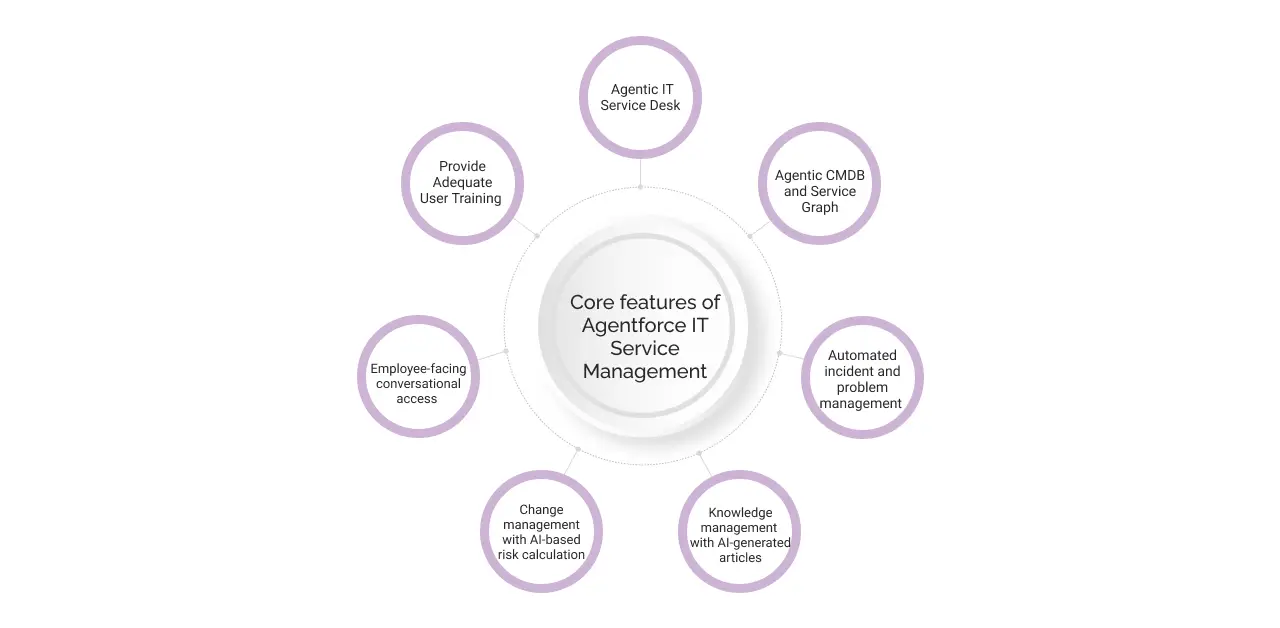
1. Agentic IT Service Desk
When an issue requires human support, your IT teams get a clear summary instead of a raw support ticket. The system provides details about what happened, the affected system, and the steps already taken by the AI agent. This helps your IT teams spend less time diagnosing the issues and more time resolving them.
2. Agentic CMDB and Service Graph
The Agentic CMDB provides a real-time view of IT infrastructure and system dependencies. This ensures both AI agents and IT teams work with accurate, up-to-date information when diagnosing and resolving issues.
3. Automated incident and problem management
The system automatically identifies related incidents and groups them into one major incident instead of creating multiple separate tickets. It also connects incidents to their root cause, helping prevent the same issue from recurring.
4. Knowledge management with AI-generated articles
The platform automatically creates and recommends knowledge articles based on your database and how issues are resolved. This helps organizations build and maintain an up-to-date knowledge base without requiring IT teams to document every solution manually.
5. Change management with AI-based risk calculation
Before a system change is approved, the AI evaluates its potential risk based on the affected systems. This gives IT teams additional insights to make more informed approval decisions.
6. Employee-facing conversational access
Employees can raise IT requests through the tools they already use, including Slack, Microsoft Teams, email, web, or an employee portal. This removes the need to learn or access a separate application, making adoption easier.
7. HR support on the same platform
Agentforce ITSM works alongside Agentforce for HR Service, allowing employees to submit both IT and HR requests through the same conversational interface instead of using separate systems.
How does Agentforce for IT Service Management work?
Agentforce IT Service Management (ITSM) simplifies how employees get IT support while reducing the workload for IT teams. Here’s how the process works:
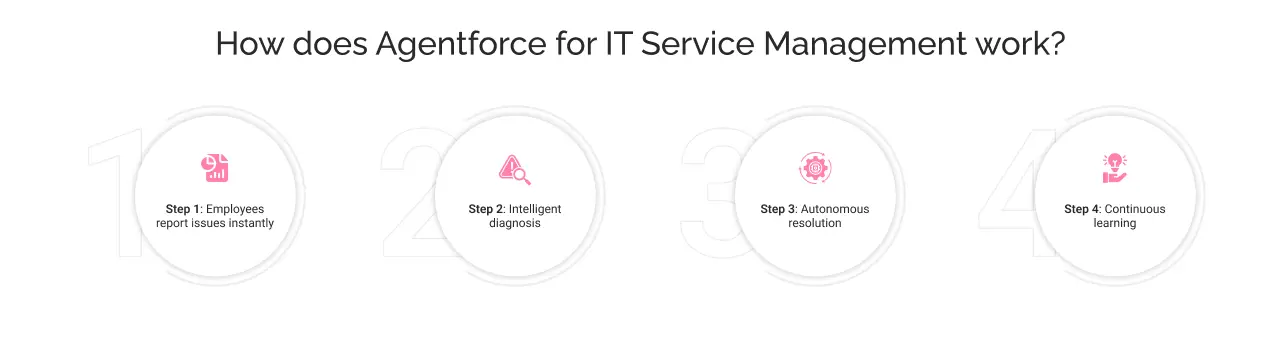
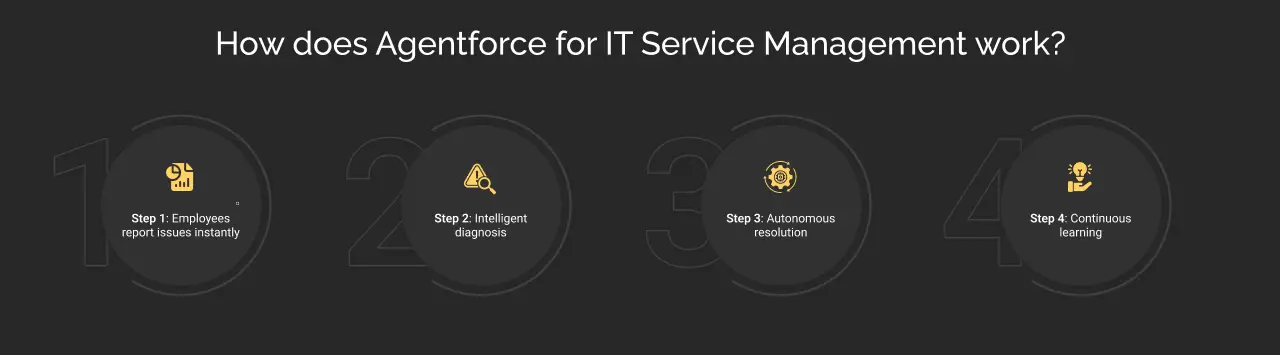
Step 1: Employees report issues instantly
Your employees do not have to open a portal or fill out a form to log an issue; they can simply describe their issue in Slack or Microsoft Teams.
For example, they can simply type “My VPN is not connecting” or “I need access to Salesforce Marketing Cloud.”
There is no need to create tickets manually, navigate multiple menus, or wait for confirmation emails.
Step 2: Intelligent diagnosis
Once the employee submits a request, the Atlas Reasoning Engine analyzes the issue using two key sources:
- The organization’s trusted knowledge base, which contains documented solutions and best practices.
- The live Agentic CMDB, which provides real-time visibility into IT systems, assets, and their relationships.
By combining both sources, Agentforce understands what the employee is experiencing and what’s happening behind the scenes. This helps it identify the root cause instead of making assumptions based only on the reported symptom.
Step 3: Autonomous resolution
After identifying the problem, Agentforce takes action.
For common requests, such as password resets or application access, it can resolve the issue automatically without involving an IT agent.
If the issue is more complex, Agentforce prepares everything before handing it over. It summarizes the problem, includes its findings, and routes the request to the appropriate IT specialist. The IT team can focus on solving the issue instead of spending time on initial investigation and ticket triage.
Step 4: Continuous learning
Every escalated issue contributes to improving future IT service operations.
When multiple incidents share the same root cause, Agentforce automatically links them together. It helps IT leaders identify recurring problems early, allowing them to fix underlying issues before they generate a large number of repeat support requests.
Throughout the entire process, employees interact using natural conversations instead of complicated support systems. At the same time, IT teams spend less time sorting and diagnosing tickets, allowing them to focus on more value work.
How much does Agentforce IT Service Management cost?
Agentforce IT Service Management (ITSM) pricing is based on the type of user. Employees who request IT support require one license, while IT administrators and service desk teams need another because they use advanced management and automation features.
| License type | Price | What’s included | Best for |
|---|---|---|---|
| AI Agents for Employees (Requester License) | $15 per user/month | Conversational AI support for reporting issues, requesting access, and resolving common IT requests through self-service. | Employees who submit IT requests through Slack or Microsoft Teams. |
| IT Service Desk for Fulfillers (Enterprise Edition) | $75 per user/month | Access to core ITSM capabilities, including CMDB, Discovery, Incident Management, Change Management, and the Service Desk Workspace. | IT service desk agents and administrators. |
| IT Service Desk for Fulfillers (Unlimited Edition) | $150 per user/month | Everything in Enterprise Edition, plus predictive SLA breach modeling and AI-generated knowledge articles. | IT teams that need advanced AI capabilities. |
Note: Pricing reflects Salesforce’s publicly listed rates as of July 2026 and is subject to change.
Important pricing considerations
Before estimating your Agentforce ITSM budget, there are a few key points to keep in mind:
- Flex credits are included: Agentforce Flex Credits and Mule for Flow are included with the IT and HR Service offerings. This means organizations don’t have to worry about additional AI usage or workflow consumption costs for these products.
- Annual licensing: Although pricing is shown on a monthly basis, licenses are generally purchased as an annual subscription, n ot on a month-to-month basis.
- Your total cost depends on user mix: Most organizations require a large number of requester licenses for employees and a much smaller number of fulfiller licenses for IT staff. So, your overall investment depends more on your workforce distribution than on the price of an individual license.
Once you know what Agentforce ITSM costs, the natural next question is how it stacks up against the tool most IT teams already know: ServiceNow. The two are not interchangeable, and the right choice usually comes down to what’s already running in your stack.
Agentforce IT Service Management vs. ServiceNow ITSM
Agentforce IT Service and ServiceNow ITSM use AI to improve IT support, but they take different approaches.
| Agentforce ITSM | ServiceNow ITSM | |
|---|---|---|
| Built on | Native to the Salesforce Platform, agentic by default. | Built on the Now Platform, AI layered on via Now Assist add-on. |
| AI role | Agents resolve requests autonomously as the default experience. | Now Assist augments human agents (summarizes, suggests, drafts) and doesn’t replace the ticket workflow. |
| Scope | IT and HR service management. | Full IT operations suite: ITSM, ITOM, asset management, security, and risk. |
| Pricing model | Published per-user pricing ($15 / $75 / $150). | Custom quote only; no public pricing. |
| Best fit for | Organizations already using Salesforce CRM or Service Cloud. | Organizations already using ServiceNow for IT operations, asset management, or security. |
| Switching cost | Lower if Salesforce is already your system of record. | Lower if ServiceNow already runs your broader IT operations. |
Which is the better fit?
Organizations already using ServiceNow for IT operations, asset management, or security may benefit from staying within its ecosystem. Businesses that already rely on Salesforce for CRM or customer service can often adopt Agentforce IT Service more quickly because it uses the same platform, data, and workflows.
What do you need before implementing Agentforce IT Service Management?
Before your team starts configuring anything, get these four things in order first.
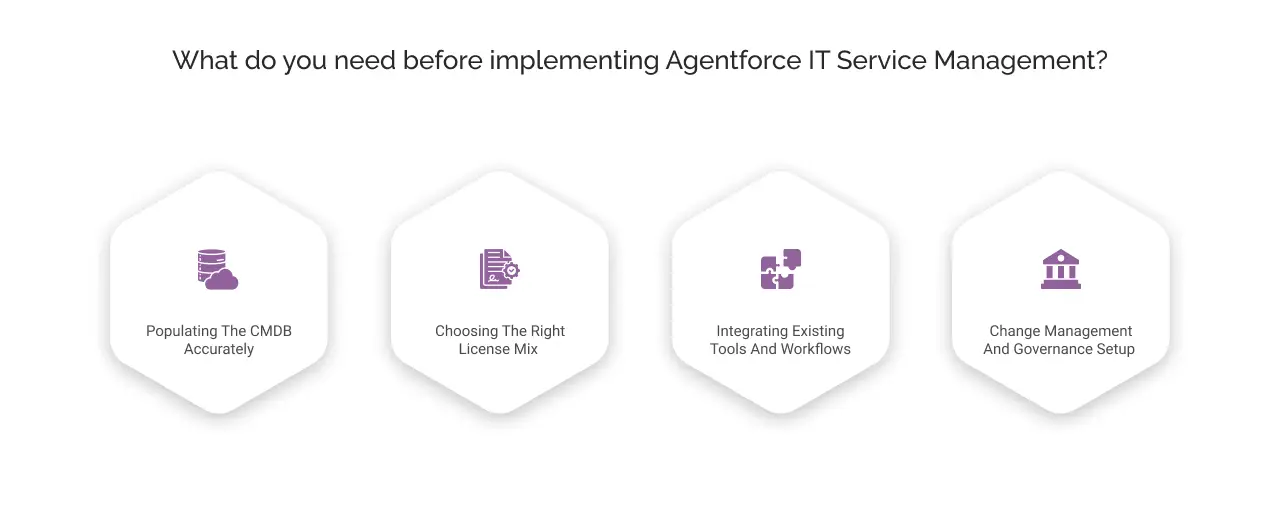
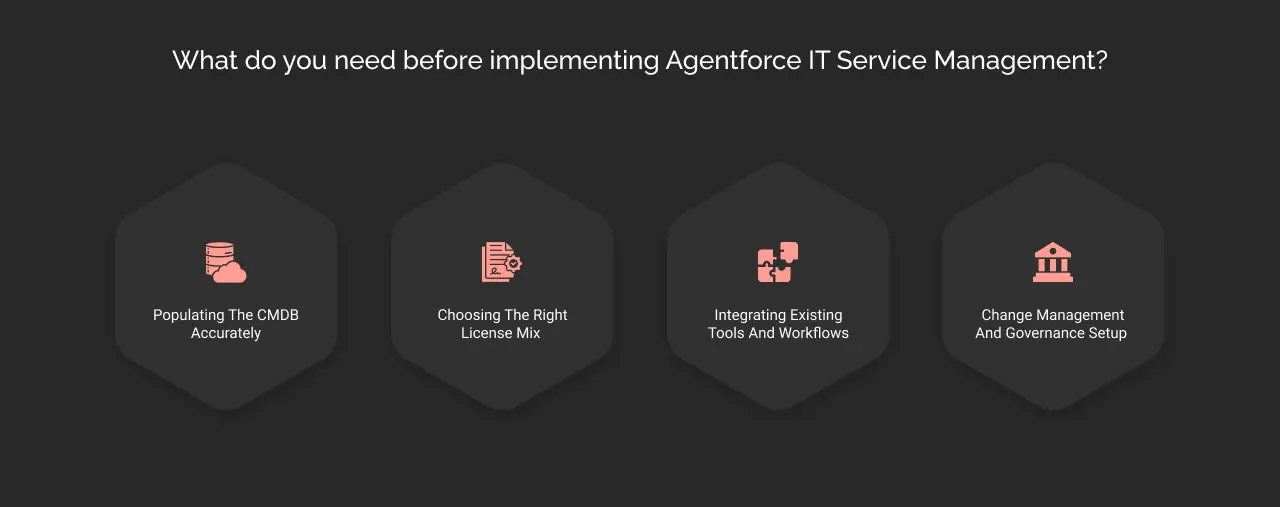
Populating the CMDB accurately
The Agentic CMDB relies on accurate and up-to-date infrastructure data. If your asset records are outdated, incomplete, or spread across multiple systems, Agentforce may struggle to identify the root cause of incidents. Cleaning and organizing your data is the most important, and underestimated part of the implementation.
Choosing the right license mix
Choosing the right mix of licenses is one of the biggest factors in controlling implementation costs. Many organizations work with a Salesforce implementation partner to assess their user requirements, estimate licensing needs, and design an ITSM solution that aligns with both their operational goals and budget before making a final investment.
Integrating existing tools and workflows
Agentforce supports more than 100 pre-built integrations with platforms such as Google, Microsoft, and Workday. However, having a connector available does not mean it’s already configured for your organization’s workflows, approval processes, or security requirements. It requires custom configuration to ensure everything works seamlessly.
Change management and governance setup
AI-powered risk assessments for change requests are only effective when approval workflows and governance policies are configured correctly. You should define roles, approvals, and Change Advisory Board (CAB) processes early, as it ensures the AI generates recommendations that IT teams can trust.
None of these challenges are reasons to avoid this platform. They are simply common implementation considerations that require careful planning. That’s why most organizations bring in an implementation partner rather than configuring solo.
How can Cyntexa help you get Agentforce IT Service Management running the right way?
Agentforce IT Service Management can significantly improve how organizations deliver IT support by automating routine tasks, accelerating issue resolution, and enhancing employee experiences. While the platform is designed for faster deployment than traditional ITSM solutions, achieving long-term success depends on implementing correctly from the start.
At Cyntexa, we help organizations maximize the value of their Salesforce investment by delivering end-to-end Agentforce ITSM implementation services. From preparing and organizing CMDB data to configuring integrations, optimizing licensing, and establishing IT service workflows, our Salesforce experts ensure your implementation is built for long-term success.
If you are planning to implement Agentforce IT Service Management or evaluating whether it’s the right fit for your business, contact us today!
It’s built on per-user licensing, so cost scales with headcount rather than requiring a large flat fee. Smaller teams should consider the Fulfiller license cost ($75–$150/user/month) against how much IT staff they actually have, since the ROI is higher when there’s real ticket volume to automate.
Schedule a consultation call today!
Don’t Worry, We Got You Covered!
Get The Expert curated eGuide straight to your inbox and get going with the Salesforce Excellence.
Co-founder and CTO at Cyntexa also known as “VJ”. With 10+ years of experience and 22+ Salesforce certifications, he’s a seasoned expert in Salesforce Data Cloud & AI Products, Product Engineering, AWS, Google Cloud Platform, ServiceNow, and Managed Services. Known for blending strategic thinking with hands-on expertise, VJ is passionate about building scalable solutions that drive innovation, operational efficiency, and enterprise-wide transformation.


Cyntexa.
Join Our Newsletter. Get Your Daily Dose Of Search Know-How
Frequently Asked Questions
Yes. Customer Service handles external, customer-facing support cases. IT Service Management is built for internal employees and IT infrastructure, powered by the Agentic CMDB. They are separate products under Salesforce's Agentforce and Service Cloud platform.
It's designed to replace the ticket-and-queue model specifically, not every tool in your IT stack. It automates the same ITIL-aligned processes traditional ITSM software handles (incident, problem, change, request management), but delivers them through autonomous AI agents instead of manual workflows.
Employees can raise requests through Slack, Microsoft Teams, email, web, or a dedicated employee portal, without learning a separate application.
It's built on per-user licensing, so cost scales with headcount rather than requiring a large flat fee. Smaller teams should consider the Fulfiller license cost ($75–$150/user/month) against how much IT staff they actually have, since the ROI is higher when there's real ticket volume to automate.