




Agentforce 2025–2026: Statistics, Success Stories, and Salesforce’s AI Agent Trends
source on Google

Table of Contents
source on Google
Around one and a half years ago, Agentforce was a keynote announcement. Today, it’s a $2.9 billion Annual Recurring Revenue (ARR) product with over 29,000 enterprise deals closed.
That’s not a proof of concept; that’s a product that actually works and helps enterprises multiply their team’s productivity. That’s why enterprises are paying for it.
This blog breaks down exactly what happened in Agentforce’s first full year, the verified number from Salesforce’s Q4 2026 earnings, the customer results that actually moved the needle, and what the patterns highlight where Agentforce is heading inside enterprise operations.
What is the Salesforce Agentforce Revenue for FY26?
In Q4 fiscal year 2026, Salesforce posted record growth in Agentforce and Data 360, closing out a record full year with record ARR growth and deal momentum.
Below is the performance summary based on the Salesforce Q4 FY26 earnings release:
| Metric | Q4 FY26 Result |
|---|---|
| Total Revenue | $11.2 billion (up 12% Y/Y) |
| Agentforce + Data 360 ARR | $2.9 billion (up over 200% Y/Y), including $1.1 billion Informatica Cloud ARR |
| Agentforce ARR Alone | $800 million (up 169% Y/Y) |
| Deals closed since launch | 29,000, up 50% quarter-over-quarter |
| Tasks completed by AI Agent (Agentic Work Units) | 2.4 billion, growing 57% quarter-over-quarter |
| Salesforce Data 360 Scale | 112 trillion records ingested in FY26, up 114% Y/Y |
| Zero Copy Ingestion | 53 trillion via Zero Copy (up 310% Y/Y) |
| Unstructured data processed | 18 terabytes in FY26 |
One of the standout factors of the Salesforce Q4 2026 report is “More than 60% of Agentforce and Data 360 Q4 bookings came from existing customer expansion.” That means companies are not just piloting, they are doubling down on deployments that are already running. Every single one of Salesforce’s Top 10 Q4 customer wins included Agentforce Sales, Agentforce Service, and Data 360 as part of the deal.
| Compare from where it started: In Q4 FY25 (February 2025), Agentforce had 5,000 deals with $900M in AI+ Data Cloud ARR, and 50 trillion Data 360 records. In 12 months, deals grew 5.8x, and ARR grew more than 3 times. |
Within Salesforce’s own operations, Agentforce handled over 2.8 million interactions and saved employees more than 500,000 hours through Agentforce in Slack alone.
What are Agentic Work Units (AWU) and How Does Salesforce Measure AI Productivity?
One of the significant moves Salesforce made in Q4 FY26 was introducing a new metric: Agentic Work Units (AWUs).
Rather than counting seats or logins, an AWU measures a discrete task that an AI agent actually completed, like a case resolved, a record updated, or a workflow triggered. By the end of FY26, Salesforce had delivered 2.4 billion AWUs, growing 57% in a single quarter.
It shifts the conversation from “how many licenses did we sell?” to “how much work did AI actually do?” That’s a meaningful distinction for any team trying to justify AI investment to a CFO. The question is no longer whether your AI subscription is active; it’s whether it’s producing results.
How Fast is Agentforce Growing? A 2024–2026 Adoption Timeline
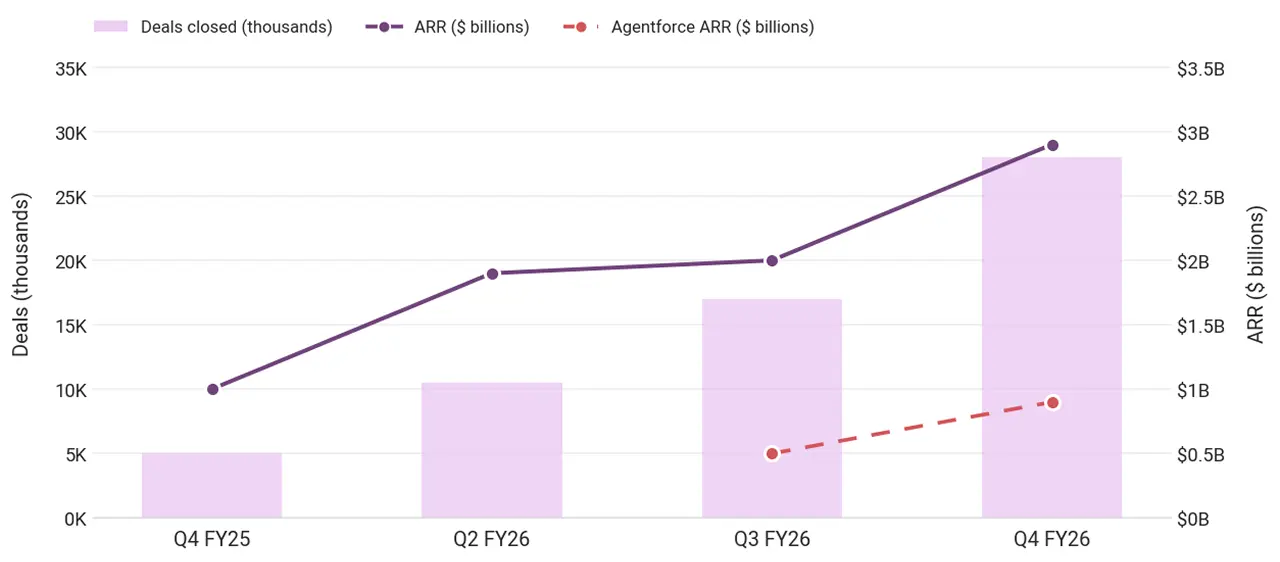
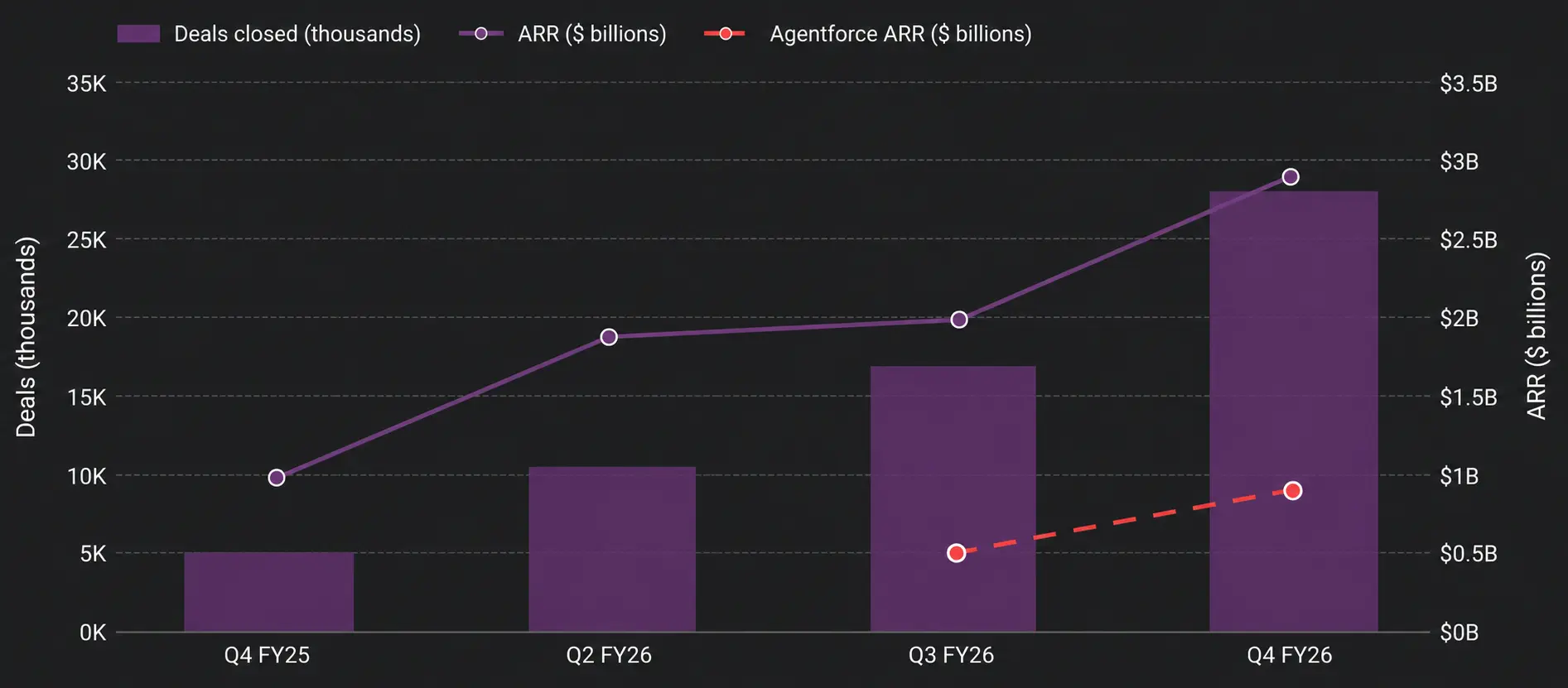
Here is how Agentforce’s adoption has accelerated, quarter by quarter, since launch:
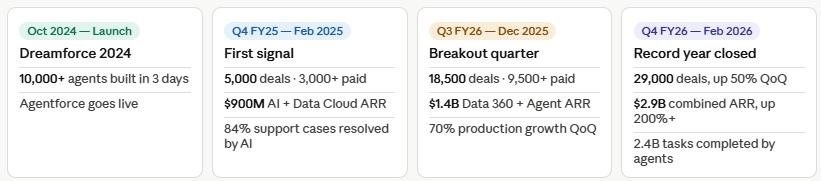
Oct 2024: Launched at Dreamforce 2024
Agentforce goes live. Within three days of Dreamforce, attendees build 10,000+ AI agents, signaling strong demand across both technical and non-technical users.
Q4 FY25 (Feb 2025): Early traction confirmed
- 5,000 deals closed, 3,000+ paid
- $900M AI + Data Cloud ARR, up 120% Y/Y
- 50 trillion Data Cloud records
- Salesforce’s internal AI agents resolve 84% of support cases without human help
Q2 FY26 (Aug 2025): Momentum builds
- Agentforce deals surpass 10,000
- Agentforce 2DX launched, enabling proactive agent execution
- Slack announced as the agentic execution layer
Q3 FY26 (Dec 2025): Breakout quarter
- 18,500+ deals, 9,500+ paid deals up 50% QoQ
- $1.4B Agentforce + Data 360 ARR (up 114% Y/Y)
- $500M+ Agentforce ARR alone (up 330% Y/Y)
- 3.2 trillion tokens processed
- Agentforce accounts in production grew 70% QoQ
Q4 FY26 (Feb 2026): Record year closed
- FY26 Agentforce ARR: $800million (up 169% Y/Y)
- 29,000 Agentforce deals
- $2.9B Agentforce + Data 360 ARR (up 200%+ Y/Y), including $1.1 billion Informatica Cloud ARR
- 112 trillion Data 360 records ingested in FY26
- 2.4 billion tasks completed by AI agents (AWUs)
- 19 trillion tokens processed all-time, up 5x Y/Y
What are the Top Salesforce Agentforce Statistics and ROI Results?
Agentforce’s growth has been significantly highlighted through these numbers. Companies are getting ROI as it boosts productivity and reduces manual labor without compromising trust and data governance.
1. 10,000+ Agents Created in 3 Days
At Dreamforce 2024, attendees created more than 10,000 AI agents within three days, highlighting strong interest across technical and non-technical users alike. Since then, Agentforce has been adopted by leading giants, including Indeed, Finnair, Heathrow Airport, Saks, and SharkNinja, to scale operations without scaling headcount.
2. 29,000 Deals Closed, and Counting
From 5,000 deals in Q4 FY25 to 18,500 in Q3 FY26 to 29,000 by Q4 FY26, Agentforce deal velocity has accelerated every quarter. Paid deals grew 50% quarter-over-quarter in Q3 FY26 alone, showing that pilots are converting to production-grade deployments at scale.
3. Resolving Queries Without Human Support
Salesforce’s internal help portal now handles over 1 million conversations per year with an 75% resolution rate, without human escalation. It reduces response time by 65% for 90% of users.
4. AI Means Lower Churn and Higher Growth
Teams that have implemented AI, including Agentforce, are experiencing measurable business benefits. As per the Salesforce State of Sales report, AI-enabled teams experience lower turnover, improved quote attainment, and higher growth.
5. 4 Trillion+ Flows Already Built
Agentforce connects directly with Salesforce Flows. Customers have created over 4 trillion automations, saving 5.6 billion hours of work. AI agents can now use these automations as actions, improving their ability to get work done without custom development.
Which Companies Are Using Salesforce Agentforce?
Agentforce is taking away the stress of maintaining operational efficiency across different industries, company sizes, and geographies.
How Many Customers Does Agentforce Have (Through Q4 FY26)?
Salesforce’s Q4 FY26 report confirms that Agentforce has closed 29000 deals since launch. As we mentioned, Agentforce + Data 360 ARR reached $2.9 billion, making it the fastest-scaling product in Salesforce history. Nearly 90% of Forbes’ Top 50 AI companies run on Salesforce, with an average of 4 clouds.
Top Companies Using Agentforce
Many of the world’s leading companies using Agentforce are based in the United States. Below is a curated list of organizations leveraging AI Agents from Salesforce:
- AAA
- Goodyear
- Camping World
- Equinix
- Saks Fifth Avenue
- CentralSquare
- ezCater
- OpenTable
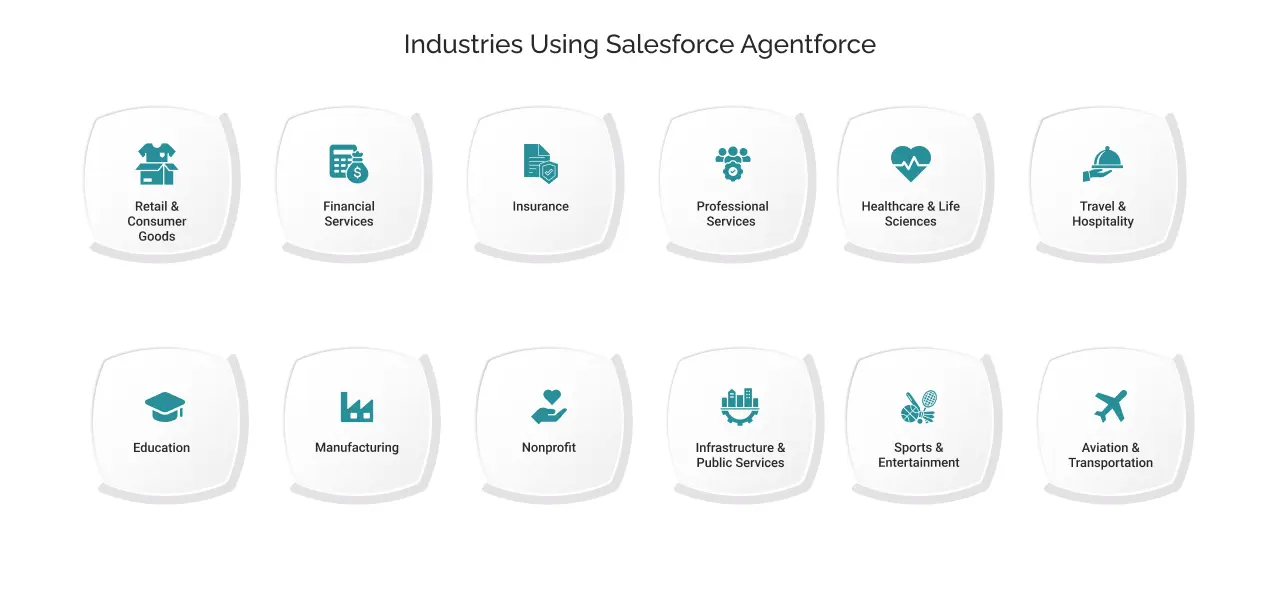
Industries Using Salesforce Agentforce
Across industries, the demand for intelligent and scalable automation is growing. As Agentforce is a digital labor platform, it handles the work, keeping your team occupied, so your people can focus on the work that actually requires them.
Retail & Consumer Goods
| Company Name | Headquarters | Industry | Agentforce Use Case |
|---|---|---|---|
| Saks | New York, New York, USA | Retail | Elevated luxury shopping experience by unifying data and AI Service Agents. |
| SharkNinja | Needham, Massachusetts, USA | Consumer Goods | Enhanced product development and customer engagement through AI-driven insights. |
Financial Services
| Company Name | Headquarters | Industry | Agentforce Use Case |
|---|---|---|---|
| Sammons Financial Group | West Des Moines, Iowa, USA | Financial Services | Elevated luxury shopping experience by unifying data and AI Service Agents. |
| Indeed | Austin, Texas, USA | Employment Services | Enhanced product development and customer engagement through AI-driven insights. |
Insurance
| Company Name | Headquarters | Industry | Agentforce Use Case |
|---|---|---|---|
| Young Drivers | Canada | Automotive Insurance | Scaling customer support and scheduling with Agentforce to meet growing customer demands. |
Professional Services
| Company Name | Headquarters | Industry | Agentforce Use Case |
|---|---|---|---|
| Mike Morse Law Firm | Southfield, Michigan, USA | Legal Services | Boosted productivity by 35% with Salesforce AI insights. |
| 1-800Accountant | New York, New York, USA | Accounting Services | Automated client onboarding and support using Agentforce. |
| Capita | London, UK | Business Services | Enhanced service delivery and client engagement through Agentforce. |
| Vivint | Provo, Utah, USA | Home Security | Streamlined customer support and installation scheduling using Agentforce. |
| AAA Washington | Bellevue, Washington, USA | Travel & Insurance Services | Enhanced member services and roadside assistance coordination through Agentforce. |
Healthcare & Life Sciences
| Company Name | Headquarters | Industry | Agentforce Use Case |
|---|---|---|---|
| Adobe Population Health | San Francisco, California, USA | Healthcare | Improved patient data management and care coordination with Agentforce. |
| Precina | San Diego, California, USA | Healthcare | Leveraged Agentforce for advanced analytics in patient care. |
| Amplifon | Milan, Italy | Healthcare (Hearing Aids) | Tailored hearing care with smart scheduling through autonomous agents. |
| Wellness Extract | Vancouver, Canada | Health Supplements | Streamlined customer inquiries and order processing using Agentforce. |
| Transcend | USA | Telehealth | Offering 24/7 personalized telehealth support with a limitless workforce to meet increasing demand. |
Travel & Hospitality
| Company Name | Headquarters | Industry | Agentforce Use Case |
|---|---|---|---|
| OpenTable | San Francisco, California, USA | Hospitality | Enhanced customer service experiences using Agentforce. |
| ezCater | Boston, Massachusetts, USA | Food Services | Transformed customer experience through Agentforce integration. |
| Secret Escapes | London, UK | Travel & Hospitality | Delivered fast, 24/7 support with autonomous agents for travelers. |
| Engine | USA | Travel Platform | Autonomously resolving over half a million inquiries annually, allowing reps to focus on providing personalized service. |
Education
| Company Name | Headquarters | Industry | Agentforce Use Case |
|---|---|---|---|
| Wiley | Hoboken, New Jersey, USA | Publishing | Achieved a 213% ROI by streamlining operations with Agentforce. |
| Carnegie Learning | Pittsburgh, Pennsylvania, USA | Education Technology | Enabled sales teams to focus more on selling by automating processes with Agentforce. |
| Unity Environmental University | New Gloucester, Maine, USA | Higher Education | Improved student engagement and administrative efficiency through Agentforce. |
Manufacturing
| Company Name | Headquarters | Industry | Agentforce Use Case |
|---|---|---|---|
| Kawasaki Engines | Maryville, Missouri, USA | Manufacturing | Boosted customer satisfaction by integrating Agentforce for efficient service management. |
| Fisher & Paykel | East Tamaki, Auckland, New Zealand | Manufacturing | Streamlined operations and improved customer service using Agentforce. |
| Luminator | Plano, Texas, USA | Manufacturing | Leveraged Agentforce to optimize production processes and supply chain management. |
Nonprofit
| Company Name | Headquarters | Industry | Agentforce Use Case |
|---|---|---|---|
| Big Brothers Big Sisters of America | USA | Nonprofit Mentorship | Assisting matching specialists to find the right mentor-mentee pairs in half the time, enhancing one-to-one mentorship programs. |
| College Possible | Saint Paul, Minnesota, USA | Nonprofit Education | Enhanced student support services and donor engagement using Agentforce. |
Infrastructure & Public Services
| Company Name | Headquarters | Industry | Agentforce Use Case |
|---|---|---|---|
| The Adecco Group | Zurich, Switzerland | Staffing Services | Improved talent matching and client services with Agentforce. |
| CentralSquare Technologies | Lake Mary, Florida, USA | Public Sector Software | Streamlined municipal operations and citizen engagement using Agentforce. |
| Sweeping Corp | Cleveland, Ohio, USA | Environmental Services | Optimized scheduling and service delivery through Agentforce. |
Sports & Entertainment
| Company Name | Headquarters | Industry | Agentforce Use Case |
|---|---|---|---|
| Formula 1 | London, UK | Sports & Entertainment | Speeded up service response by 80% with personalized fan experiences. |
| Equinox | New York, New York, USA | Fitness & Wellness | Improved member engagement and class scheduling using Agentforce. |
Aviation & Transportation
| Company Name | Headquarters | Industry | Agentforce Use Case |
|---|---|---|---|
| Heathrow Airport | London, UK | Aviation | Providing faster service and cutting call times by up to 40% with personalized support to travelers. |
| Finnair | Helsinki, Finland | Aviation | Delivering instant answers for customers at scale, with a digital workforce resolving 80% of customer service questions. |
How Does Agentforce Improve Sales and Customer Service Productivity?


Over the last 12 months, one thing has become clear:
“AI Agents are the foundational element that enables users to work with AI in a secure and effective manner.”
Agentforce’s Agentic framework helps teams across sales, service, marketing, and commerce redefine how they work. Let’s look at where the impact is showing up.
Agentforce in Sales
Salesforce’s State of Sales (7th Edition) shows that reps spend only 40% of their time actually selling. The rest 60% goes to admin, data entry, prospecting, and planning. That’s the gap agents are closing.
With Agentforce for Sales:
- 9 in 10 sales teams use AI agents today or expect to use them within two years.
- 94% of sales leaders with agents say they’re critical for meeting business demands.
- 54% of sales teams already have agents deployed.
- Agents most benefit: data accuracy, sales planning, customer retention, and prospecting.
- 88% of reps with agents say AI increases their odds of hitting sales targets.
Nearly half of reps say cold outreach is one of the worst parts of the job, and just as many say their team doesn’t have the bandwidth to do it consistently.
Salesforce applied this, and in four months, Agentforce agents contacted 130,000 leads and created 3,200 pipeline opportunities from them. The company expects to scale that 10x in the following year.
Agentforce in Service
Customer service is where Agentforce has its most visible impact, and the numbers from Salesforce State of Service (7th Edition) show exactly how fast things are moving.
What Salesforce’s State of Service (7th Edition) found:
- 79% of service leaders say investing in AI agents is essential to meet current business demands, and AI has become the 2nd priority from the 10th priority in a single year.
- Companies using AI agents expect to decrease service costs and case resolution times by 20% on average.
- By 2027, 50% of all service cases are expected to be resolved by AI, up from 30% in 2025.
- Service professionals project that AI agents will boost upsell revenue by 15%.
- 89% of service professionals say conversational AI increases self-service resolution rates.
For example, Wiley, a publishing company, upgraded from a basic chatbot to Agentforce-powered service agents. Their case resolution improved by over 40% in the first few weeks, seasonal agents onboarded 50% faster, and total ROI came in at 213%, with $230,000 in documented savings.
Agentforce for SMBs
Let’s bust a myth first: AI at this level is not just for large enterprises.
Salesforce SMB Trends research shows small and mid-sized companies are moving faster on AI:
- 75% of SMBs are already investing in AI
- Over a third have fully implemented AI in at least one part of their business
- Among those using it, 91% report revenue growth, with 80% calling AI a game-changer
- The fastest-growing SMBs are 1.8x more likely to be using AI than their slower-moving peers.
Agentforce in Commerce
Commerce is one of the fastest-moving areas for AI agents, and the shift is happening at a pace most retailers didn’t anticipate. The November 2025 Agentforce Commerce launch data highlights this:
- Online traffic driven by AI assistants like ChatGPT grew 119% year-over-year in the first half of 2025.
- AI agents are projected to drive 22% of global orders during peak shopping periods like Cyber Week.
Salesforce’s Agentforce Commerce platform, launched in November 2025, enables retailers to distribute product catalogs directly to consumer AI channels like ChatGPT while maintaining brand control and customer relationship ownership across every touchpoint.
The result for customers is a faster, more relevant shopping experience. For businesses, it’s a backend that continuously learns which products, prices, and promotions are driving results, and acts on that without waiting for a human to review a dashboard.
What is AgentExchange? Exploring the Salesforce AI Marketplace


AgentExchange started as a dedicated marketplace for AI agents, apps, and automation components at TrailblazerDX 2025. At TDX 2026, Salesforce rebranded and consolidated three separate platforms, AppExchange, Slack Marketplace, and the Agentforce ecosystem, into a single unified marketplace under the AgentExchange name.
AgentExchange now brings together 10,000 Salesforce apps, 2,600+ Slack apps, and 1,000+ Agentforce agents, tools, and MCP servers.
Key Statistics
- 200+ Initial Partners: Including Google Cloud, DocuSign, Box, and Workday
- 14000+ vetted agents, apps, and tools (as of April 2026).
- $50 million fund for builders and partners announced at TDX 2026
- Salesforce AppExchange and Slack Marketplace are now unified under AgentExchange
Core Components
AgentExchange offers four primary types of agentic components:
- Actions: Extend what agents can do by integrating Apex, flows, APIs, and prompts, enabling you to add features tailored to your industry.
- Prompt Templates: Reusable, pre-written prompts that ensure consistent agent interactions
- Topics: Group actions and instructions around specific tasks
- Agent Templates: AI-powered solutions with built-in setup guidance and fast deployment
It is a practical implementation for enterprise teams; you no longer browse a separate AI marketplace. The agents, skills, and integrations are in the same place as the apps you already run, and they’re pre-vetted, pre-reviewed, and ready to connect to your existing Salesforce org.
Why Enterprises Are Choosing Agentforce Over DIY AI Agent Builds?


Enterprise leaders have moved past “Should we use AI Agents?” They’re now asking: “How fast can we get them live, and how reliably can they scale?”
Agentforce Delivers Results 16x Faster Than DIY Builds
As per the Valoir 2025 study, organizations using Agentforce took only 4.8 months to go from strategy to full deployment, versus 75.5 months for teams building a natively DIY agentic stack.
| Build Phase | DIY Projects | Agentforce |
|---|---|---|
| Model Setup | 12 months | 1 months |
| Data Integration | 3.5 months | 0.3 months |
| Prompt Engineering | 12 months | 1 month |
| Guardrails & Security | 18 months | 0 months |
| Workflow & UI Development | 6 months | 1 month |
| Accuracy Optimization | 24 months | 1.6 months |
| Total Duration | 75.5 months | 4.8 months |
DIY teams face issues such as scattered tools, steep learning curves, and constant context switching across infrastructure, security, and UX. Agentforce delivers an integrated agentic foundation, right out of the box.
Agentforce Brings Enterprise-Grade Accuracy from Day One
Many DIY agentic pilots are just 52% accurate, which isn’t ideal for enterprise deployment. The same Valoir study found Agentforce customers consistently reached 85-95% accuracy. This is based on data across real-world use cases.
- Simple agents: 95% accuracy
- Complex, multi-source agents: 80–90% accuracy
- DIY plateau: 50–60% accuracy (and no clear path forward)
Why this much difference?
Agentforce comes integrated with smart features. It brings contextual intelligence, harmonized data from Data Cloud, and built-in reasoning layers. Guided prompts that get smarter with usage.
Trust, Governance, and Compliance are in Agentforce’s Core Architecture
DIY teams often spend 12–18 months building security layers that still fall short of enterprise standards. Agentforce comes embedded with the Einstein Trust Layer, providing zero data retention, secure retrieval and grounding of data, and full audit trails for every output. That’s why healthcare, public services, and financial services are choosing Agentforce.
What Are the Top AI Agent Trends Shaping CRM in 2026?
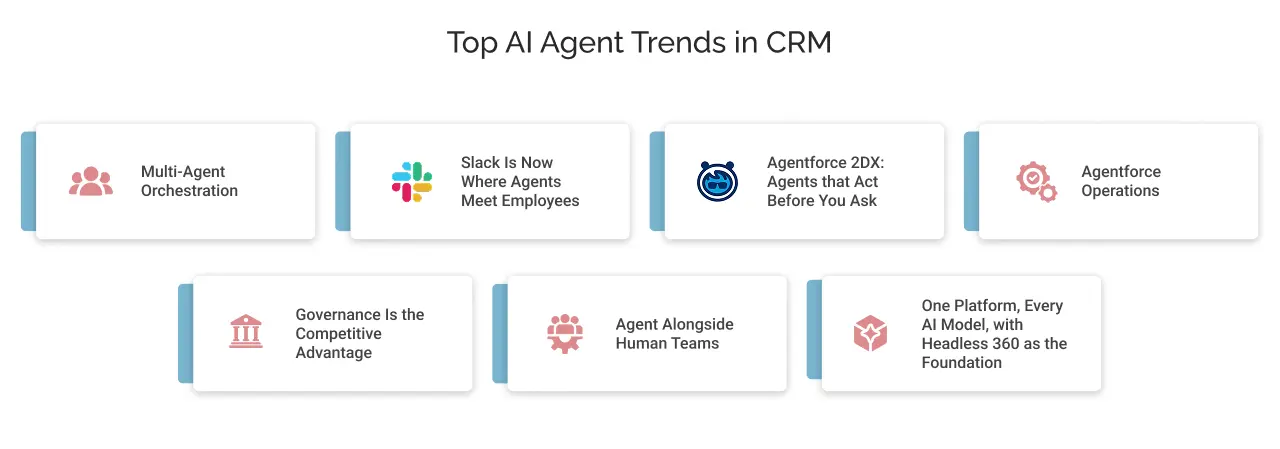
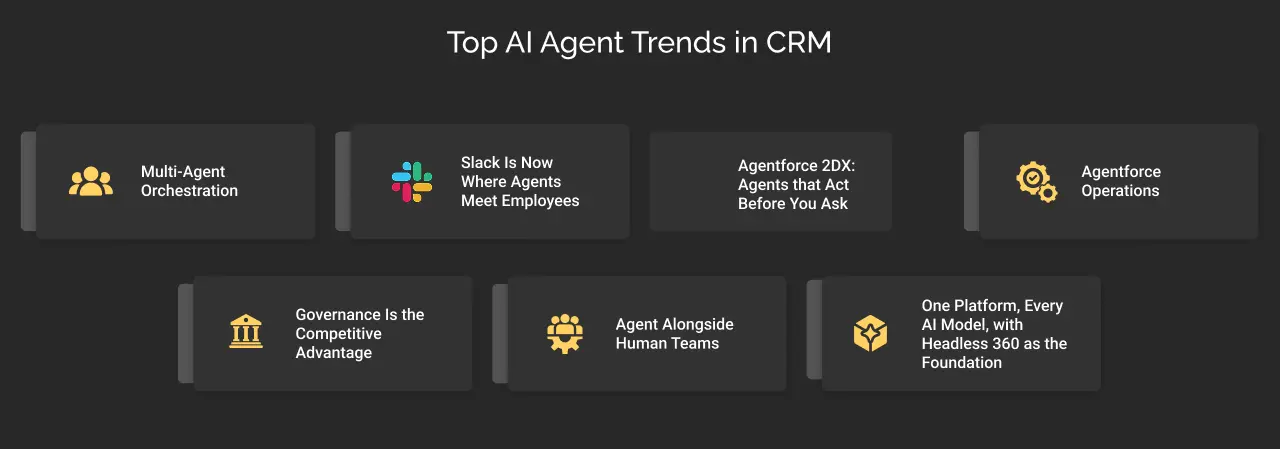
The future of work is powered by people and AI working together. AI agents are evolving from task-doers to insight analysts, and that’s turning tables for teams across every organization.
Here’s what’s driving their next wave of growth.
Trend 1: Multi-Agent Orchestration, Now in Production
Agentforce has moved beyond single-function AI agents into coordinated multi-agent systems, and Salesforce has made this native infrastructure, not a future roadmap item.
What’s new in 2026:
Salesforce now supports multi-agent workflows natively through Agentforce orchestration. Through AgentExchange, companies can deploy pre-built skills and actions that agents share, coordinate, and hand off between themselves, without custom code. Agents can divide tasks, share context, and make collective decisions using a central orchestration layer and shared memory built into Data Cloud.
Architectural Considerations:
- Agent Collaboration: Agents communicate to divide tasks, share context, and make collective decisions
- Orchestration Layer: A central layer manages agent interactions, task assignments, and workflow progression
- Shared Memory: Agents use a shared knowledge base to stay consistent across interactions
Implementation Example:
Imagine one AI agent identifying potential leads, a second qualifying them against predefined criteria, and a third scheduling meetings or sending follow-ups, all coordinated automatically. That’s multi-agent orchestration, removing the manual back-and-forth from sales.
Trend 2: Slack Is Now Where Agents Meet Employees
Salesforce is redefining how enterprises interact with technology entirely. The shift is clear: Agentforce is not just agent-first; it’s Slack-first.
What’s new in 2026:
At Dreamforce 2025, Salesforce positioned Slack as the enterprise’s new agentic operating system. In January 2026, a completely rebuilt Slackbot launched at general availability, not a basic notification bot, but a full AI agent with access to your enterprise data, CRM records, workflows, and Agentforce agents.
As of April 2026, Agentforce for Sales, IT Service, HR Service, and Tableau now run natively inside Slack. Reps can query CRM records, get AI-generated account research, and update opportunities without opening Salesforce at all. Custom AI agents on Slack have grown 300% since January 2026.
The practical shift this creates: Employees don’t need to change how they work or learn a new interface. The agents come to where work already happens.
What Needs to Change in Your Architecture:
- Agent-Centric Design: Users interact via natural language, no need to learn complex software interfaces.
- Slack as Execution Layer: Agents surface interactive components, approval cards, data layouts, workflow steps, natively inside Slack and any MCP-compatible surface (ChatGPT, Claude, Gemini, Teams)
- Contextual Awareness: Agents maintain cross-channel history from Data 360, making every interaction consistent across every channel.
- Slack’s MCP (Model Context Protocol) server, launched in February 2026, allows external AI tools, including Claude, Perplexity, and others, to pull data from Slack and act within it.
Trend 3: Agentforce 2DX: Agents that Act Before You Ask
Salesforce Agentforce 2DX shifts agents from reactive to proactive. Previously, agents waited for a question; 2DX agents watch for signals and act upon them without being prompted.
What Agentforce 2DX actually delivers:
- Proactive Execution: Agents act when triggered by data updates, user actions, or system events, without needing a prompt.
- Embedded Everywhere: Whether it’s Slack, mobile, or embedded UIs, agents connect with users where they already work.
- Workflow native: Powered by MuleSoft and Flow, Agentforce 2DX fits into existing processes, reducing operational friction.
Implementation Example:
When a delay appears in a customer’s order, an AI agent detects it instantly, sends the customer an update via Slack, adjusts the delivery date in the CRM, and sets up a follow-up task for the logistics team. All of it handled automatically, behind the scenes.
Trend 4: Agentforce Operations
Front-office AI automation, service agents, sales agents, and commerce bots have been Agentforce’s story for the past 18 months. In April 2026, Salesforce launched Agentforce Operations, which extends into the back office.
The Issue:
Even fast, modern customer-facing experiences slow down because employees still do manual back-office processes. They paste data between systems, wait for approvals over email, and manually validate compliance across multiple platforms. Such tasks take hours and sometimes even days.
The Solution:
Agentforce Operations uses specialized AI agents to handle these processes end-to-end. They can extract data from documents, validate compliance, route approvals, and track status, all without requiring companies to replace their existing systems.
Real Examples from the April 2026 Announcement:
- Banking: AI Agents manage end-to-end loan underwriting, extracting data from tax returns, chasing missing signatures, validating compliance rules across systems, so loan officers focus on customers, not paperwork
- Insurance: AI manages claims, from verifying details to collecting documents, to speed things up
- IT: AI completes employee access requests, from approvals to setup, without manual steps.
Agentforce Operations is generally available as of April 29, 2026. Ecosystem integration features, including auto-sync with Salesforce Flows, to enter Beta in May 2026.
Trend 5: Governance Is the Competitive Advantage
As AI agents take on complex tasks, the real question is not just whether they can do them, it’s whether you can trust them, check their work, and understand how they did it.
Agentforce’s Governance Framework Includes:
- Data Governance: Data classification, access controls, and full audit trails
- Policy Management: Defined boundaries for agent decision-making and escalation protocols
- Monitoring and Auditing: Real-time monitoring for anomalies and policy compliance
- Human Oversight: Clear intervention points when a decision exceeds the agent’s authority
Implementation Example:
In financial services, AI agents managing customer transactions follow strict compliance rules. When an agent encounters a transaction that exceeds its confidence threshold or falls outside policy, it flags it and routes it to a human rep, without the customer experiencing any delay.
Trend 6: Agent Alongside Human Teams
Agentforce is changing customer support, not just for customers but for the teams serving them. AI agents act as real-time co-pilots for human reps, streamlining both internal and external workflows.
Why this matters:
- Customer support costs are rising while personalization expectations grow.
- Teams are stretched thin, toggling between fragmented systems.
- Agentforce handles volume so humans can handle complexity.
What this means for enterprise architecture:
- A unified interaction layer across web, mobile, messaging, and portals.
- Agents maintain cross-channel history from Data 360; every interaction builds on the last.
- When a case does reach a human, the agent hands off a full summary: what the customer asked, what was tried, and what’s recommended next.
Implementation Example:
A customer reaches out through a chat window. An AI agent jumps in immediately, asking quick qualifying questions and offering instant support. If a human is needed, the agent transfers the conversation with a full summary, context, history, and recommended next steps. The human rep steps in fully informed. The customer never has to repeat themselves.
Trend 7: One Platform, Every AI Model, with Headless 360 as the Foundation
Agentforce’s cross-cloud integration story changed significantly in FY26; it’s no longer just about connecting Salesforce to external databases. It’s about giving companies a choice over which AI models power their agents.
What’s new in 2026:
Salesforce now supports Google Gemini models natively through its LLM gateway, alongside Anthropic’s Claude. Enterprises can use multiple models, switching or combining them based on what each task requires, all through a single platform. Also, the Atlas Reasoning Engine, Agentforce’s core reasoning layer, now uses Gemini as a first-class model option.
The Google Cortex Framework enables secure, grounded agent responses using your BigQuery data, so agents can reason over the enterprise data without that data leaving your environment. Zero Copy technology means 53 trillion records were accessed in FY26 without being physically moved, up 310% year-over-year.
Headless 360: Making Salesforce Accessible from Anywhere
Announced at TDX 2026 (April 2026), Headless 360 is the architectural shift that makes cross-platform, cross-model integration work. It separates Salesforce’s capabilities from its traditional interface, exposing everything (data, workflows, business logic, permissions) as an API, MCP tool, or CLI command.
The result: Coding agents, external AI tools, and custom frontends can call Salesforce data and execute Salesforce workflows without opening the Salesforce UI. Data 360 exposes the enterprise context, open escalations, renewal dates, support SLAs, and relationship history as an API endpoint that any agent can reach, from anywhere.
Architectural Considerations:
- MuleSoft Integration: Agents access external apps via MuleSoft’s Anypoint Platform.
- External Services (ES): Agents automate across platforms by calling third-party APIs directly.
- Data Cloud Connectivity: Real-time data from Sales, Service, and Marketing Cloud feeds agents with context-rich actions.
- Google Gemini + Cortex Framework: Advanced data processing and secure AI grounding via BigQuery
- MCP (Model Context Protocol): Slack’s MCP server (launched February 2026) allows external AI clients, including Claude, Perplexity, and OpenAI, to pull data from Slack and take actions.
Implementation Example:
An AI agent processing a customer order pulls the customer’s details from Salesforce, checks an external inventory system via MuleSoft, places the order through a logistics provider’s API, grounds its response using BigQuery data via Cortex, and sends a confirmation, all in one seamless, cross-cloud workflow.


Conclusion
The AI conversation has changed. It’s no longer about what’s possible; it’s about what actually works.
Agentforce is already making that shift happen. From 5,000 deals and $900M in ARR at the start of FY26, to 29,000 deals and $2.9B in ARR by year’s end, the growth speaks for itself. This isn’t experimental tech. It’s secure, built to scale, and deeply embedded where work happens.
For enterprise leaders, the question isn’t whether AI agents fit; it’s how to deploy them responsibly. The question is whether you’re building the foundation, clean data, clear governance, and defined use cases that make them actually work.
At Cyntexa, our Salesforce Data and AI team works with organizations from that foundation forward. Whether you are evaluating your first Agentforce deployment or scaling an existing one, we help you build it right.
Don’t Worry, We Got You Covered!
Get The Expert curated eGuide straight to your inbox and get going with the Salesforce Excellence.
Co-founder and CTO at Cyntexa also known as “VJ”. With 10+ years of experience and 22+ Salesforce certifications, he’s a seasoned expert in Salesforce Data Cloud & AI Products, Product Engineering, AWS, Google Cloud Platform, ServiceNow, and Managed Services. Known for blending strategic thinking with hands-on expertise, VJ is passionate about building scalable solutions that drive innovation, operational efficiency, and enterprise-wide transformation.


Cyntexa.
Join Our Newsletter. Get Your Daily Dose Of Search Know-How