



How to Choose the Right Salesforce Development Partner in 2026

Table of Contents
When companies like Spotify, PepsiCo, and Standard Bank boost advertising productivity with Salesforce, the impact comes not just from the platform but from how well it is implemented.
Behind every effective setup is a development partner who understands the business and builds with the right architecture and technical depth. As Salesforce evolves into a multi-cloud, AI-powered ecosystem, choosing the right development partner becomes a strategic decision, not a transactional one.
A right partner isn’t defined by the biggest certification count or the lowest quote. It’s the one who understands why something should be built and has the technical judgment to determine how it should be built in a scalable and sustainable way.
This blog will help you understand what a credible Salesforce development partner looks like, what to evaluate, what to avoid, and how to make the right choice with confidence.
Who Is the Right Salesforce Development Partner?
The right Salesforce development company or partner matches strong technical ability with a clear understanding of your business goals. Their approach goes beyond coding and bring real knowledge of how Salesforce continues to evolve.
They design solutions with solid architecture, long-term stability, and practical design instead of quick fixes or heavy customization. They also bring product thinking, platform governance, and the ability to translate business challenges into new opportunities.
Types of Salesforce Partners
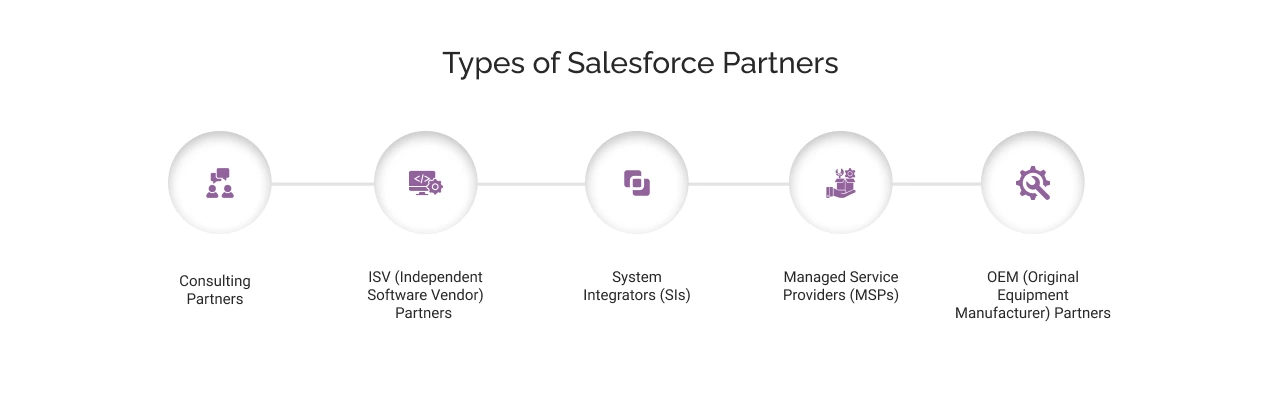
Before choosing a partner, it’s important to understand that Salesforce’s ecosystem includes multiple partner categories, each serving a different purpose.
Selecting the wrong type often leads to mismatched expectations, scope gaps, or paying for expertise you don’t actually need. Let’s take a brief overview of each type and their engagement appropriation:
1. Consulting & Implementation Partners:
These partners focus on process mapping, solution design, and tailoring the platform to meet functional and operational needs. They bring certified consultants who specialize in aligning Salesforce with your business workflows. They are typically the best fit for development-heavy engagements where architecture, configuration, and coding expertise are required.
2. ISV (Independent Software Vendor) Partners:
These partners offer a packaged functionality, such as analytics apps, industry solutions, or extensions via AppExchange. They are not development partners for your org but providers of ready-made products that can reduce build time.
3. System Integrators (SIs):
These are the partners are certified partners that connect Salesforce with other enterprise systems. They offer integration, architecture, and multi-cloud delivery expertise, alongside services like implementation, customization, and process automation, to help businesses scale and streamline operations.
4. Managed Service Providers (MSPs):
These partners offer continuous post-go-live administration, monitoring, and enhancement support. They’re ideal when you need long-term Salesforce maintenance rather than one-time development.
5. OEM (Original Equipment Manufacturer) Partners:
These partners embed Salesforce capabilities within their proprietary products, often used by product-led organizations. They matter when you want Salesforce functionality packaged into a custom-built product or internal tool.
Now that you know the different types of Salesforce partners, the next step is determining which one is the right fit. Let’s find out the factors to consider before selection.
Key Factors to Consider Before Choosing a Partner
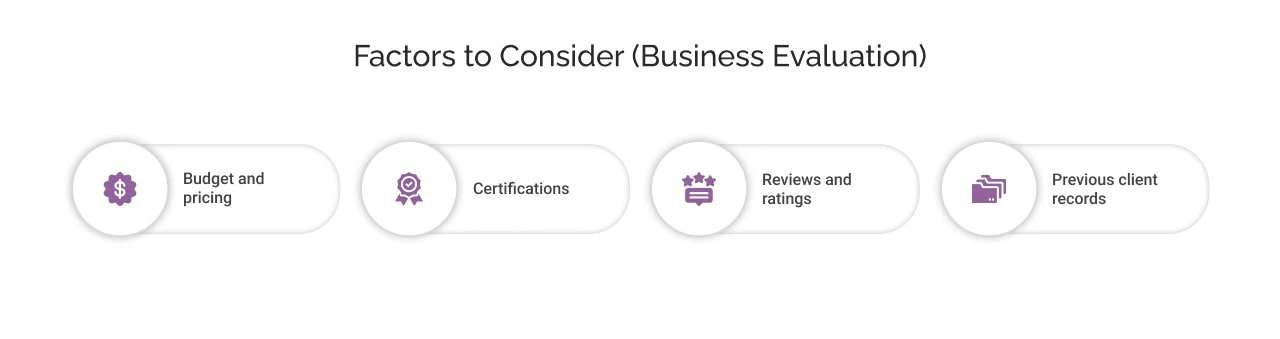
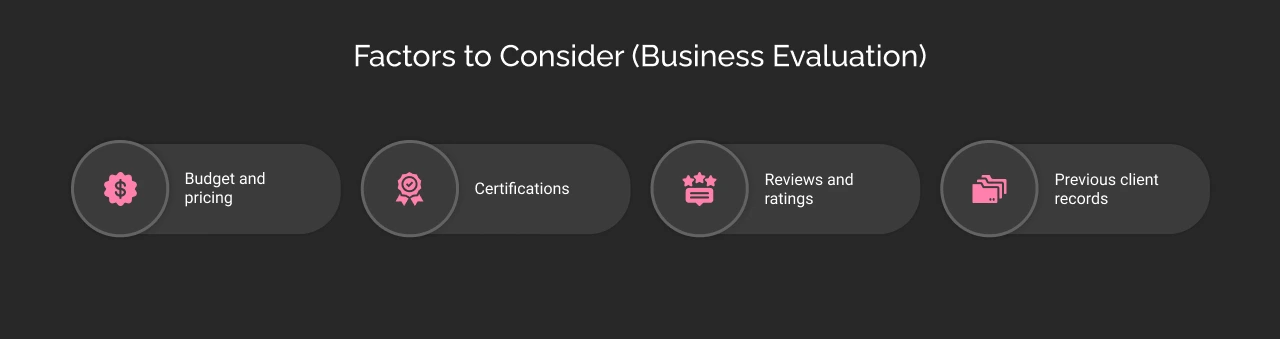
Here are some of the factors that businesses should consider when they are looking for the right partner:
1. Budget and Pricing:
Ensure the partner’s pricing aligns with your project scope and long-term goals. Transparent cost structures help avoid hidden fees and budget overruns.
2. Certifications:
Look for Salesforce-certified professionals to guarantee platform expertise and adherence to best practices. Certifications validate technical credibility and reduce implementation risk.
3. Reviews and Ratings:
Client feedback offers insights into reliability, communication, and delivery quality. As high ratings from platforms such as Clutch or AppExchange often reflect consistent performance and customer satisfaction.
4. Previous Client Records:
Review past projects and customer success stories to assess domain experience and solution relevance. A strong portfolio signals their ability to handle similar business challenges.
5. User Support Resources:
Support material and resources provided by the partner, such as blogs guides etc., help to showcase their subject matter expertise and focus on providing in-depth partner support for users.
However, the selection of a partner should not be driven solely by certifications, pricing, and past projects. They matter, but they don’t guarantee that the partner can solve your unique business problems. Here’s why businesses should also consider the technical capabilities of the partner. Let’s take a look at some of the important technical factors.
Essential Technical Skills to Look For:
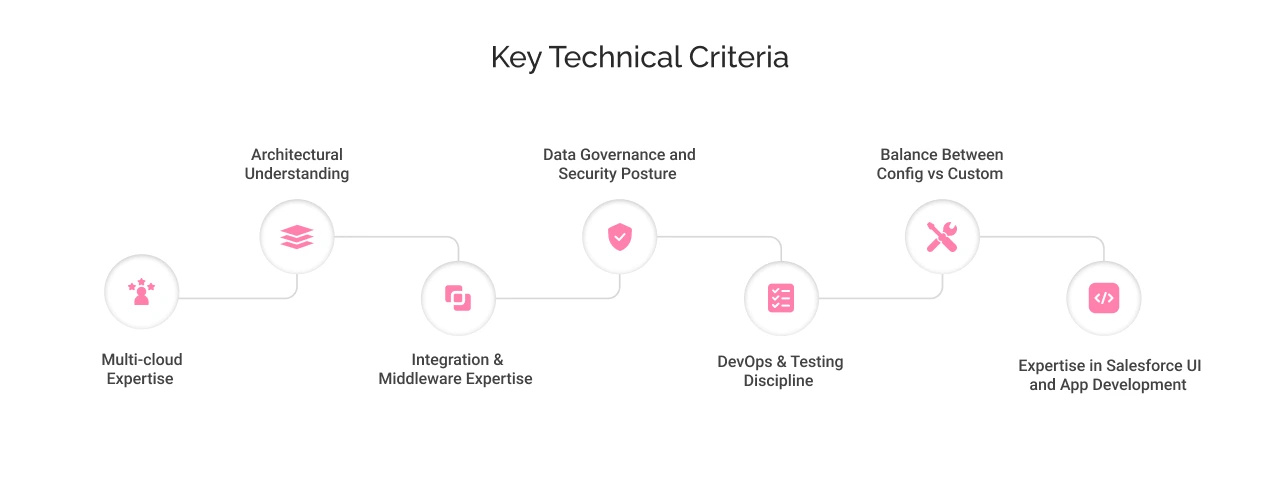
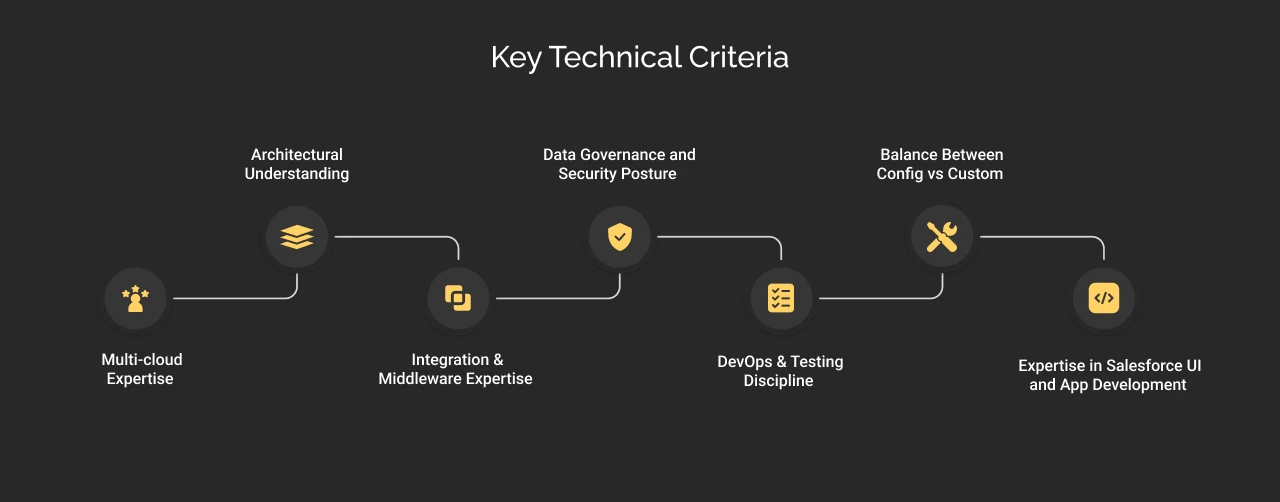
Here are some of the technical factors businesses should consider before selecting a Salesforce development partner.
1. Multi-cloud Expertise:
A right partner brings a multi-cloud experience. They know when to integrate Data Cloud for identity resolution, Marketing Cloud for real-time personalization, Revenue Cloud for quoting and billing, and so on. The partner should not just have a limited scope of learning when it comes to Salesforce clouds; they have to be well-versed with all important clouds relevant to your business, their updates, mechanisms, and upcoming releases.
2. Architectural Understanding:
A strong development partner always begins with the bigger architectural picture. They should assess whether your company needs a single or multi-org setup, design a clean data structure, and map out how different systems will talk to Salesforce. A good partner will plan your system in a way that avoids future failures, unnecessary complexity, and performance issues.
3. Integration and Middleware Expertise:
Integrations are the backbone of any Salesforce ecosystem. A skilled partner should simplify this for you, explaining what data will flow, when it will sync, and how they will prevent issues like duplicated or outdated records. An experienced partner should be able to:
- Be experienced in REST, SOAP, and Streaming APIs.
- Have experience with using MuleSoft, Dell Boomi, or custom middleware.
- Understand the differentiation between event-driven and batch-based synchronization.
For example, when integrating Salesforce with SharePoint, the partner should ensure that data ownership and sync frequency are governed, avoiding circular data updates that can cause transactional mismatches.
4. Data Governance and Security Posture:
Customer data authenticity and integrity define system trust. Your partner should know how to keep your data accurate, protected, and compliant. They should clearly explain how access will be controlled, how sensitive information will be protected, and how your setup will stay compliant with regulations like GDPR or HIPAA. A strong security posture today prevents legal, financial, and trust issues tomorrow.
5. DevOps and Testing Discipline:
Smooth deployments and stable releases depend on mature DevOps practices. A capable partner doesn’t rely on manual spreadsheets or trial-and-error deployments; they use automated processes, proper version control, and structured testing. This reduces errors, keeps environments in sync, and ensures your system evolves without breaking existing functionality.
6. Balance Configuration vs. Custom Development:
The partner should be able to justify when a requirement truly needs custom Apex, Lightning Web Components, or API-led development, and when standard features like Flows or Dynamic Forms can solve the need more sustainably.
7. Expertise in Salesforce UI and app development:
They must be able to demonstrate hands-on experience with Lightning Web Components, custom UI design, and Salesforce Mobile SDK when needed. This ensures that anything they build from the custom interfaces, guided workflows, to the mobile-ready experiences is future-proof and performance-based.
Key Questions to Ask a Salesforce Development Expert
Choosing a Salesforce partner becomes easier when you know what to ask at each stage of the selection process. These questions help you understand how they think, how they build, and whether they can support your long-term goals. Here are some of the critical questions a business must ask its development partner. For a better understanding, we have taken a phased approach for explanation:
Before Selection:
1. How do you understand our business before suggesting a Salesforce solution?
A dependable partner starts with discovery, process analysis, and use-case mapping, not quick configurations or pre-decided “solutions.”
2. How do you approach org strategy and long-term scalability?
This question reveals whether they think in terms of data models, automation load, multi-cloud expansion, role structures, and future upgrades, not just the immediate requirement.
3. How do you plan to prevent technical debt during the project?
This question will ensure whether the partner can build solutions that stay maintainable and scalable long after go-live.
4. How do you design integrations so that data remains consistent, clean, and reliable across all systems?
This helps you assess the partner’s ability to architect integrations that protect data quality and prevent downstream system conflicts.
5. Who will architect and review our solution, the certified experts or outsourced developers?
This helps you validate whether experienced architects actually design the system or whether work is pushed to junior offshore teams without oversight.
During Evaluation:
6. What DevOps and release management practices do you follow?
Instead of asking them to show pipelines or metadata, this business-level version checks whether releases will be predictable, tested, and low-risk.
7. How do you ensure quality assurance and testing across complex Salesforce builds?
The right partner explains test planning, regression handling, and UAT alignment, and maintains test coverage.
8. How do you keep us involved in decisions without slowing down the project?
Most projects fail due to communication issues. Look for rhythm: sprint demos, weekly syncs, transparent decision logs, and documentation habits.
Methods to Evaluate:
Stakeholder alignment check: See how well they understand your business goals, constraints, and decision workflows.
- Technical audits: Review metadata management and CI/CD pipelines.
- Capability workshops: Give a small business case and observe their problem-solving.
- Governance fit: Assess their ability to align with your change management processes.
- Communication clarity: Evaluate whether they can explain technical decisions in business language.
- Value-to-effort reasoning: Ask how they priorities features based on impact, not just feasibility.
Just Before Signing the Contract:
9. Which engagement model do you recommend for our project, and why?
A mature partner explains when fixed scope works, and when outcome-based models reduce risk.
10. What will our delivery team look like, and how quickly can they ramp up?
You should know the mix of roles, availability of backups, and what happens if a key resource exits.
11. What is your plan for documentation, knowledge transfer, and environment handover?
This helps you avoid long-term dependency and ensures the partner doesn’t hold your system knowledge.
12. What are the key contract terms we should be aware of: SLAs, IP, exit clauses, and transition support?
Businesses often overlook contract risks. A trustworthy partner will explain what each term means for delivery accountability and long-term ownership.


Mistakes to Avoid When Choosing a Salesforce Development Partner
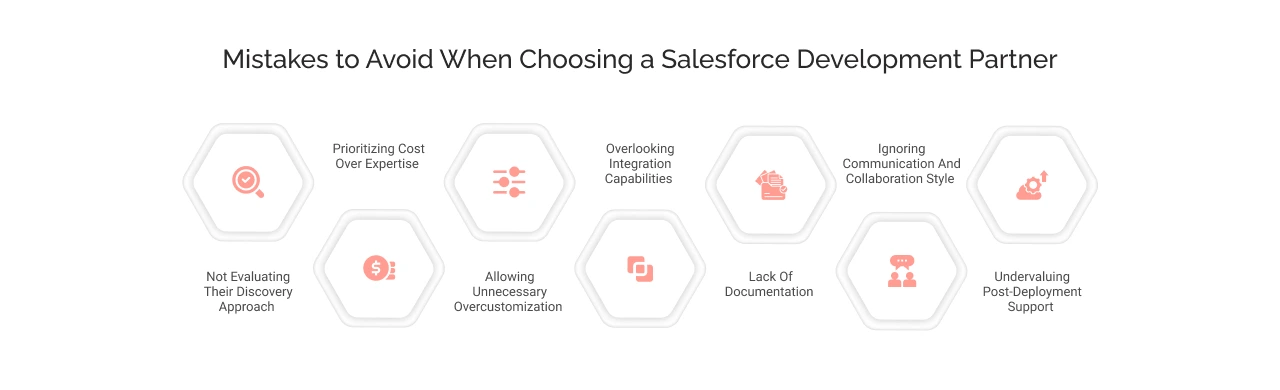
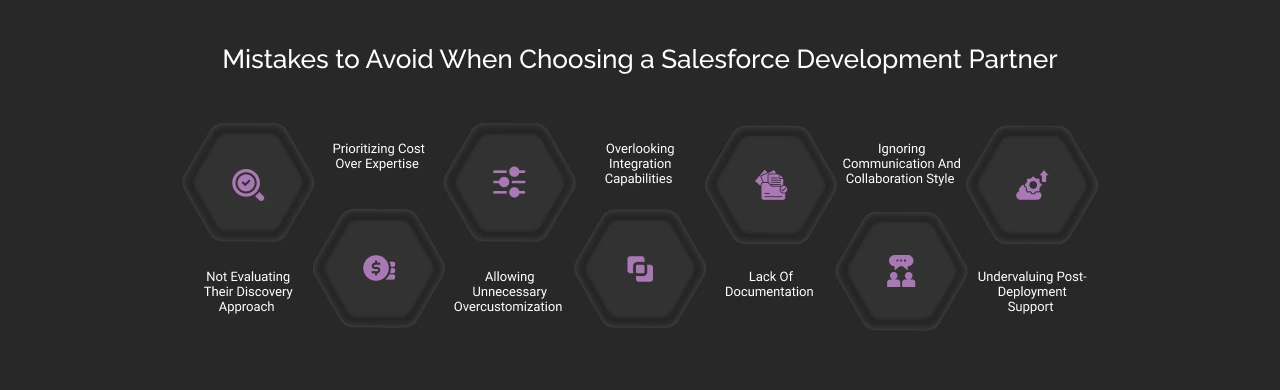
Here are some of the mistakes businesses should avoid during their selection process:
1. Not Evaluating their Discovery Approach:
If a partner treats discovery as a checkbox activity, there is a high chance that the project will start with unclear requirements, incorrect estimates, and solutions that don’t reflect real business workflows. Strong development teams run structured workshops, map processes, and define technical boundaries before development begins, ensuring accuracy from day one.
2. Prioritizing Cost Over Expertise:
Choosing the lowest bid may seem financially safe, but in Salesforce development, it often leads to hidden costs, weak architecture, and outdated practices. These shortcuts snowball into delays, integration failures, and heavy technical debt that becomes far more expensive to fix later. A reliable partner clarifies costs upfront and ensures budget decisions never compromise long-term scalability.
3. Allowing Unnecessary Over-customization:
Many businesses unknowingly approve custom development simply because they aren’t aware that Salesforce’s standard features can deliver the same outcome. This leads to cluttered orgs, difficult maintenance, slower upgrades, and long-term dependency on the same partner. A right development partner educates you on what can be achieved through configuration, reserves code only for high-value scenarios, and keeps your system clean, scalable, and future-ready.
Click here to learn what happens when you try to connect every system with Salesforce.
4. Overlooking Integration Capabilities:
Salesforce rarely functions alone, yet many businesses fail to assess a partner’s experience with ERPs, data lakes, custom APIs, middleware platforms, or real-time sync models. Weak integration knowledge quickly results in duplicate data, security vulnerabilities, and brittle inter-system dependencies. A competent partner will demonstrate clear integration patterns, middleware strategy, and proven experience handling complex data flows.
5. Lack of Documentation:
Avoiding proper documentation might appear as a negligible risk, but this can cost a business a compromised setup in the long run. This is because without a documented data model, laid out integration flows, and ERDs (entity relationship diagrams), future teams would lack any context that they could have used for maintenance or scaling the systems.
6. Ignoring the Communication and Collaboration Style:
Even the most technically strong partner can derail a project if they communicate poorly, hide risks, or manage changes informally. Inconsistent updates and unclear decision paths often cause scope confusion and delivery delays. The right partner establishes structured communication, standups, sprint reviews, and collaborates proactively rather than reactively.
7. Post-deployment Support:
Many businesses assume the project ends after it goes live. However, the right partner ensures a smooth transition from project mode to continuous delivery and support. This is because Salesforce evolves with every release update and integration enhancement. So if the potential partner doesn’t define their post-deployment support, monitoring, knowledge transfer, and mechanism of dealing with user-adoption challenges, then things post-deployment can go haywire.
Signs Your Salesforce Partner May Not Be the Right Fit
Here are some of the signs that will guide you if your partner selection is wrong or not:
Sign 1: They focus on features rather than architecture.
Reason: It’s a sign they lack architectural depth. An experienced partner begins with system design, not just deliverables.
Sign 2: They rely on change sets and spreadsheets for deployments.
Reason: It indicates that they follow legacy practices and not agile development methodology, which can lead to a higher production risk.
Sign 3: They say “yes” to everything you ask.
Reason: This indicates that either the partner is inexperienced or purely execution-driven.
Sign 4: They can’t explain the API or the governor limit strategy.
Reason: Salesforce’s multi-tenant environment demands architectural awareness; ignorance here can cause serious runtime failures post go-live.
Sign 5: They have no sandbox strategy or test environments.
Reason: If they don’t mention a UAT, integration, or staging sandbox plan, your releases are headed for instability.
Sign 6: They have no visibility into roles and team structure.
Reason: It reflects weak governance and knowledge retention on their end.
Sign 7: They avoid giving direct answers about timelines or scope.
Reason: It indicates they either lack technical clarity or are masking estimation gaps that can lead to overruns later.
Sign 8: They push for customizations without understanding the process
Reason: It shows they are proposing the solution without taking proper precision, which can result in risks of misaligned functionality.


Final take
In the end, the partner you choose plays a big role in how well Salesforce supports your business. If you are looking for a Salesforce development experts that can guide you with clarity and build solutions that grow with you, Cyntexa is a good place to start. Their team focuses on scalable architecture, disciplined development practices, and long-term platform evolution. So don’t just use Salesforce better, evolve your business with it. Book a call today!
Don’t Worry, We Got You Covered!
Get The Expert curated eGuide straight to your inbox and get going with the Salesforce Excellence.
AUTHOR
Vishwajeet Srivastava
Salesforce Data Cloud, AI Products, ServiceNow, Product Engineering
Co-founder and CTO at Cyntexa also known as “VJ”. With 10+ years of experience and 22+ Salesforce certifications, he’s a seasoned expert in Salesforce Data Cloud & AI Products, Product Engineering, AWS, Google Cloud Platform, ServiceNow, and Managed Services. Known for blending strategic thinking with hands-on expertise, VJ is passionate about building scalable solutions that drive innovation, operational efficiency, and enterprise-wide transformation.


Cyntexa.
Join Our Newsletter. Get Your Daily Dose Of Search Know-How