



How to Choose the Right Salesforce Integration Partner in 2026

Table of Contents
Salesforce integration failure does not emerge as a system error. It shows up as missed revenue, delayed decisions, and long-term technical debt, affecting the entire Salesforce ecosystem.
As an organization matures on Salesforce, integration challenges, such as disconnected systems, delayed data synchronization, and manual workarounds, become inevitable. It creates technical inefficiencies and impacts customer experience, operational workflows, and compliance.
This is where partnering with Salesforce integration experts becomes a strategic decision. Working with them enables businesses to experience intelligent customer engagement by integrating Salesforce with tools like ERP, marketing automation tools, and customer service solutions.
If your Salesforce ecosystem feels disconnected or is working slowly, it’s a sign that you should hire an integration partner. In this post, we will outline how to evaluate and choose a right Salesforce integration partner who can reduce risks, build reliable integrations, and strengthen your long-term business strategy.
Key takeaways
- Understanding the quality of the right Salesforce integration partner
- Prerequisites of hiring an integration partner
- Technical factors to evaluate a Salesforce partner
- Evaluating the partner considering the business values
- Warning signs to see before hiring a Salesforce integration partner
Who is the Right Salesforce Integration Partner?
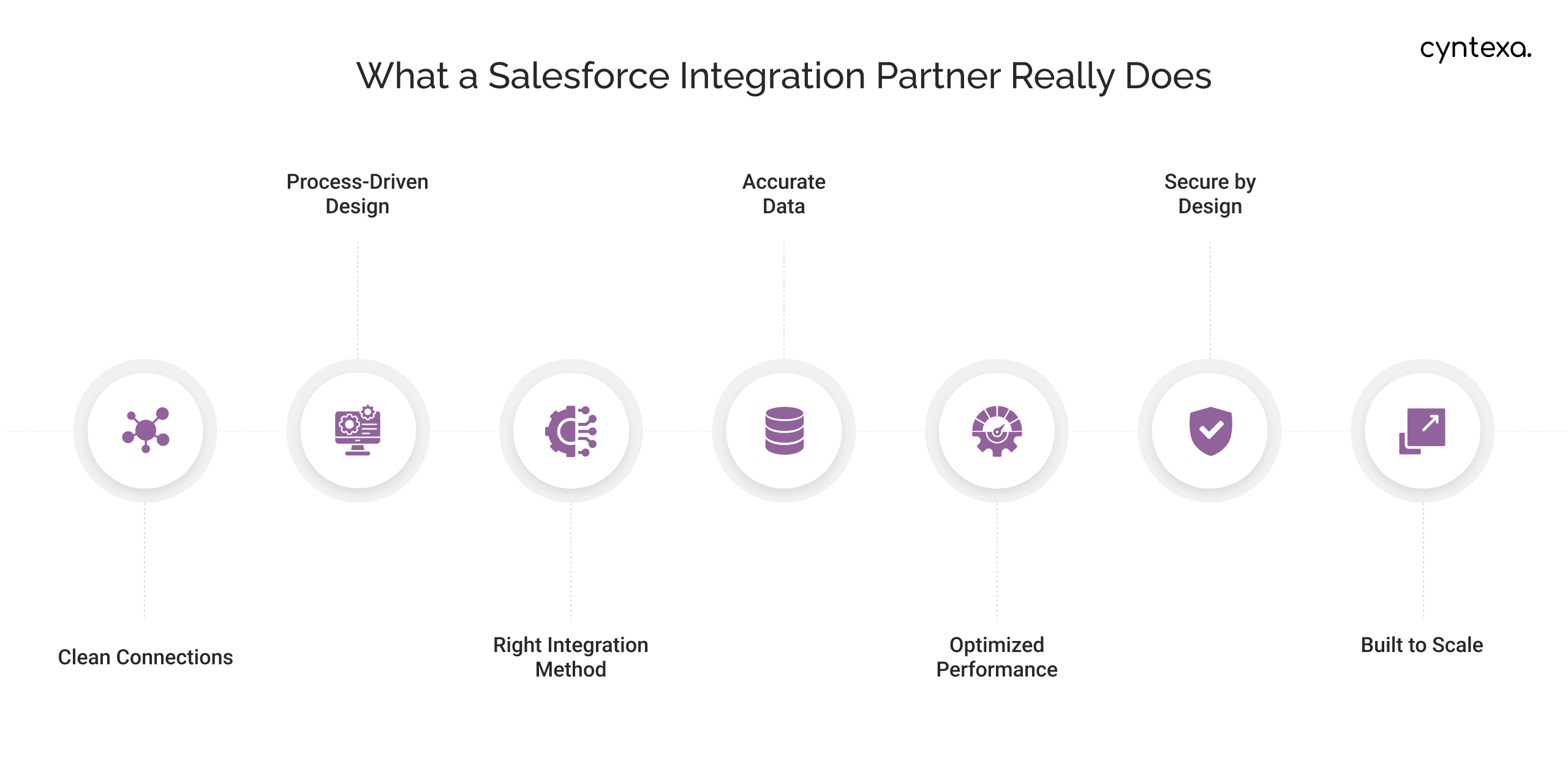
A right integration partner offers specialized and industry-specific solutions. They go far beyond creating basic connections. They:
- Ensure seamless data flow across platforms, preventing data silos that lead to strong & informed decision-making.
- Build & manage complex integrations that align with business processes & growth plans.
- Work on right integration patterns (synchronous, asynchronous, batch data synchronization, data virtualization)
- Ensure data consistency and not just connectivity. It ensures on-time error handling.
- Ensure optimum system performance with robust engineered integrations rather than building overengineered designs, which otherwise leads to long-term technical debt.
- Build maintainable, auditable, and compliant integrations that secure the Salesforce ecosystem and not just the endpoints. Each integration adheres to security standards and secures the business from unauthorized access & system vulnerabilities.
- Anticipate future integration requirements and scale the system for the future, leading to reduced performance bottlenecks, more flexibility, and lower maintenance costs.
Types of Partners: Which One is the Best Choice for Your Business?
Businesses often get confused when it comes to understanding Salesforce partners based on their types and tiers:
1. Consulting Partner (Tier-Based): There are four categories based on the number of certifications and the customer success rate. These partners act as strategic advisors who provide roadmap development and holistic CRM optimization, focusing on long-term business goals and maximizing ROI.
| Tier | Description |
|---|---|
| Base | Basic registered partner. Suitable for small businesses and entry-level projects. |
| Ridge (formerly Silver) | Formally known as Silver partner. Possess a strong track record. Ideal for small to mid-size companies. |
| Crest (Gold partner) | Gold partner with in-depth knowledge Have a proven success rate. Caters to mid-market and handles complex integrations. |
| Summit (formerly Platinum) | Formally known as Platinum partner. Suitable for enterprise-level complexities. |
2. Managed Services Provider (MSP): They work as an extended part of your internal team ensuring continuous optimization and support services.
3. ISVs: The Independent Software Vendors build 3rd-party apps for the AppExchange marketplace.
4. System Integrators: Integrate Salesforce with third-party systems like ERP, databases, and marketing automation. Focuses on automating data sharing & workflow between systems.
Choosing the right partner depends on the complexity, budget, and size of your project. Let’s move forward and understand the different factors to consider before choosing the right integration partner.
Prerequisites to Select the Right Salesforce Partner
As an expert Salesforce integration partner, we have witnessed projects failing, not because of partner capabilities, but due to unclear objectives, misaligned ownerships, and unrealistic expectations.
Address the following prerequisites upfront, and accelerate time to value:
- Business objective: Have a clear business objective. Is it real-time inventory visibility, unified customer accounts, accurate revenue reporting, or anything else? In its absence, you may receive over-engineered integration, affecting business outcomes.
- Existing integration needs: Evaluate your existing tools and identify areas where integration is required. It will help you learn about expected expenses and the necessary technology ecosystem to integrate with Salesforce – ERP, email platforms, data warehouse, etc.
- Set accountability: Set accountability for outcomes and alignment across teams before choosing the partner. It facilitates faster approvals and smooth change management throughout the integration process.
- Timeline expectations: Before approaching the integration partner, define a realistic project scope, timelines, and budget to prevent cost overruns and extreme scope creep. It allows partners to phase the integration prerogatives and architect robust solutions.
Now that you have equipped yourself with the prerequisites of hiring an expert, it’s time to build understanding around the key factors that you need to consider while hiring a Salesforce integration partner.
How to Choose a Salesforce Integration Partner? Key Factors to Evaluate
To help you make an informed decision, we have classified these evaluation criteria into two categories: business maturity and technical depth. Let’s first understand technical factors:
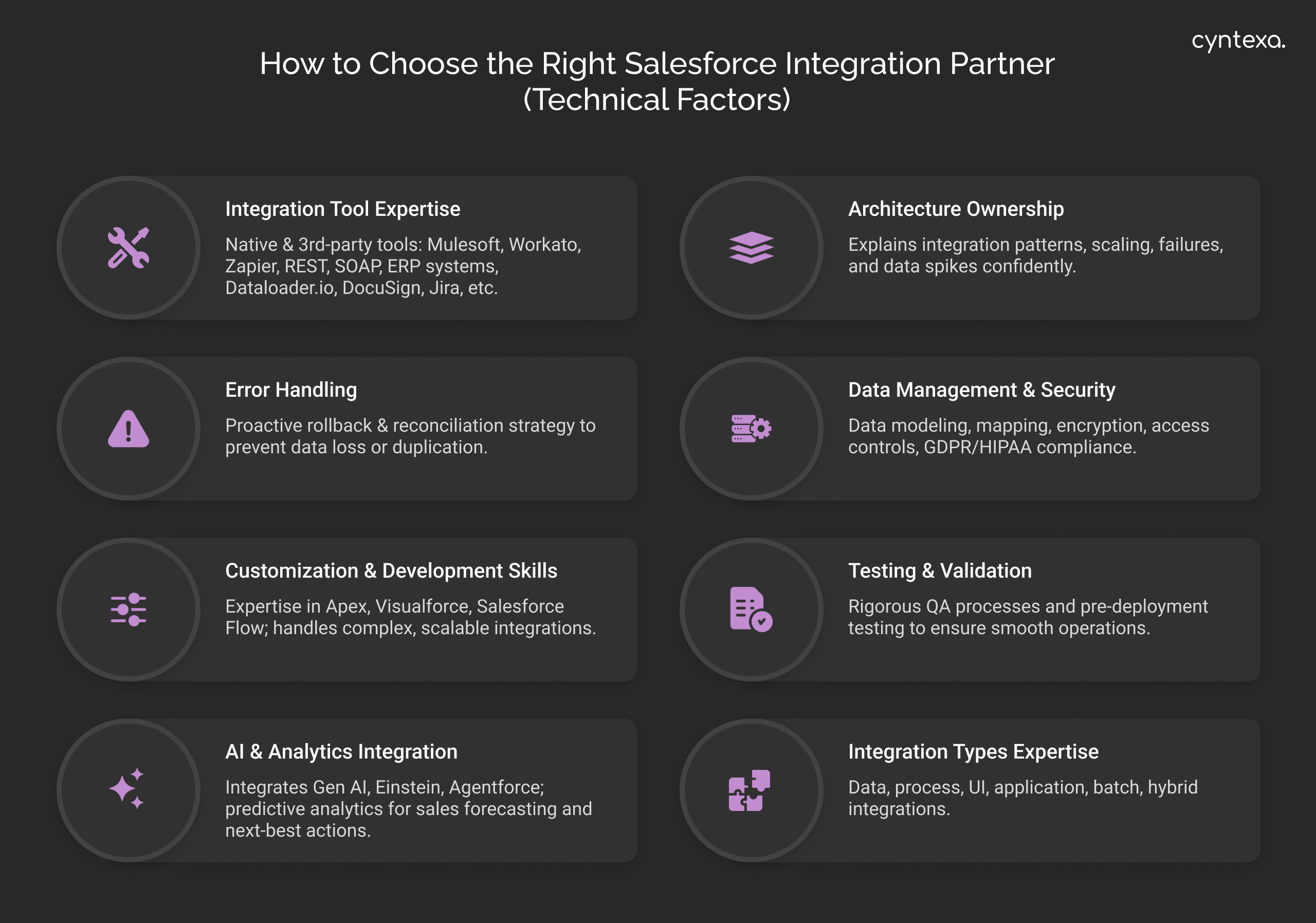
Technical Factors
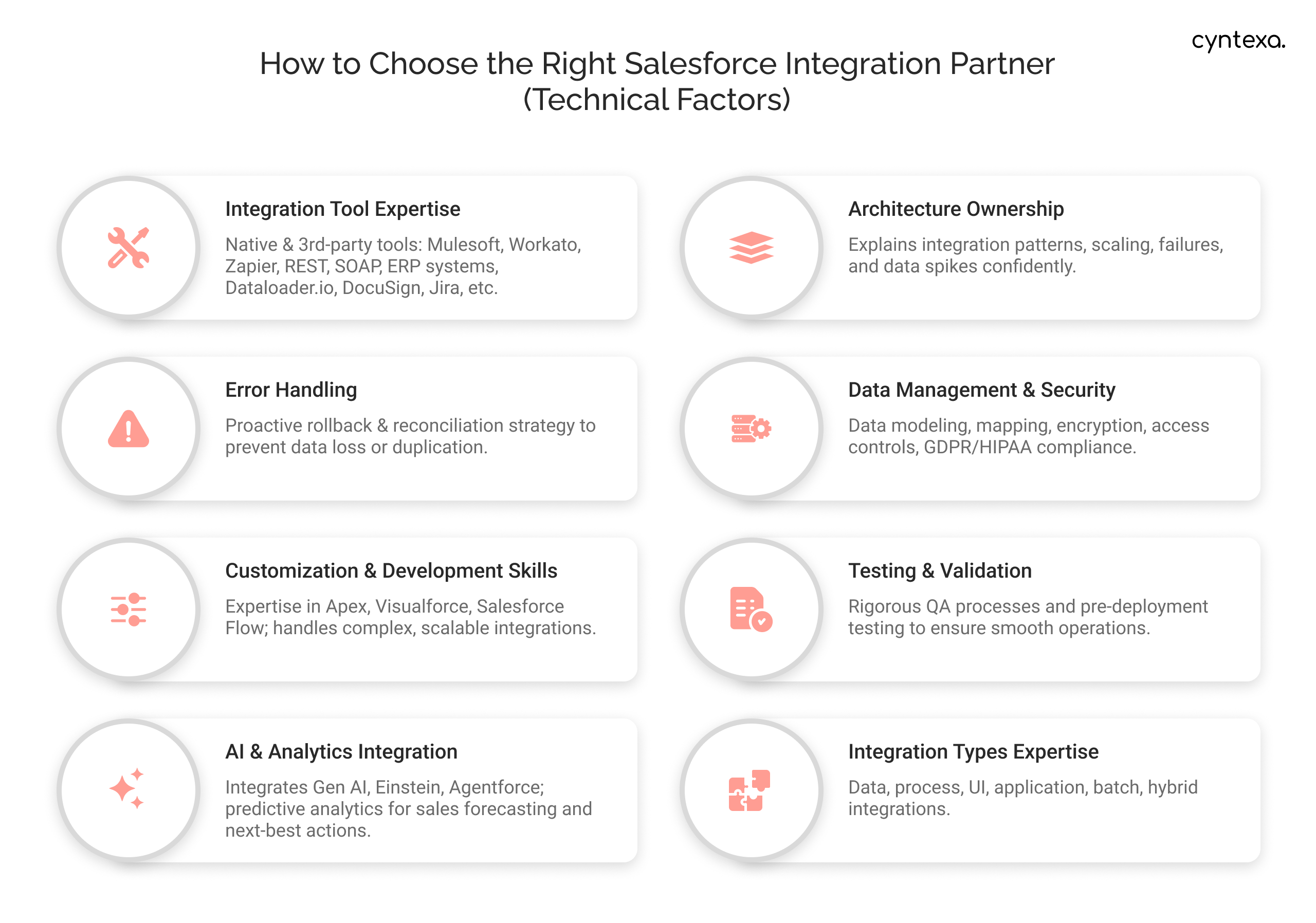
- Expertise in integration tools: The right Salesforce integration partner understands both native and third-party integration tools, and knows when to apply each. They can assess whether your project calls for API-led platforms like MuleSoft or low-code automation tools such as Workato or Zapier. A capable partner has an understanding of API & middleware solutions like REST, SOAP, ERP (SAP, Oracle), Dell Boomi, Talend, Matillion, Dataloader.io, DocuSign, QuickBooks, Jira, etc.
- Architecture ownership: An experienced partner must have the ability to explain the reasons for choosing the specific integration patterns. They must understand how the architecture will behave under different situations – scaling, failure, data spikes, etc. In short, analyze their ownership skill in architectural design.
- Error handling approach: A right partner proactively plans integrations to cope with errors that can lead to failures. Assess whether they have an explicit rollback & reconciliation strategy. Discuss this factor while evaluating their tech skills, as it is critical in a production environment where data duplicity or loss has financial consequences.
- Data management, recovery & security: Evaluate how strongly they demonstrate their expertise in data modelling, data quality, mapping, and security protocols, including access controls, encryption, and compliance with GDPR or HIPAA. Their one wrong approach in data management may leads to data conflicts, corruption, broken integrations, and high maintenance overhead.
- Customization and development skills: Analyze their skills in handling complex integrations. An experienced Salesforce integration partner goes beyond basic customization. They are well-versed in tools like Apex, Visualforce, Salesforce Flow, etc., that enable custom development, build rapid business logic, and bring scalability, accommodating future business growth.
- Testing and validation skills: They must be able to demonstrate their hands-on experience in quality assurance processes and rigorous testing strategies that prevent issues and resolve them if there are any, before the final deployment.
- AI & analytics integration: Analyze if the integration expert can harness the power of tools like Gen AI, Einstein, and Agentforce to integrate them with insightful reporting. A good partner can build & deploy custom AI models to analyze legacy data that predict sales forecasting, customer churn, and recommend the next-best actions for sales reps.
- Expertise in integration types: Analyze their capabilities in handling different kinds of Salesforce integrations. Some key types are:
- Data integration
- Process integration
- User interface integration
- Application integration
- Batch integration
- Hybrid integration
Business Value Factors
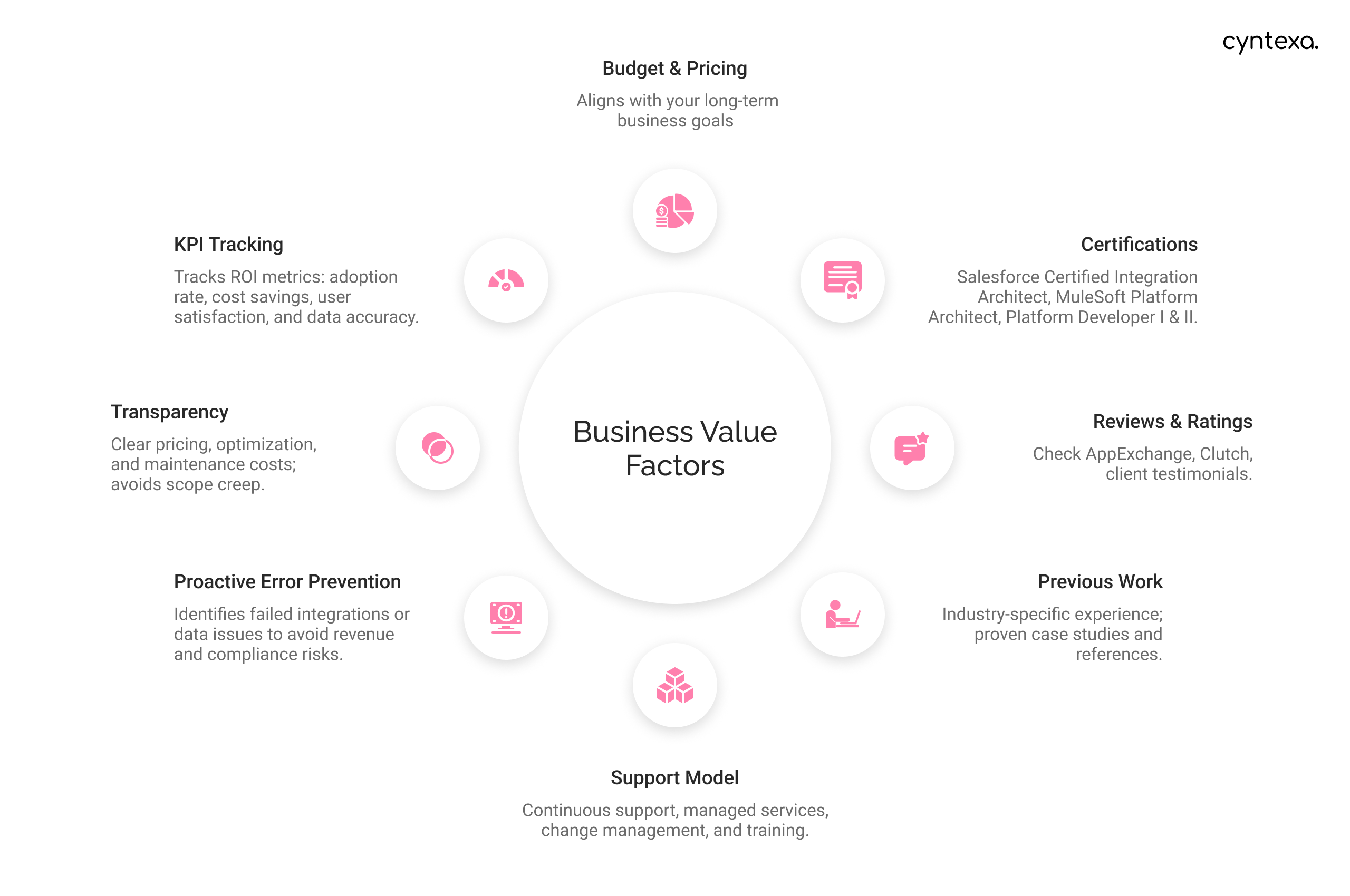
- Budget & pricing: It is a basic business value that a business visionary considers before hiring the right partner. Set your budget and connect with the partner that has a pricing model that aligns with your long-term business goals.
- Certifications: A partner with a team of certified professionals is an assurance of strong integrations. Check for the certificates like Salesforce Certified Integration Architect, MuleSoft Platform Integration Architect, and Salesforce App Architect. Make sure they have Salesforce certified platform developer I and II because it is crucial in building custom integrations and managing complex data processes.
- Reviews & ratings: To learn what their previous partners say about them, you can visit platforms like AppExchange and Clutch and analyze their reliability and delivery quality.
- Previous work: A Salesforce system integrator, who holds previous work experience, especially related to your industry, ensures they are proficient in industry-specific data models and compliance requirements. To validate this, you can review their case studies, client testimonials, and past project references.
- Support model: A good partner offers support beyond deployment. Ensure they clearly state it in the SLAs. Check what kind of post-integration support they offer. Some of the support models are:
- Continuous support models
- Managed services
- Change management and use training strategies
- Proactively identify errors, avoiding revenue risks: A strong integration partner is the one who proactively identifies failed integrations, data duplicity, and manual fallbacks, which could lead to revenue risks, compliance risks, and operational risks.
- Transparency: An ideal integration partner maintains transparency in both pricing and project execution. They communicate optimization and maintenance costs upfront, so there are no surprises later. A trustworthy partner also avoids building integrations that create unnecessary complexity or scope creep, ensuring that every solution is intentional, scalable, and aligned with your business goals.
- Track KPIs: A reliable partner will help you track and measure KPIs through which businesses can also track a project’s ROI. They are aware of the tracking metrics like adoption rate, cost savings, user satisfaction score, and data accuracy that ensure the project is delivered on time.
Top 10 Questions to Ask Before You Hire Them
1. Tell us about any specific Salesforce integrations that you have implemented with systems like ERP, CRM, and marketing tools
Reason: It will confirm their hands-on experience with tech stacks. You will also come to know if they can handle complex or merely basic connectors.
2. How do you handle custom integrations and APIs?
Reason: This question will help you understand how capably they can manage custom integrations and API development. Start by asking about the system that you are planning to integrate, then check if they have integrated Salesforce with systems like yours.
3. What integration tools and middleware solutions do you typically use?
Reason: It ensures they utilize cutting-edge, advanced, trending Salesforce tools over outdated solutions.
4. How do you handle data mapping, transformation, and security?
Reason: Their answer will uncover their proficiency in handling pitfalls in data governance and compliance.
5. What’s your way to ensure data integrity and security?
Reason: It will help you understand if the potential partner follows a clear and detailed approach to securing your data.
Ask about their data migration process, use of ETL tools like MuleSoft, data loader, etc. You can also learn about their understanding of the built-in security model.
6. What methodology do you follow for integration
Reason: You can see if their working approach aligns with your project delivery style. A suitable methodology can avoid project delays.
7. How do you future-proof your process with evolving business needs?
Reason: This will help you understand their proficiency in designing integrations, which can avoid cost rewrites as the tech stack scales.
8. What post-integration support do you provide?
Reason: It will guarantee long-term success, proper user acceptance training, and adequately documented KPIs.
9. How many certified Salesforce integration professionals do you have on your team?
Reason: Verified their credibility over self-proclaimed expertise.
10. What is your way to measure integration success?
Reason: Helps you set clear expectations and prevent cost creep. You can learn about their strategic thinking, accountability, and commitment towards outcomes.
Bonus question- Will you train my team on the post-integration process, and how?
Reason: Helps you understand if they have a structured plan to train your users and admins. Ask if they can tailor training as per different roles in the organization. It should not be one-size-fits-all demos.
Check if they provide hands-on exercises, role-based training, recorded sessions, and all necessary training documentation.
Read more: 25+ Salesforce Integrations Every Business Should Know About
Warning Signs to Look for Before Hiring a Salesforce Partner
Investing in a Salesforce integration partner is a significant financial commitment. Therefore, businesses need to hire the right expert who can bring efficiency to the business process, leading to higher productivity.
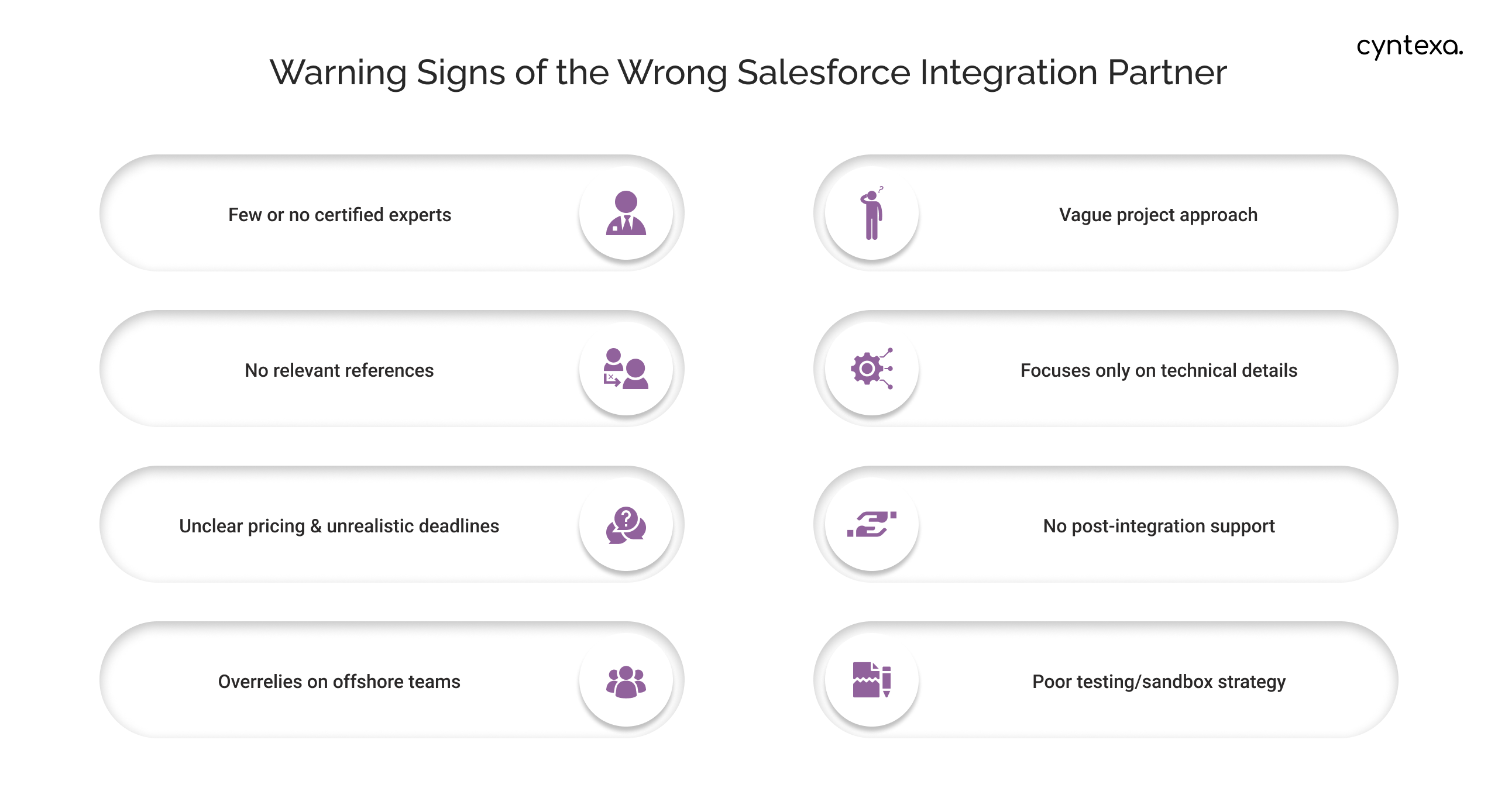
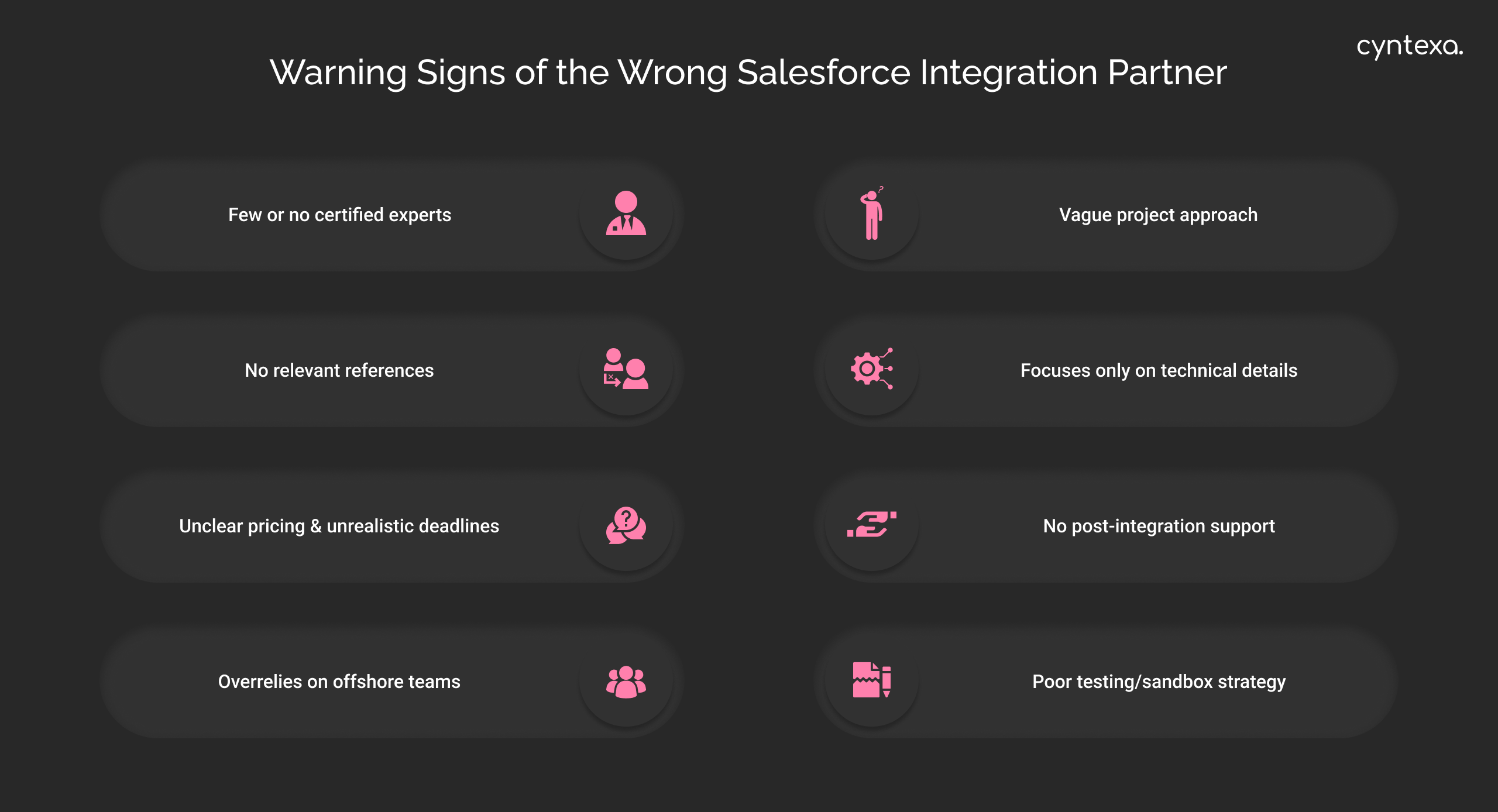
However, there are a couple of signs that tell you the Salesforce partner is not the right fit:
- No or very few certified Salesforce experts.
- Vague project methodologies and unclear integration strategies.
- Not able to provide reference clients with similar integrations.
- Majorly inclined towards technical details without considering business outcomes.
- No knowledge of the impact of integrations on business processes and outcomes.
- Unclear pricing structure.
- Unrealistic deadlines due to a vague understanding of requirements.
- No provisions for post-integration support.
- Highly relies on offshore teams, with improper communication.
- They agree on everything you ask for.
- No proper sandbox strategy and an improper testing environment.


Conclusion
Choosing the right Salesforce integration partner in 2026 is a strategic investment for a business that ensures your CRM platform will stay aligned with your growth strategy.
The right partner not only knows the Salesforce system inside out but is also proficient in using other systems that you want to integrate with.
The evaluation factors outlined in this guide will help you hire the right expert who can bring long-term connectivity between systems, driving measurable ROI.
Don’t Worry, We Got You Covered!
Get The Expert curated eGuide straight to your inbox and get going with the Salesforce Excellence.
AUTHOR
Vishwajeet Srivastava
Salesforce Data Cloud, AI Products, ServiceNow, Product Engineering
Co-founder and CTO at Cyntexa also known as “VJ”. With 10+ years of experience and 22+ Salesforce certifications, he’s a seasoned expert in Salesforce Data Cloud & AI Products, Product Engineering, AWS, Google Cloud Platform, ServiceNow, and Managed Services. Known for blending strategic thinking with hands-on expertise, VJ is passionate about building scalable solutions that drive innovation, operational efficiency, and enterprise-wide transformation.


Cyntexa.
Join Our Newsletter. Get Your Daily Dose Of Search Know-How