








Databricks Genie One Explained: Architecture, Use Cases, Pricing, Usage & Implementation Considerations & More
source on Google

Table of Contents
source on Google
Databricks Genie One was announced on June 16, 2026, at the Data + AI Summit 2026. It enables teams to interact with AI/BI dashboards and access Databricks apps without needing to understand technical concepts such as SQL, queries, or compute.
In this guide, we will explain what Genie One is, how it works, how it differs from other Databricks AI tools, its use cases, limitations, and pricing.
What is Databricks Genie One?
Genie One is an agentic coworker built into Databricks that helps marketing, finance, sales, and operational teams ask questions in plain English and get answers grounded in the company’s governed data.
Put simply, a user does not need to write SQL to ask a question. They can ask in natural language, such as “Which customers had the biggest drop in product usage this quarter?” Genie uses the available business context and governed data to find the answer and provide it as text, a table, or a chart that the user can actually work with.
Genie One can also bring together other Databricks experiences, including AI/BI dashboards and Databricks Apps, giving business users a common place to work with data and AI.
How does Genie One fit into the Genie family?
Genie is the name for a family of Databricks AI experiences built on the same governed data foundation. The names have changed a few times, which is why they are easy to mix up.
| Product | Primary purpose | Main users |
| Genie One | A simplified interface for asking questions, working with dashboards and shared data assets | Business users |
| Genie Agents | Configured environments where data teams set up trusted data, metrics, and business rules that power Genie One answers | Data teams, with business users consuming the results |
| Genie Code | An AI agent for coding, data engineering, and technical tasks inside Databricks | Developers and technical practitioners |
Genie One is the user-facing experience. Genie Agents provide the configured data and business context behind its answers. Genie Code handles the technical side, such as writing, debugging, and running code and pipelines.
How the names changed
The original AI/BI Genie was a feature for asking questions about data on Databricks.
Databricks has since grouped everything under the Genie name. Genie Spaces are now called Genie Agents, and Databricks Assistant was replaced by Genie Code in March 2026.
Databricks Assistant vs Genie Code
Databricks Assistant answered one question at a time, such as writing a query, explaining code, or finding errors. It waited for your next prompt before doing anything else.
Genie Code works like an agent. You give it a goal, and it can plan and complete multiple steps, such as building or fixing pipelines.
Both are designed for people who work with code, while Genie One is designed for business users.
Why do businesses use Genie One?
Genie One makes data easier to access for people who may not have SQL or data analysis skills.
A business user who has a question may need to find the right dashboard, ask an analyst for help, or wait for a new report. Genie One makes this process shorter by letting people ask directly, in their own words, and get an answer from company-governed data.
How does Databricks Genie One work?
When a user asks Genie a question, it uses the available business context and data configured in the relevant Genie Agents to understand the request, generate the right query, and provide results in a business-friendly format.
For example, if a user asks:
“What were our high-performing products last quarter?”
Genie needs to understand what “high-performing” means for your organization, which table contains the relevant data, and which time period represents the previous quarter. This understanding comes from how well the Genie Agent behind it has been set up.
Genie One is not a chatbot guessing an answer. Its responses are grounded in the governed data, with Unity Catalog permissions applied to the underlying Databricks environment.
Databricks Genie One architecture
Genie One’s architecture works in three layers, and each plays a different role in data quality, context, and user interaction.
- The data layer is the governed lakehouse, including tables, metric views, and lineage managed through Unity Catalog. This is the ground truth Genie queries against, so the quality and documentation of the underlying data is the biggest factor in Genie’s answer accuracy.
- The context layer is Genie Ontology, which sits above the data layer and provides business context from Databricks assets and connected external apps. Genie Agents use this context for specific business use cases. They define which data to use, along with the SQL expressions and example queries required to answer business questions.
- The interface layer is where business users ask questions, in Genie One on the web or in the mobile apps. Genie uses the available context, generates and validates SQL against the governed business data, and returns the result as text, a table, or a chart. Genie Code is a separate experience for technical users.
Genie Ontology: The context layer behind Genie One
Genie Ontology is a unified context layer that gives Genie a business-aware map of an organization’s data and business concepts.
It combines business context modeled through Unity Catalog with context Genie infers automatically from existing Databricks assets, dashboards, metrics, pipelines, and usage patterns. It also extracts context from connected workplace systems including Google Drive and Jira.
For example, an organization may define “active customer” differently from another company.
Genie Ontology can help Genie understand the organization’s specific definitions, business rules, and authoritative sources, rather than relying on generic interpretations.
What are the use cases for Databricks Genie One?
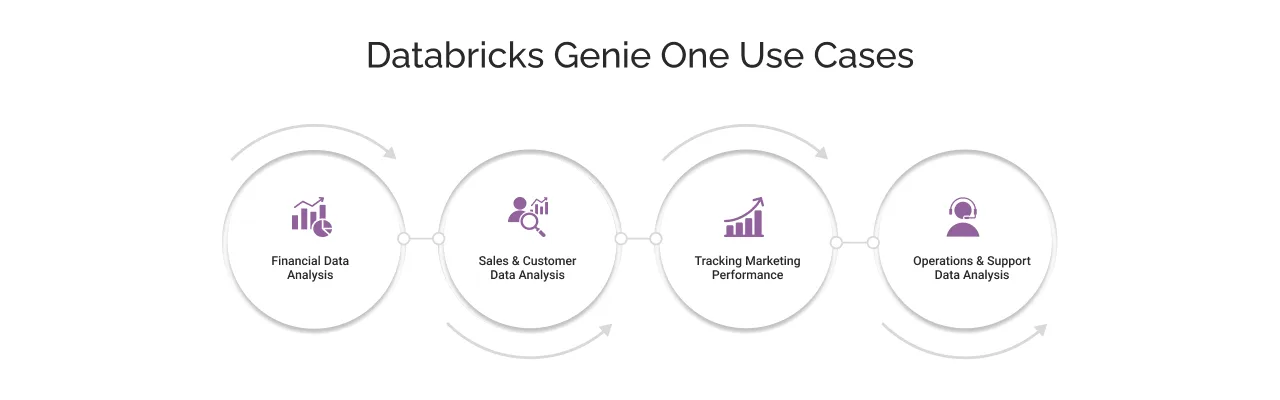
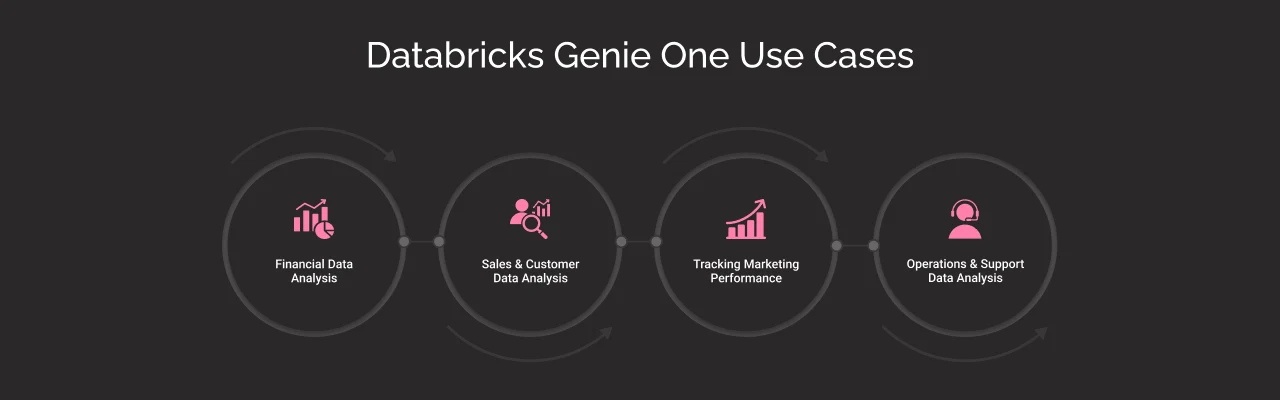
Genie One is useful anywhere business teams regularly need answers from governed organizational data.
Finance and financial analysis
Finance teams can ask questions about revenue, expenses, margins, budgets, and other financial metrics without writing SQL for every analysis.
For example: How did gross margin change compared with last quarter?
Sales and customer analysis
Sales teams can explore customer, pipeline, and product usage data through natural-language questions.
For example: Which accounts with the largest open pipeline have had no activity this month?
This can help sales teams investigate potential risks or opportunities without waiting for a custom analysis.
Marketing performance
Marketing teams can use Genie to explore campaign performance, customer engagement, conversion rates, and other marketing metrics.
For example: Which campaigns generated the highest number of qualified leads last quarter?
Operations and support
Operations teams can investigate changes in business performance and identify unusual trends.
For example: Why did support ticket volume increase this week?
How does Genie One handle security and governance?
Genie One builds on Unity Catalog, which controls who can access which data. Genie Agents define which data is used to answer questions, so answers stay within data the organization has approved for that purpose. Administrators can also track Genie usage and cost through Databricks billing system tables and set budgets that either alert or block usage when a limit is reached.
Considerations When Using Databricks Genie One
Genie One makes data easier to access, but it does not eliminate the need for a clean and organized data foundation.
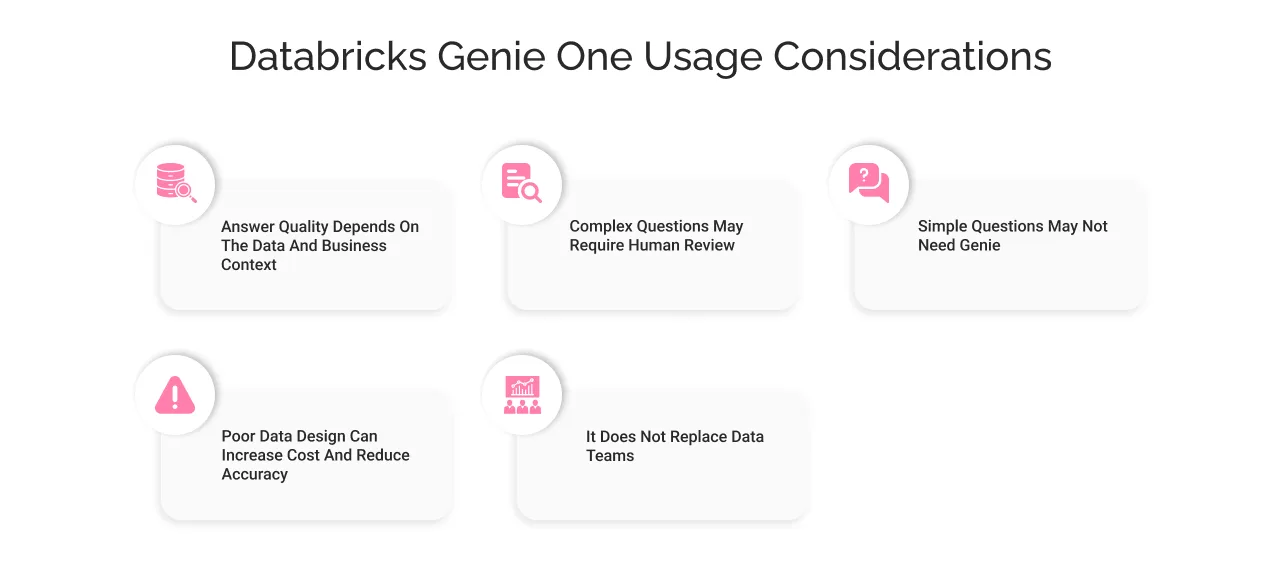
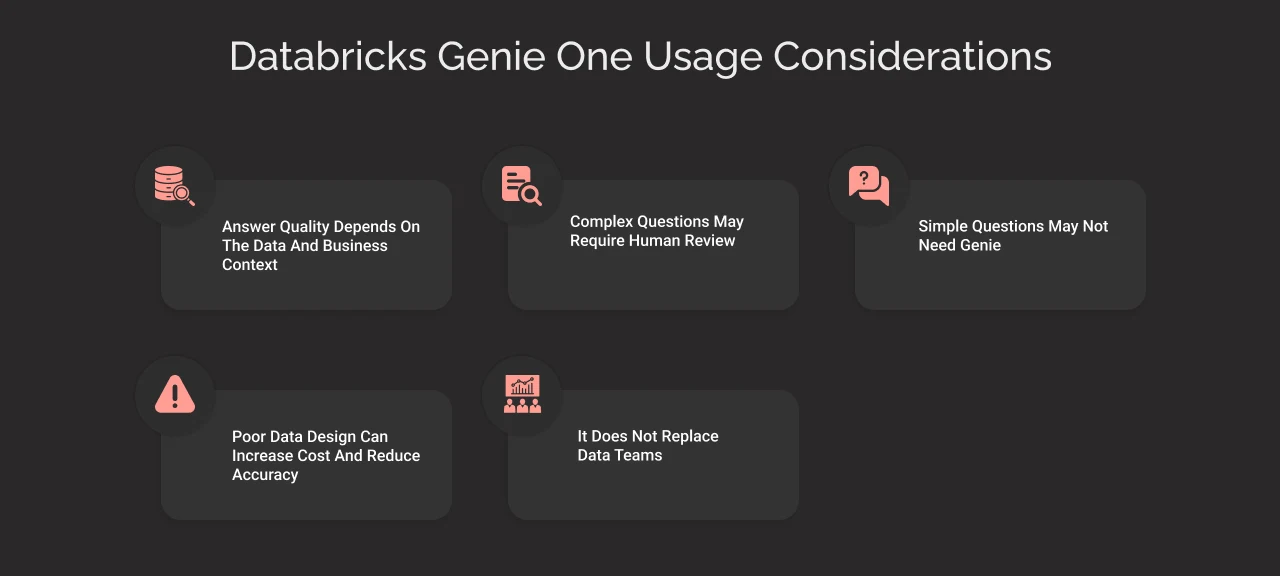
Answer quality depends on the data and business context
If the underlying tables are poorly documented, metrics are not clearly defined, or relationships between datasets are unclear, Genie may struggle to provide an accurate answer.
Data teams can improve results by providing clear descriptions, SQL expressions, example queries, business rules, and trusted metrics through Genie Agents.
Complex questions may require human review
Genie can handle business questions, but complicated questions may require additional context or review.
Questions involving unclear business definitions, unusual calculations, or complex relationships between datasets can be more difficult to answer reliably.
Accuracy can also drift over time. When tables, columns, or business definitions change, answers that were correct before may become incorrect. Databricks guidance recommends keeping a set of benchmark questions and re-running them after significant data or schema changes, so any drop in accuracy is caught early.
For important financial or compliance-related decisions, users should validate the answer and underlying data rather than assuming an AI-generated response is always correct.
Simple questions may not need Genie
Genie adds the most value on questions that dashboards do not already answer. One data team leader on the Databricks Community forum shared that their team saw little added value in using Genie for straightforward questions, such as last month’s sales by a single dimension. But they were more interested in deeper exploratory analysis.
When planning your first use cases, start with questions that currently take up an analyst’s time rather than ones an existing dashboard already covers.
Poor data design can increase cost and reduce accuracy
Genie still needs to query data to answer questions. Poorly designed datasets, unnecessary joins, or large tables can make queries expensive or slower.
Structured tables, clearly defined metrics, and relevant examples can help reduce unnecessary query complexity.
It does not replace data teams
Genie One reduces how often business users must ask analysts for simple answers, but data teams remain responsible for building and maintaining the data foundation.
They also play an important role in configuring Genie Agents, defining business logic, testing responses, and monitoring quality over time.
Databricks Genie One pricing: How much does it cost?
Genie pricing is based on usage, with no seat-based fees, and the current structure includes promotional free usage. As of October 2026, here is how Databricks Genie pricing works [Premium plan, AWS Cloud, & US East (N. Virginia)]:
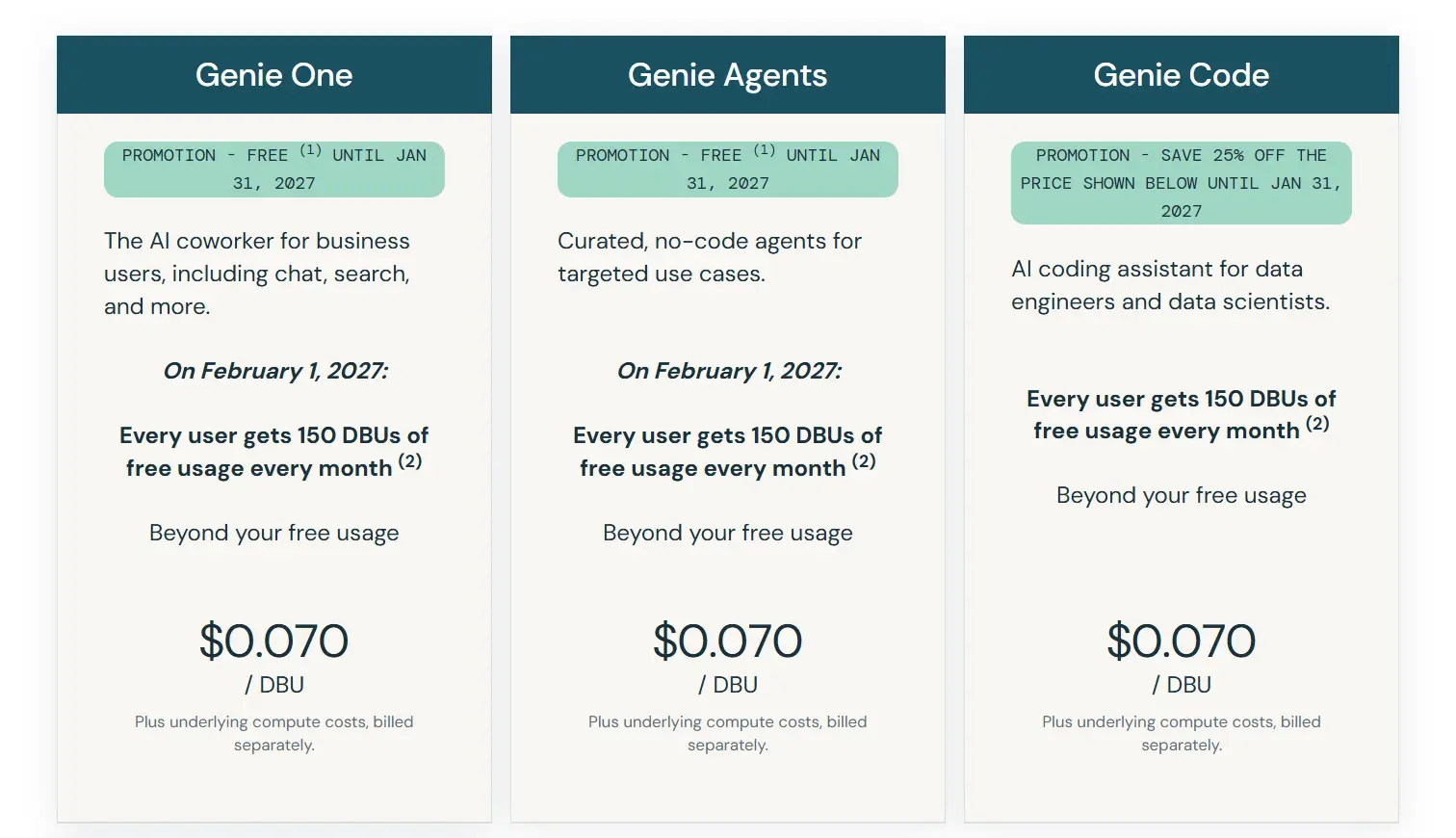
- Genie One and Genie Agents: Usage by users is free through January 31, 2027. This covers named users. Usage by service principals, such as automated integrations, is billed.
- Genie Code: Each user gets 150 free DBUs per month; usage beyond that is pay-as-you-go, with Databricks listing Genie rates starting from $0.07 per DBU. Databricks also applies a 25% promotional discount to billed Genie usage through January 31, 2027.
- Compute is separate: Free usage covers Genie’s AI usage only. The SQL warehouse or serverless compute that runs Genie’s queries is billed separately at standard Databricks rates, so you may still see compute charges while your Genie usage is free.
Because Databricks pricing and promotional offers can change, organizations should check the current Databricks pricing before preparing a long-term budget.
The cost of a Genie implementation depends on how underlying data is modeled and queried. Well-defined metrics, proper views, and data design can help avoid unnecessary compute usage.
How do you get started with Databricks Genie One?
Getting started with Genie One usually begins with identifying the business questions that teams want to answer and the data required to answer them. A practical Genie One implementation follows these steps:
- Identify business use cases: Determine which teams and questions will benefit most from natural-language data access.
- Review your data foundation: Check whether the required data is available, reliable, documented, and governed through Unity Catalog.
- Define business metrics: Establish clear definitions for important metrics and business terms.
- Configure Genie Agents: Select the right data, add SQL expressions and example queries, and provide instructions.
- Test the responses: Use realistic business questions to evaluate the generated answer quality.
- Roll out to users: Start with a specific group of users and expand to other teams as adoption grows.
- Review and improve: Review feedback, usage, and benchmark results and update the underlying context as business requirements change.
This approach helps businesses treat Genie as part of their data strategy rather than simply enabling another AI feature.


How can a Databricks partner help with Genie One?
A Databricks consulting partner can help businesses build the data and governance foundation required for a successful Genie One implementation.
This can include:
- Assessing the existing Databricks environment
- Identifying suitable business use cases
- Reviewing Unity Catalog governance and data quality
- Designing the data and metric structure required for Genie
- Configuring and testing Genie Agents
- Creating verified SQL expressions and example queries
- Establishing testing and monitoring processes
- Supporting business-user adoption
Cyntexa’s Databricks consultants helps businesses plan and implement Databricks solutions, including data architecture, Unity Catalog governance, AI and analytics workloads, and Genie implementations.
Schedule a consultation call today.
Don’t Worry, We Got You Covered!
Get The Expert curated eGuide straight to your inbox and get going with the Salesforce Excellence.
Co-founder and CTO at Cyntexa also known as “VJ”. With 10+ years of experience and 22+ Salesforce certifications, he’s a seasoned expert in Salesforce Data Cloud & AI Products, Product Engineering, AWS, Google Cloud Platform, ServiceNow, and Managed Services. Known for blending strategic thinking with hands-on expertise, VJ is passionate about building scalable solutions that drive innovation, operational efficiency, and enterprise-wide transformation.


Cyntexa.
Join Our Newsletter. Get Your Daily Dose Of Search Know-How