



Complete Guide to Hiring Skilled Salesforce Developers

Table of Contents
Your Salesforce instance is the key to your revenue; you cannot afford an unskilled developer who does not understand the technical aspects of your business.
Hiring a Salesforce developer is a critical decision a technical leader makes. A bad hire is not only a financial loss for your company, but it is also a data integrity disaster. Poor hiring creates technical debt in the form of messy code, broken automations, and security gaps that cost more to fix later.
So, businesses nowadays don’t just need a coder; they need a problem solver.
Whether you are looking to fix a failed Salesforce implementation or simply want to reduce the technical debt, this guide covers how you can find and hire a skilled Salesforce developer without the guesswork.
How to hire skilled Salesforce developers?
Finding the right Salesforce developer is possible when you follow a structured process.
Note down the requirements
If you hire a generalist developer when you need a specialized one, the chances of implementation failure can increase.
Before searching for a Salesforce developer, you need to look at your current project scope. If your team is surrounded by significant support tickets, password resets, and minor updates, you likely need a junior-to-mid-level developer who can clear backlogs effectively.
However, if you are planning for Salesforce ERP integration, launching a customer portal, or re-architecting a security model, a junior developer will struggle here. For these strategic initiatives, you can hire an experienced Salesforce developer who understands system design and scalability.
One more consideration is the region the developer resides in. Salesforce developer hourly rates vary as per regions, and if your teams work remotely, hiring developers from markets like India can be a cost-effective option.
If you are unsure whether you need a full-time or contractual Salesforce developer, you can read our blog to clear your confusion.
Related: Collaboration Tips with Contractual Remote Salesforce Developers
Sourcing candidates through specialized channels
Here are the different platforms where you can look for and onboard Salesforce developers.
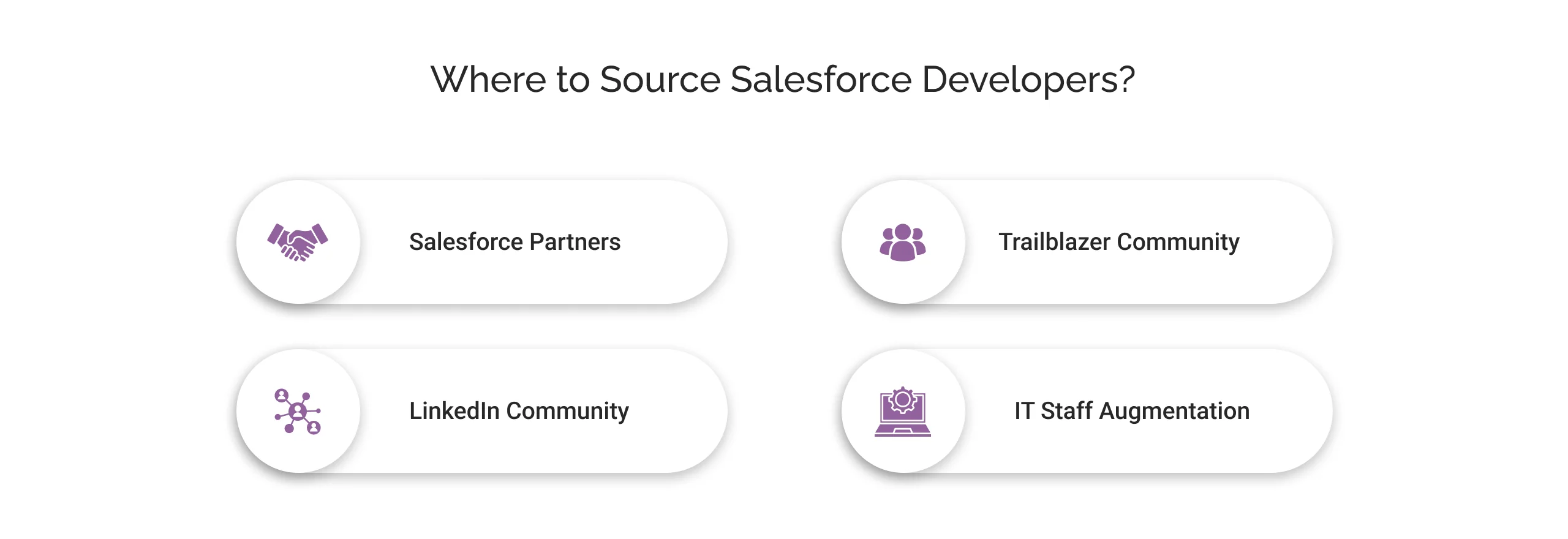
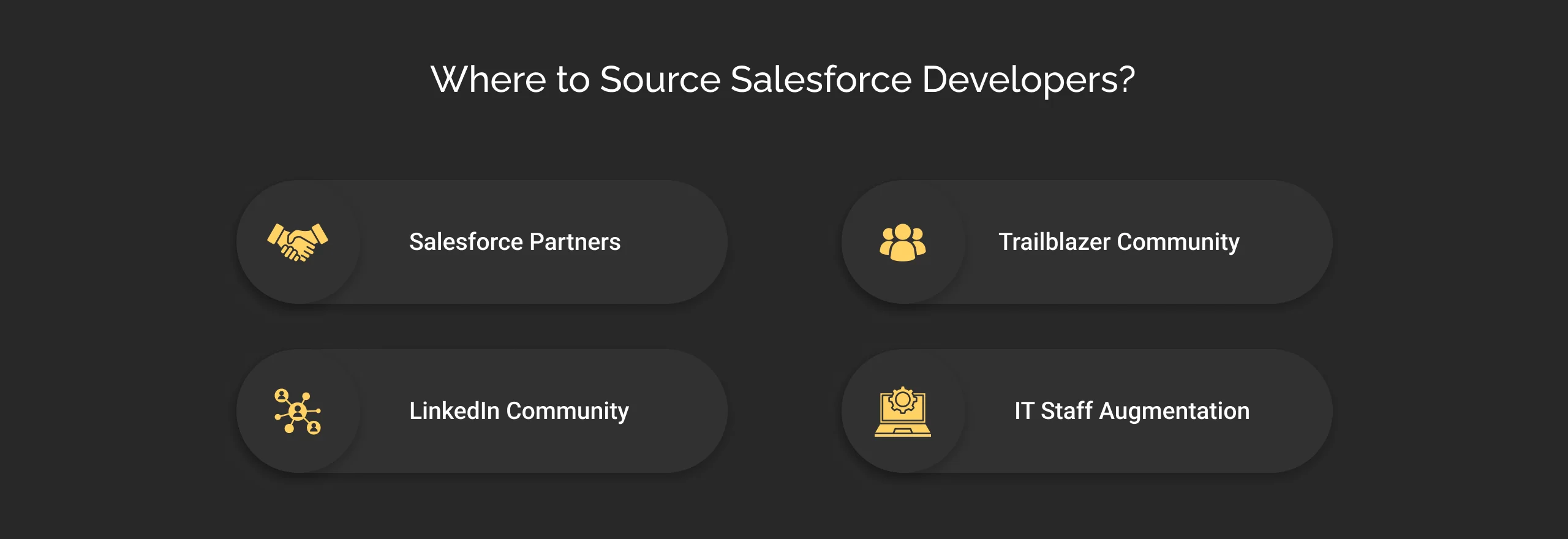
Salesforce Partners (AppExchange): The Salesforce AppExchange provides a directory of trusted and certified partners. Consulting partners listed here have already been vetted by Salesforce for performance and customer satisfaction. Additionally, this is ideal if you want to hire a team.
Trailblazer community: Here, passionate developers solve Salesforce problems for others. You can look for the users with “Ranger” and above Trailblazer rankings or those who are consistently answering complex technical questions on the developer forums.
LinkedIn community: On LinkedIn, you can look for candidates who actively share knowledge and case studies in their field. You can avoid the developers who are just listing their certifications.
IT staff augmentation: If you want to avoid the long 3-4 months Salesforce developer recruitment process, this strategic option is a great choice. Statistics show an increasing number of companies turning to staff augmentation for fulfilling their IT hiring needs.
Related: The Ultimate Guide to Salesforce Outsourcing
Must have essential skills
In 2026, a skilled Salesforce developer is not only one who knows how to write code, but one who is also familiar with AI-powered technology development. Having an understanding of customer experience trends is also valuable, as Salesforce implementations directly impact customer interactions.
Languages & frameworks: When hiring, ensure that the Salesforce developer is proficient in Apex for back-end logic, SOQL for database queries, and Lightning Web Components (LWC) for building custom user interfaces.
AI-readiness: The evolving technology and business systems are shifting towards agent-based workflows for automation and maximizing productivity. It is ideal to hire a developer who is familiar with Einstein AI, Copilot, and Data Cloud. Developers with these skills understand how to sort and prepare your data for AI applications.
Integration skills: Salesforce developers must have prior knowledge of connecting Salesforce with the existing platforms using native, REST/SOAP APIs, and middleware.
Standard features (Flows): A developer should know when to use standard Salesforce tools like Flows instead of custom code to keep their system easy to maintain.
Technical skills are a prerequisite, but soft skills are equally important. Discover the essential technical & soft skills to evaluate when hiring a Salesforce developer.
Screening & Vetting
Only after seeing the candidate’s profile, you only know what they claim, but you need to verify if they actually have knowledge.
Verifying certifications: You can check if the developer has certifications like Platform Developer I and II, it showcases their baseline knowledge. Also, you should always look for their project work history.
Practical assessment: You can give them a real-world problem to solve and check whether they resolve it or not. For example, ask them to review an inefficient code snippet and optimize it.
Knowledge of Governor Limits: Salesforce runs in a multi-tenant environment, meaning the resources are shared. If you hire a developer who does not understand Governor limits, they will write code that works with fewer records, such as 1000 records, but crashes when you process 10,000 or more records.
Technical examination
You must know how Salesforce developers handle pressure situations.
Ask scenario-based questions: You can ask questions like “A stakeholder wants a feature that you know will hit Governor Limits, how do you handle this situation?” This helps you test their technical knowledge and their communication skills.
Prior experience with production fixes: A Salesforce developer must have prior experience with making mistakes in production org and how they have fixed them. Hiring an experienced developer ensures they do not make the same mistakes and help you optimize a stable system.
Pro tip: When you have selected suitable candidates, a structured onboarding process can reduce time-to-productivity. To make the process seamless, you can understand more about the best practices for onboarding Salesforce developers here.
How to measure success after hiring skilled Salesforce developers?
Hiring alone does not guarantee the business value you are considering. You should measure success through these metrics after the first quarter:
- Bug rates: Are their deployment consistent or require hotfixes? Reduced bug rates indicate developers are doing well and testing properly in the Sandbox environment before deploying.
- Speed: It is normal that the newly hired Salesforce developer starts slow as they understand your work, but by the end of the quarter, they should be navigating your systems seamlessly and closing tickets with increased speed.
- Adoption: You should ensure that your team is using what the hired Salesforce developer has built. The metrics show you if the developer understands the business users or is just coding.


Conclusion
Hiring a skilled Salesforce developer is about finding a suitable candidate/partner who understands your business workflows, stays updated with the latest happenings in the Salesforce ecosystem, and can transform your business goals into a technical reality that scales.
With Cyntexa, you can hire a Salesforce developer who is certified, vetted, and ready to solve problems from day 1.
Stop searching and start building. Connect with us today!
Don’t Worry, We Got You Covered!
Get The Expert curated eGuide straight to your inbox and get going with the Salesforce Excellence.
AUTHOR
Vishwajeet Srivastava
Salesforce Data Cloud, AI Products, ServiceNow, Product Engineering
Co-founder and CTO at Cyntexa also known as “VJ”. With 10+ years of experience and 22+ Salesforce certifications, he’s a seasoned expert in Salesforce Data Cloud & AI Products, Product Engineering, AWS, Google Cloud Platform, ServiceNow, and Managed Services. Known for blending strategic thinking with hands-on expertise, VJ is passionate about building scalable solutions that drive innovation, operational efficiency, and enterprise-wide transformation.


Cyntexa.
Join Our Newsletter. Get Your Daily Dose Of Search Know-How