




How Agentforce AI Agents for Healthcare Can Improve Patient Care?
source on Google

Table of Contents
source on Google
The conversations that once revolved around what AI could do have now given way to action. The industry has moved into the Agentic Era in 2026. Businesses are not only able to deploy AI that can chat, but they are also able to orchestrate autonomous systems that can act.
For healthcare providers, this means moving beyond simple chatbots to a fully agentic enterprise, where AI agents can handle complex workflows from clinical intake to insurance claims settlements.
With the release of Agentforce for Healthcare, Salesforce has bridged the gap between administrative burden and clinic excellence.
In this blog, you will explore how AI agents for healthcare are solving the industry’s most critical problem of unstructured data.
Understanding Agentforce AI Agent for Healthcare
An Agentforce AI Agent for Healthcare is an autonomous entity built on the Atlas Reasoning Engine that can reason, plan, and execute complex tasks within the healthcare ecosystem. Grounded in real-time clinical data via Salesforce Data 360 (Data Cloud), these agents go beyond answering simple FAQs to performing high-value actions like verifying surgery eligibility, managing insurance claims and orchestrating end-to-end patient care workflows.
Key Capabilities of AI Agents for Healthcare
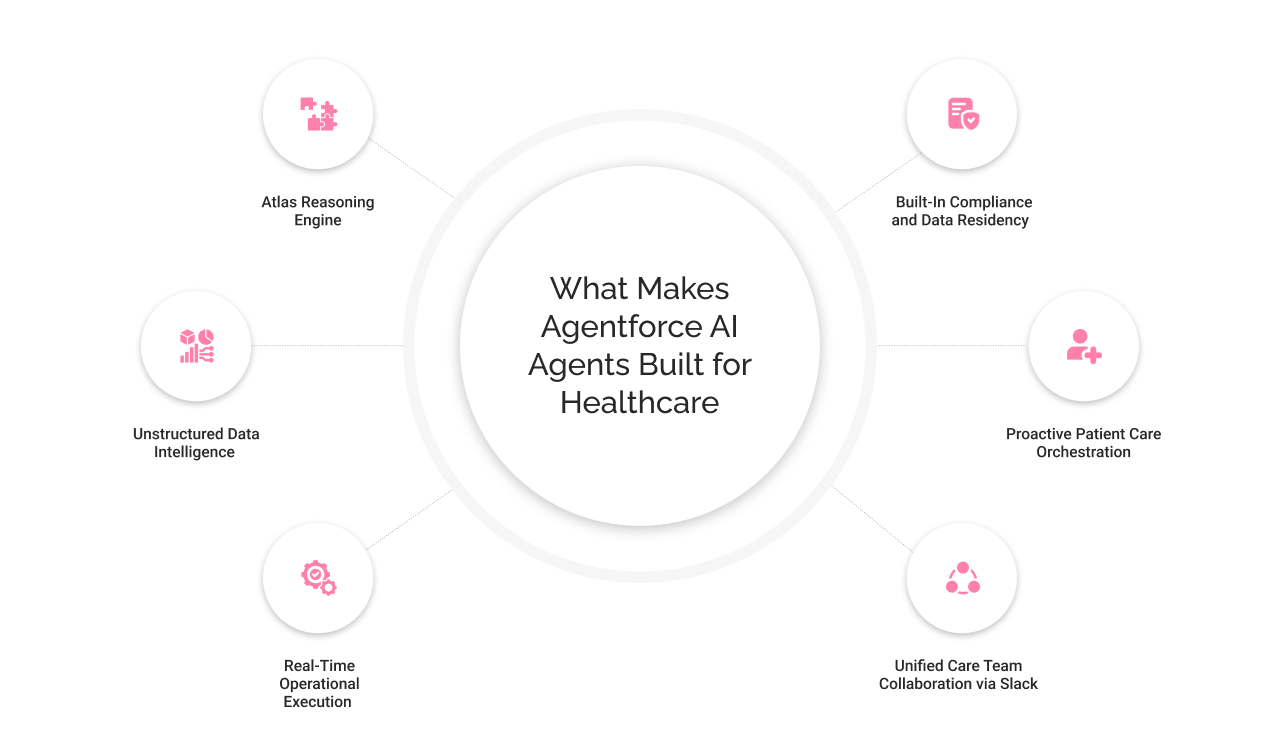
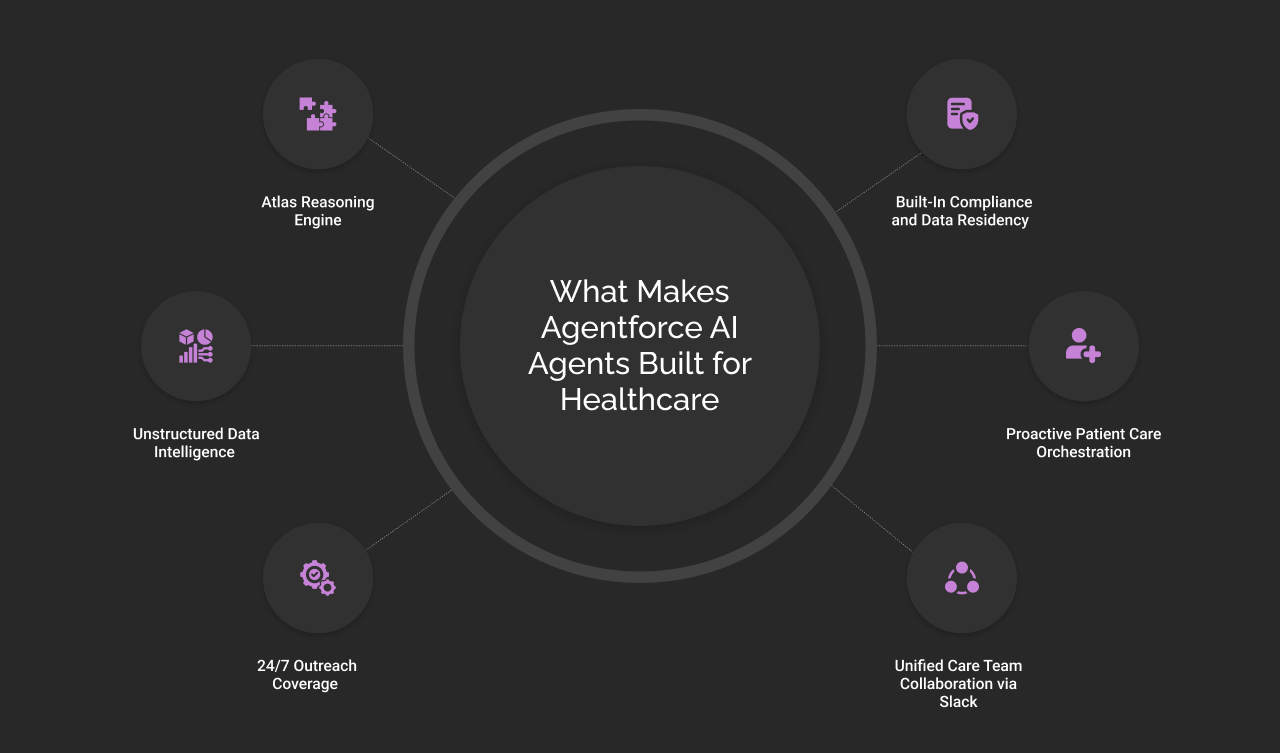
1. The Atlas Reasoning Engine
Agentforce is powered by the Atlas Reasoning Engine, which moves beyond simple next-word prediction. It evaluates user intent, identifies the necessary clinical data, and constructs a multi-step plan to resolve a query.
This transforms your organization into an agentic enterprise that can scale patient support without a linear increase in headcount. It is the difference between an AI that only answers a question and one that resolves a clinical case.
2. Reasoning over Unstructured Data
By leveraging zero-copy integration via Data 360, Agentforce allows your clinical teams to reason over unstructured data lake objects, including clinical PDFs, discharge summaries, and handwritten notes, without moving a single byte of sensitive data.
This reduces manual patient history review time as agents can reason directly over:
- Discharge Summaries: Identifying risk factors across years of treatment.
- Lab Documents: Correlating disparate test results into a single clinical narrative.
- Knowledge Articles: Grounding agent responses in the latest medical guidelines.
3. Instant Operational Execution
By utilizing Agentforce for Health Cloud, healthcare organizations can verify member eligibility instantly. AI agents eliminate the traditional 24-48 hour wait time insurance verification lag and improve the initial time to treatment.
4. Global Compliance & Residency
Healthcare organizations can enforce strict data residency and segmentation by integrating Data Spaces. It ensures HIPAA and global compliance, such as GDPR, across a specific region while maintaining a unified AI agent for healthcare strategy.
5. Proactive Care Orchestration
By connecting Data 360 triggers to Agentforce, systems can now automatically initiate care journeys based on real-time health data. For example, triggering a follow-up for a patient whose wearable devices detect a high-risk cardiac anomaly.
6. Slack as the Care Team Interface
AI agents in healthcare enable real-time clinical collaboration by adopting Slack as the primary care team interface. It pushes critical patient alerts and clinical summaries directly to specialists, reducing decision-making latency and ensuring the Human in the Loop (HITL) is always informed.
How AI Agents Work in Healthcare?
| Step | Action | Business Advantage |
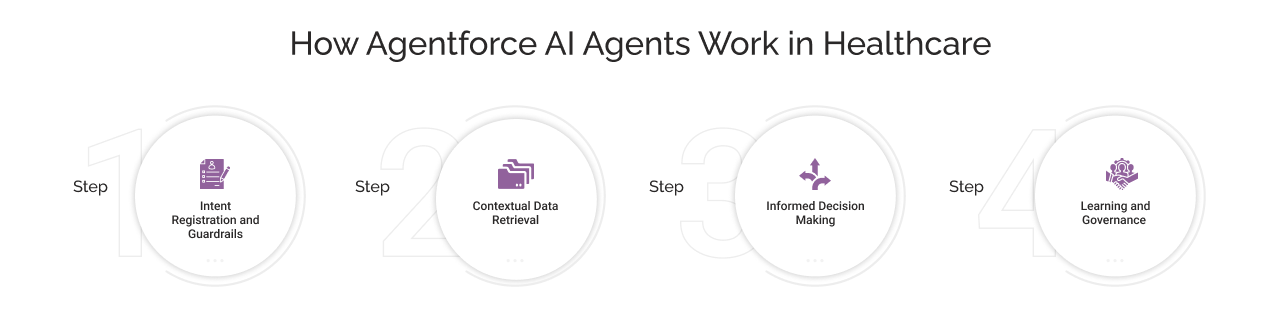
| 1. Intent & Guardrails | The agent registers a request and checks it against the Einstein Trust Layer. | Ensures PII masking and checks for clinical permissions before processing. |
| 2. Contextual Retrieval | The agent scans Data 360 for relevant EHRs, emails, and unstructured PDFs. | Uses Zero-Copy to access data in real-time without duplicating sensitive files. |
| 3. Informed Decisioning | The agent uses machine learning to assess risks and suggest a path forward. | Can automate high-value tasks like appointment scheduling and billing based on clinical data. |
| 4. Learning & Governance | Every interaction is logged for audit and continuous improvement. | Feedback from healthcare practitioners ensures the agent stays clinically relevant and accurate. |
Whenever a query is raised, the healthcare AI agents process sensitive customer data and give recommendations and responses to users accordingly. The agents can be programmed and guided by a pre-determined set of actions that they need to perform in different scenarios. Let’s take a closer look at how these agents work, considering the unique challenges and requirements of this sector.
Step 1: User Request Registration and Interpretation
- An agent first registers a user’s request and checks it against the Einstein Trust Layer to provide accurate responses to the users. This ensures PII masking and checks for clinical permissions before processing.
- For example, if a patient inputs, “I need to schedule an appointment with a cardiologist,” then the agent would check for all the permissions and the relevancy of the query, and if nothing seemed suspicious, then the agent would register the query/request and move ahead to process the request.
Step 2: Gathering Relevant Information
- The AI agents scan relevant data through Data 360 and collect the required information by using zero-copy integration.
- The agent can refer to sources, including EHRs and patients’ previous interactions via phone, text messages, PDFs, or emails. This data is vital for the agents to understand what the user expects.
Step 3: Making an Informed Decision
- AI agents can reason, predict, and respond based on pre-set actions.
- Agents use machine-learning models to assess high risks, anomalies, and potential responses to develop personalized recommendations.
- For instance, if there is a user query, “Based on my medical records, suggest specialist doctors who are available at noon on Saturday.” The agent suggests the names of specialist doctors for the patient’s condition based on the collected data.
Step 4: Learning and Adapting
- AI agents in healthcare learn from each interaction, helping them improve accuracy and effectiveness.
- Feedback from healthcare professionals also helps agents to improve future interactions. This ongoing learning ensures that AI agents stay useful and relevant.
How AI Agents Will Help Healthcare – Practitioners And Patients
For Healthcare Practitioners: The Clinical Co-pilot
- Pre-Visit Summarization: AI agents in healthcare provide a short summary of the patient’s entire medical history, including the unstructured notes to doctors.
- Refill & Claim Management: Agents can handle medicine refill requests and insurance claim settlements autonomously. They only escalate the request to the doctor when clinical judgement is required.
For example, imagine Dr. David, a heart specialist in the United States. Instead of spending 20-30 minutes searching through a new patient’s history, his AI agent provides a 30-second summary of the patient’s cardiac anomalies, recent lab results, and medication refills before he even enters the room. The agent handles the documentation work, allowing Dr. David to focus on providing better care.
For Healthcare Patients (New/ Existing)
- 24/7 Benefits Assistance: Patients get instant, accurate answers to their questions, such as “Will my insurance cover this lab test or procedure?” based on the patient’s specific plan data.
- Self-Service Navigation: From scheduling appointments to updating medical histories, patients interact with a human-centric agent that remembers their preferences and past interactions. For patients exploring GLP-1 therapies, agents can pre-screen eligibility, surface insurance options, and route users to trusted Ozempic prescription information to initiate a safe online consult—reducing back-and-forth while keeping guidance aligned with clinician oversight.
For instance, there is Mike who wants to check whether he can have a doctor’s appointment on Thursday. Instead of waiting on hold, Mike interacts with a self-service agent who remembers his preferences for a specific clinic. Then, the agent verifies his insurance coverage in real-time and updates with the possible appointments.
These scenarios showcase that care is seamless and friction-free with AI agents. Achieving this level of autonomous orchestration requires more than just deploying. It requires strategic alignment of clinical logic, data security, and a robust technical framework to ensure every interaction remains safe and accurate.


Strategize Your Transition to Agentic Healthcare Enterprise
Agentforce AI agents are changing the way healthcare businesses operate. They are improving patient outcomes, enhancing the patient experience, and making healthcare operations more efficient.
As a certified Salesforce partner, we at Cyntexa understand that becoming an Agentic Enterprise requires a deep understanding of Data 360 architecture, Data Space segmentation, and clinical workflow design.
We help healthcare organizations move from fragmented data to autonomous orchestration, ensuring that every AI agent for healthcare is grounded in trust, security, and measurable patient outcomes.
Let’s connect today and schedule a free session with our Agentforce Healthcare Consulting Experts
s to build your Agentic Healthcare Enterprise roadmap.
Don’t Worry, We Got You Covered!
Get The Expert curated eGuide straight to your inbox and get going with the Salesforce Excellence.
Co-founder and CTO at Cyntexa also known as “VJ”. With 10+ years of experience and 22+ Salesforce certifications, he’s a seasoned expert in Salesforce Data Cloud & AI Products, Product Engineering, AWS, Google Cloud Platform, ServiceNow, and Managed Services. Known for blending strategic thinking with hands-on expertise, VJ is passionate about building scalable solutions that drive innovation, operational efficiency, and enterprise-wide transformation.


Cyntexa.
Join Our Newsletter. Get Your Daily Dose Of Search Know-How
Frequently Asked Questions
AI agents can revolutionize healthcare by automating tasks, analyzing data for insights, and even assisting in diagnoses.
Agentforce in Healthcare can provide real-time data analysis and recommendations, aiding healthcare providers in making informed decisions.
AI agents can address challenges such as administrative burdens, diagnostic errors, and resource allocation inefficiencies.