





Offshore Salesforce Development: Complete 2026 Guide
source on Google

Table of Contents
source on Google
Offshore Salesforce development means hiring a dedicated team in another country, with limited time zone overlap, to build, customize, integrate, and maintain your Salesforce org. Companies use offshore Salesforce teams to access specialized Salesforce skills, scale development, and manage costs without expanding in-house teams.
As Salesforce environments have become more complex, the need for offshore development has grown. A typical Salesforce org involves custom applications, third-party integrations, data migrations, automation, Apex and Lightning development, and AI capabilities such as Agentforce.
Offshore development gives companies a way to add Salesforce expertise when they need support for a specific implementation or ongoing custom development and support.
But choosing an offshore Salesforce development partner does not depend solely on the lowest hourly rates. The outcomes depend on time zone differences, preferred communication, security, technical expertise, and engagement models.
This guide covers how offshore compares to nearshore and onshore models, why companies choose to outsource, what services and roles are typically involved, what it costs, risks and how to manage them, and how to evaluate a partner before committing.
Offshore vs Nearshore vs Onshore Salesforce Development
Offshore, nearshore, and onshore models mainly differ in location, time zone overlap, and cost. Each can work well depending on the type of Salesforce engagement you need.
Offshore development means working with a Salesforce team located in a distant country with a significant time difference. India, the Philippines, and parts of Eastern Europe are common offshore locations. This model can provide access to a larger talent pool and lower Salesforce development costs.
Onshore development means working with a Salesforce team located in the same country as your business. Since both teams work in the same time zone, they can collaborate and communicate in real time during working hours. However, onshore development is usually the most expensive option, and finding experienced Salesforce talent can be difficult in markets such as the USA, where demand is high.
Nearshore development means working with a Salesforce team located in a nearby country with similar working hours. For example, a US company may work with a team in Brazil or Mexico. This provides lower costs than onshore while still allowing teams to communicate and collaborate in real time for several hours each day.
| Factor | Offshore | Onshore | Nearshore |
|---|---|---|---|
| Time zone overlap | Limited | High | Partial to high |
| Cost | Lower | Generally higher | Moderate |
| Talent pool | Broad | Limited | Depends on the region |
| Communication | Requires structured collaboration | Real-time | Mostly real-time |
| Best suited for | Projects with strong documentation and planned collaboration | Work requiring close real-time collaboration | Projects needing regular live collaboration |
There is no Salesforce model that is completely better than others. The right choice depends on the collaboration your project requires and how well your team can work with the external team.
Why do Companies Outsource Salesforce Development?
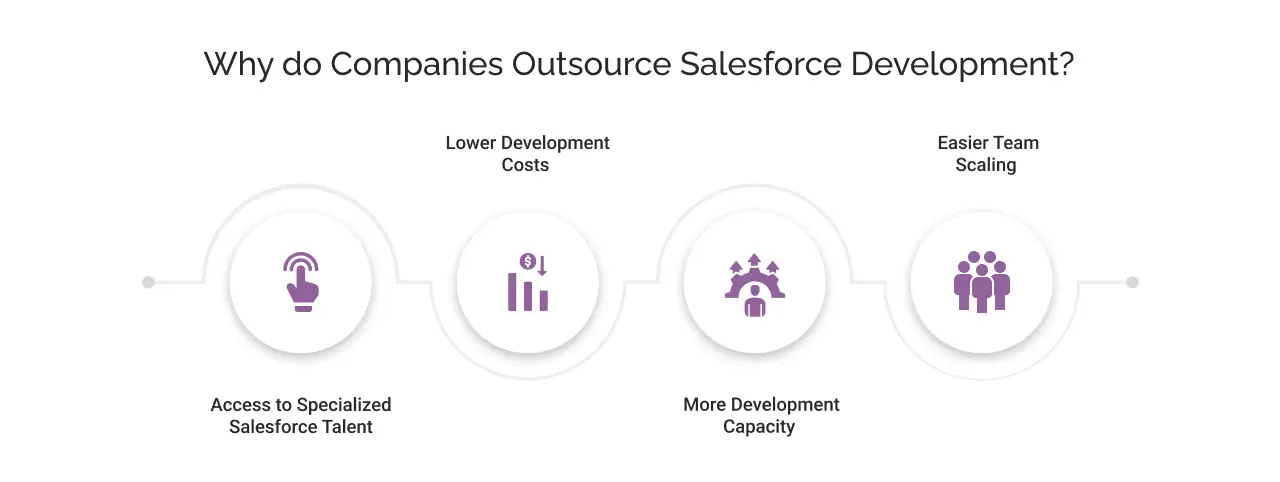
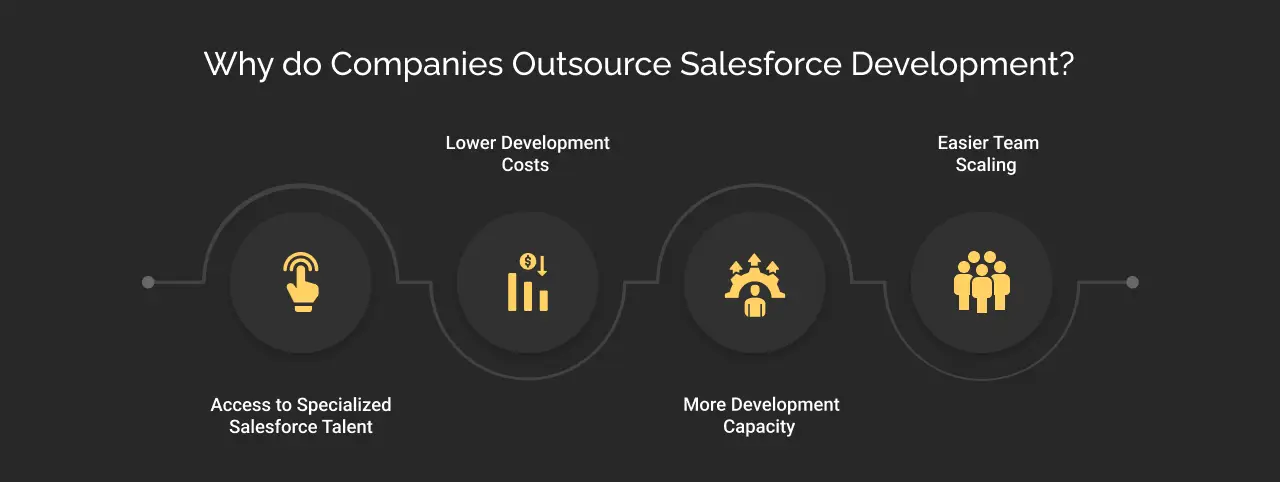
1. Access to Specialized Salesforce Talent
A Salesforce project may require administrators, developers, integration specialists, architects, and QA professionals. Hiring full-time experts for every role can be difficult as well as expensive, especially for mid-sized companies. An offshore partner can provide access to these skills when they are needed for the specific duration.
2. Lower Development Costs
Offshore teams have lower rates than comparable onshore teams, which can help companies manage the cost of ongoing development, administration, and support.
3. More Development Capacity
Your internal Salesforce teams often have a backlog of enhancements and maintenance work competing with larger projects. An offshore team can take on this additional workload, allowing the internal team to focus on strategic Salesforce initiatives.
4. Easier Team Scaling
Companies can increase the number of offshore Salesforce professionals when they have a major Salesforce implementation or a large development backlog. This model even allows them to reduce the team when the workload decreases. It provides more flexibility than hiring permanent employees for short-term needs.
Which Services are Covered Under Offshore Salesforce Development?
An offshore Salesforce team can support different parts of your Salesforce roadmap, from implementation and custom development to ongoing support.
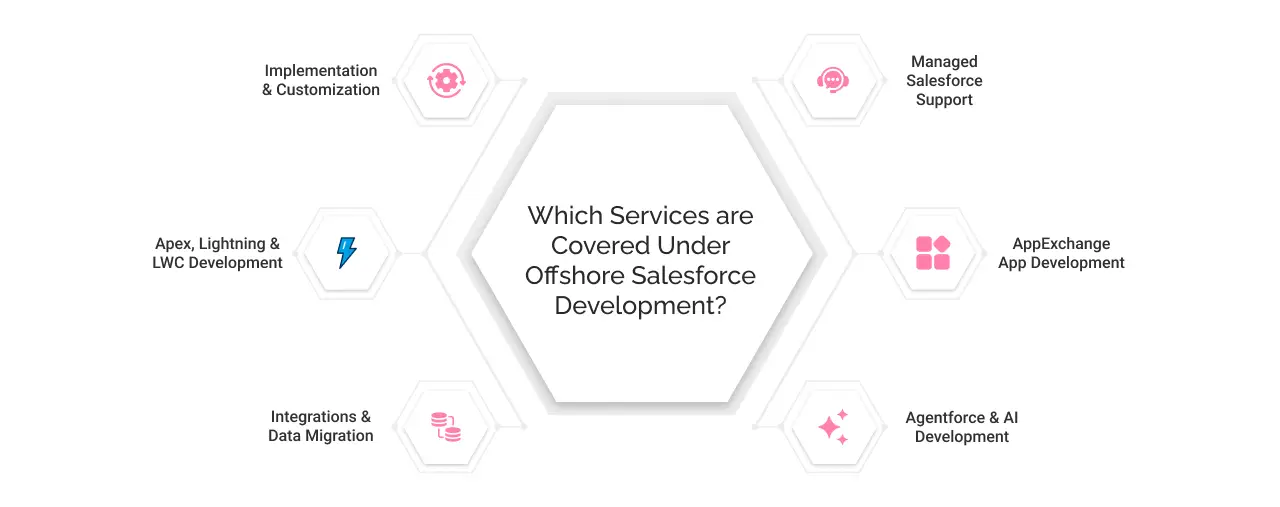
1. Implementation and Customization: This includes setting up a new Salesforce org or modifying an existing one. This covers custom objects, page layouts, validation rules, automation, and other Salesforce configurations.
2. Apex, Lightning, and LWC development: The offshore Salesforce team offers custom development when standard Salesforce features cannot meet a specific business requirement. This can include Apex classes, triggers, and Lightning Web Components.
3. Integrations and Data Migration: This includes connecting Salesforce with systems such as ERP, marketing, finance, and customer service platforms, as well as moving data into or between Salesforce orgs.
4. Managed Support: Offshore Salesforce developers provide ongoing maintenance after Salesforce goes live. This includes bug fixes, user support, enhancements, and other day-to-day Salesforce needs.
5. AppExchange App Development: It involves building packaged Salesforce applications for distribution through the AppExchange marketplace.
6. Agentforce and AI Development: This can include building and configuring AI agents, connecting them to the business data, and defining the actions they can perform.
If you are looking for an offshore Salesforce development partner, Cyntexa provides Salesforce development services for global teams that need support with custom development, integrations, data migration, automation, and ongoing Salesforce support. Our Salesforce team can work alongside your existing team or manage specific development requirements based on your project needs.
Who’s on an Offshore Salesforce Team?
The team you need depends on the project, but an offshore Salesforce engagement can include the following roles:
- Salesforce Admin: Manages your day-to-day configuration, user access, automation, reports, dashboards, and routine Salesforce maintenance.
- Salesforce Developer: Builds your custom functionality using Apex and Lightning Web Components.
- Consultant or Architect: Turns your business requirements into a technical solution. This includes designing the Salesforce data model, integrations, and overall solution architecture.
- QA Specialist: Tests configuration and custom development before the changes go into production.
- Project Manager: Manages the project scope, timelines, communication, progress, and coordination between the client and offshore team.
The roles you need depend on your requirements. Team size can vary based on the project’s complexity, timeline, and scope.
Types of Offshore Salesforce Engagement
Offshore Salesforce engagements typically use four common models, including dedicated teams, staff augmentation, project-based engagements, and time-and-material engagements.
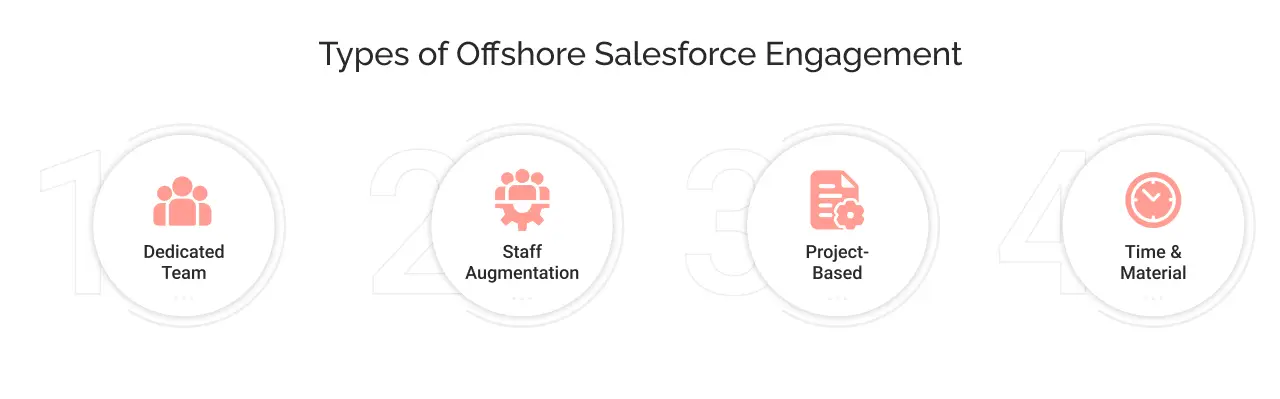
1. Dedicated Team
A dedicated team offers a group of professionals who work on your Salesforce org for a specific period. They act as an extension of your internal team and scale as your Salesforce needs change.
This model is a good fit for your ongoing Salesforce requirements and long-term development or support.
2. Staff Augmentation
Staff augmentation adds individual Salesforce professionals to your existing team to provide specific skills that your internal team is missing.
For example, you can augment a Salesforce developer for a custom development project or an integration specialist for a specific requirement.
3. Project-based or Fixed-scope
A project-based engagement is built around a specific scope, timeline, and set of deliverables. For example, an offshore Salesforce developer can handle a Salesforce data migration, implementation, or integration.
This model works best when you have clearly defined requirements and a specific result in mind.
4. Time and Material
With a time and materials engagement model, you pay based on the actual hours and resources. This gives you more flexibility when requirements change during the project.
Best Countries and Regions for Offshore Salesforce Development
Several regions are commonly considered for offshore Salesforce development. Each country offers a different combination of talent, cost, technical expertise, and time zone overlap.
- India has a large pool of Salesforce professionals and is a common choice for companies looking for Salesforce expertise and cost efficiency.
- The Philippines has a growing Salesforce talent base and strong English proficiency. It can be a good option for companies looking for offshore development and support, although the pool of senior Salesforce architects may be smaller than in India.
- Latin America, including Mexico, Brazil, and Argentina, offers closer time zone alignment with US companies. This can make real-time collaboration easier than working with teams in regions such as India or the Philippines.
- Eastern Europe, including Poland, Romania, and Ukraine, offers strong technical talent and similar working-hour overlap with Western European companies. However, the costs may be higher than in markets such as India and the Philippines.
The best choice depends on your project requirements. So first, you should evaluate the partner’s Salesforce expertise, security practices, delivery process, and experience with similar projects.
Offshore Salesforce Development Cost
There is no fixed price for offshore Salesforce development. The total cost depends mainly on the Salesforce work involved and the expertise required.
- Project scope: A simple Salesforce configuration change will cost far less than a full implementation, a complex integration, or an Agentforce project.
- Team experience: A junior Salesforce administrator has a lower hourly rate than a senior developer, architect, or specialist with advanced expertise.
- Project duration: A short-term project with a defined scope is priced differently from ongoing Salesforce development and support.
These factors vary from one project to another; generic hourly rates can give you only a rough idea of the cost. A project-specific quote based on your requirements will give you a more accurate estimate.
Common Risks with Offshore Salesforce Development and How to Mitigate them
Offshore Salesforce development can work well, but companies need to plan accordingly before starting an engagement.
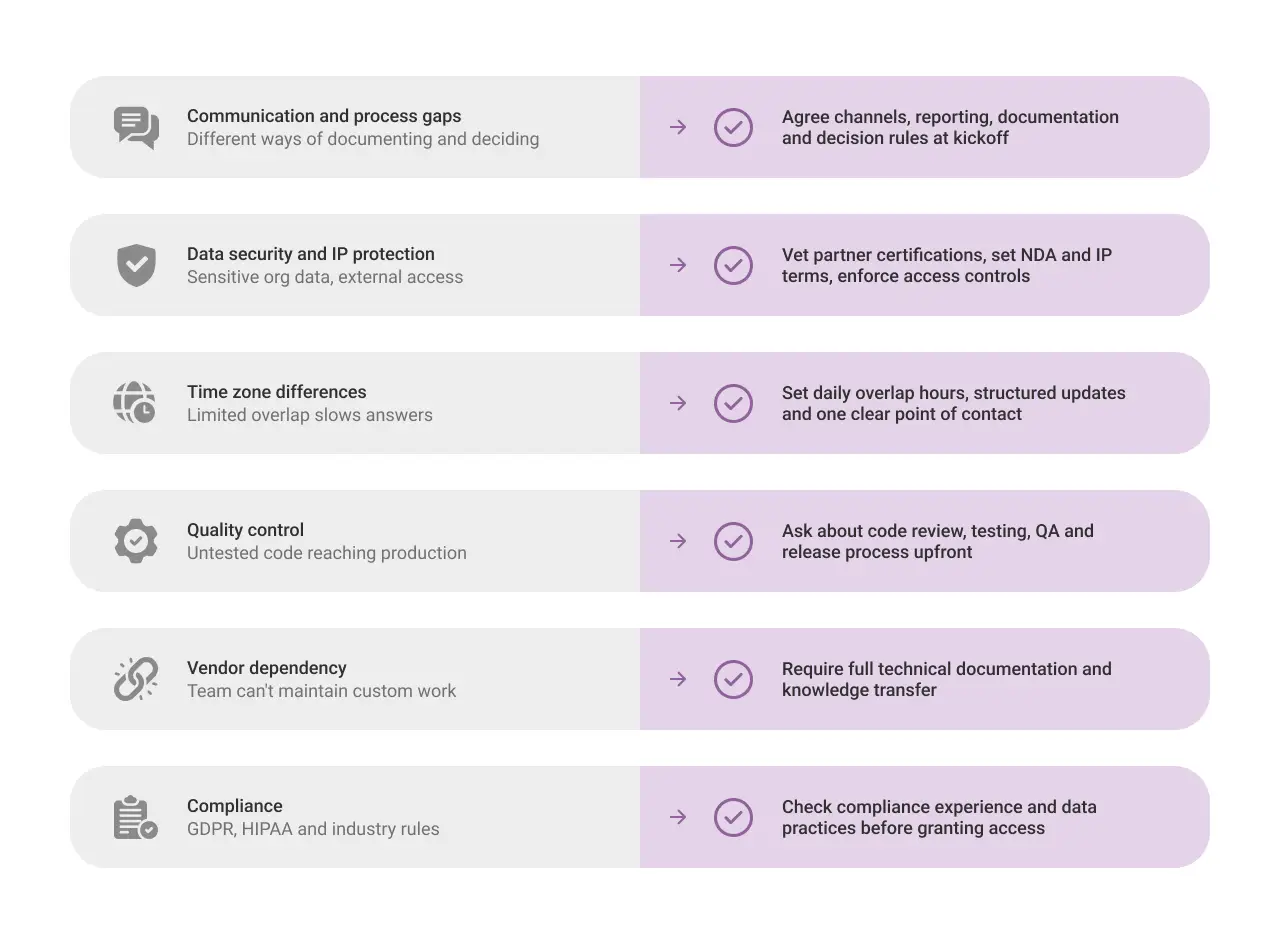
1. Communication and Process Differences
Different teams have different ways of communicating, documenting, and making decisions. Without setting clear expectations, this can slow down your project progression.
How to mitigate it: Agree on communication channels, reporting, documentation, and decision-making processes at the beginning of the engagement.
2. Data security and IP Protection
Your Salesforce org may contain sensitive customer and business information. Giving an external team access requires appropriate security controls.
How to mitigate it: Review the chosen Salesforce development partner’s security practices and certifications. Establish clear confidentiality and IP ownership terms, and follow appropriate access controls in Salesforce.
3. Time zone Differences
Limited working-hour overlap can make it difficult to resolve questions quickly and handle urgent issues.
How to mitigate it: Set specific overlap hours for daily discussions and use structured updates for work. A clear point of contact can also make communication easier with the offshore Salesforce developers.
4. Quality Control
Poorly tested configuration or custom code can create problems later when changes reach production.
How to mitigate it: Ask your Salesforce partner about its code review, testing, QA, and release processes before the project begins.
5. Vendor Dependency
You may become too dependent on a partner if your internal team does not understand the custom functionality.
How to mitigate it: Ensure the partner provides complete technical documentation and knowledge transfer.
6. Compliance
Depending on your industry and location, your Salesforce environment needs to meet requirements such as GDPR or HIPAA.
How to mitigate it: Check the partner’s relevant compliance experience, security protocols, and data practices before giving access to your Salesforce environment.
Does Offshore mean Lower Quality?
Not necessarily. The quality of offshore Salesforce development depends more on your chosen partner’s expertise, processes, and project management.
Quality improves when the project has clear requirements, documented processes, proper testing and security controls, and seamless communication. These practices help reduce the risks associated with working with a remote offshore team.
When evaluating an offshore provider, you should look beyond location and hourly rates. Review their Salesforce experience, delivery process, previous projects, and client references.
How to Choose an Offshore Salesforce Development Partner?
The right offshore partner should offer more than competitive pricing. You can look for:
1. Salesforce certifications
Look for certifications that match your project requirements, such as Salesforce Administrator, Advanced Administrator, Platform Developer I and II, and relevant Consultant certifications. However, certifications alone do not guarantee delivery quality.
2. Skills and experience
Ask for case studies, portfolios, and examples of projects similar to yours in terms of Salesforce products, technical complexity, industry, and scale.
3. Security practices
Ask about security certifications such as SOC 2, access controls, data handling, confidentiality agreements, and security policies.
4. Contracts and SLAs
The offshore partner should clearly define responsibilities, scope, timelines, pricing, service levels, and how changes to requirements will be handled.
5. Communication processes
The communication process should be agreed upon before the engagement starts. Clarify working-hour overlap, reporting frequency, escalation processes, and who will be your main point of contact.


Client references
It can help validate what a partner says about its capabilities. Ask for references from clients with similar requirements or project experience.
You can start with a smaller project before committing to a long-term engagement. This gives you a chance to evaluate the partner’s technical skills, communication, and delivery quality.
If you need additional Salesforce development capacity for a specific project or ongoing support for your Salesforce org, Cyntexa, an offshore Salesforce development partner, can provide Salesforce-certified developers with the expertise and development support you need.
Don’t Worry, We Got You Covered!
Get The Expert curated eGuide straight to your inbox and get going with the Salesforce Excellence.
Co-founder and CTO at Cyntexa also known as “VJ”. With 10+ years of experience and 22+ Salesforce certifications, he’s a seasoned expert in Salesforce Data Cloud & AI Products, Product Engineering, AWS, Google Cloud Platform, ServiceNow, and Managed Services. Known for blending strategic thinking with hands-on expertise, VJ is passionate about building scalable solutions that drive innovation, operational efficiency, and enterprise-wide transformation.


Cyntexa.
Join Our Newsletter. Get Your Daily Dose Of Search Know-How