





OneTrust vs ServiceNow: Comparing Privacy, Vendor Risk Management, GRC & More
source on Google
Table of Contents
source on Google
Blog Summary
- OneTrust and ServiceNow both offer enterprise GRC capabilities, but they take fundamentally different approaches to privacy, risk, and compliance management.
- This blog compares their features across privacy management, vendor risk, integrated risk management, pricing, and implementation to help you determine which platform best fits your organization's needs.
As organizations scale, spreadsheet-based governance, risk, and compliance (GRC) is not as effective as it was. Vendor assessments pile up, privacy regulations multiply, and security audits get difficult to track.
In that search, two platforms consistently come up that provide a unified solution: OneTrust and ServiceNow.
OneTrust is a data privacy and risk management platform, built to help legal and privacy teams manage consent, regulatory compliance, and third-party risk. ServiceNow is an enterprise workflow platform best known for IT Service Management (ITSM). Its Integrated Risk Management (IRM) suite extends that same platform to connect security and risk directly to IT operations.
Both platforms offer capabilities across risk management, vendor management, and compliance, but they approach each one differently.
This blog covers a comparison of OneTrust vs ServiceNow for privacy management, vendor risk, GRC, and pricing, so you can see which one fits your organization’s infrastructure and compliance goals.
Let’s get started.
OneTrust vs ServiceNow: Privacy and consent management
Privacy management means knowing what data you have, who it belongs to, and ensuring you comply with global regulations like GDPR and CCPA.
ServiceNow handles this through its Privacy Management application within the IRM suite. It focuses on integrating privacy tasks into broader IT and security workflows. OneTrust, on the other hand, was built primarily as a privacy platform, making it the industry standard for external data compliance.
| Comparison factor | ServiceNow Privacy Management | OneTrust Privacy & Data Governance |
|---|---|---|
| Data Subject Access Requests (DSAR) | Tracks and manages requests through standard workflow ticketing. Fulfilling a request typically needs manual steps or custom integrations. | Provides automated DSAR portals that can discover where a user’s data lives across your systems and automate deletion or redaction. |
| Consent and preference management | Can capture consent data if integrated with external portals, but this isn’t a core out-of-the-box function. | Offers built-in cookie consent banners and preference centers for websites and apps, customizable to local laws. |
| Regulatory compliance | Relies on third-party integrations or internal legal teams to track new laws. | Built on DataGuidance, OneTrust’s in-house regulatory research platform, updated daily and covering 300-plus jurisdictions. |
OneTrust vs ServiceNow: Vendor Risk Management (VRM)
Most enterprises rely on numerous third-party vendors, which makes vendor risk management a core requirement. Both platforms assess and monitor third parties, but they connect to the rest of your business differently.
| Comparison factor | ServiceNow VRM | OneTrust third-party risk management |
|---|---|---|
| Vendor assessments | Sends automated security questionnaires through a dedicated vendor portal, with responses scored and tracked natively. | Also uses a vendor portal for questionnaires, plus a Third-Party Risk Exchange (formerly branded Vendorpedia) with pre-completed security assessments for thousands of vendors. |
| Asset and IT integration | Integrates directly with the ServiceNow CMDB. If a vendor fails a security check, you can immediately see which internal servers or business services are affected. | Tracks which vendors touch which data types, but doesn’t offer native IT infrastructure mapping the way ServiceNow’s CMDB does. |
| Continuous monitoring | Integrates with third-party intelligence tools to monitor vendor health and trigger alerts in your IT service desk. | Integrates with threat intelligence feeds (including SecurityScorecard and RiskRecon) to monitor vendor risk scores and trigger reassessments when a score drops. |
OneTrust vs ServiceNow: Integrated risk and governance
| Comparison factor | ServiceNow IRM | OneTrust GRC |
|---|---|---|
| System of record | Runs on the same platform as ITSM and HR. A compliance issue can automatically generate an IT incident ticket for remediation. | Operates as a standalone GRC hub. It integrates with IT tools through APIs but remains a separate dashboard, used primarily by legal, risk, and compliance teams. |
| Policy and audit management | Highly automated. Because ServiceNow already has visibility into your IT environment, it can pull evidence like server configurations directly for auditors. | Strong frameworks for mapping policies to global regulations, well suited to manual or semi-automated audits focused on regulatory alignment. |
| Customization and workflow | Built on ServiceNow’s workflow engine, supporting complex, code-based or low-code routing rules for specific governance models. | Strong out-of-the-box templates and drag-and-drop workflows built for fast deployment, less suited to heavy, code-based infrastructure changes. |
OneTrust vs ServiceNow: Pricing and implementation
Since both are enterprise solutions tailored to organizational needs, their pricing structures and implementation timelines differ.
| Comparison factor | ServiceNow | OneTrust |
|---|---|---|
| Pricing model | Fulfiller-based licensing. You pay for the number of licensed users (“fulfillers”) working within the platform, across whichever modules you select (ServiceNow ITOM, ITSM, IRM, and so on). | Module and usage-based pricing. An annual platform fee (a $10,000 minimum as of 2026) plus specific modules like Cookie Consent or Third-Party Risk Management. |
| Implementation complexity | High. Because it connects to your entire IT infrastructure, implementation usually requires a servicenow implementation partner and can take months. | Moderate to high. Some modules, like cookie banners, deploy quickly. Full GRC and automated data discovery take more configuration. |
| Best for | Best suited to enterprises investing in a central operating system for IT and risk workflows. | Accessible for mid-market teams needing specific privacy tools, though cost scales quickly as more modules are added. |
ServiceNow vs OneTrust: Which platform fits your organization?
The choice is usually based on the primary problem you are solving, not which tool is better overall.
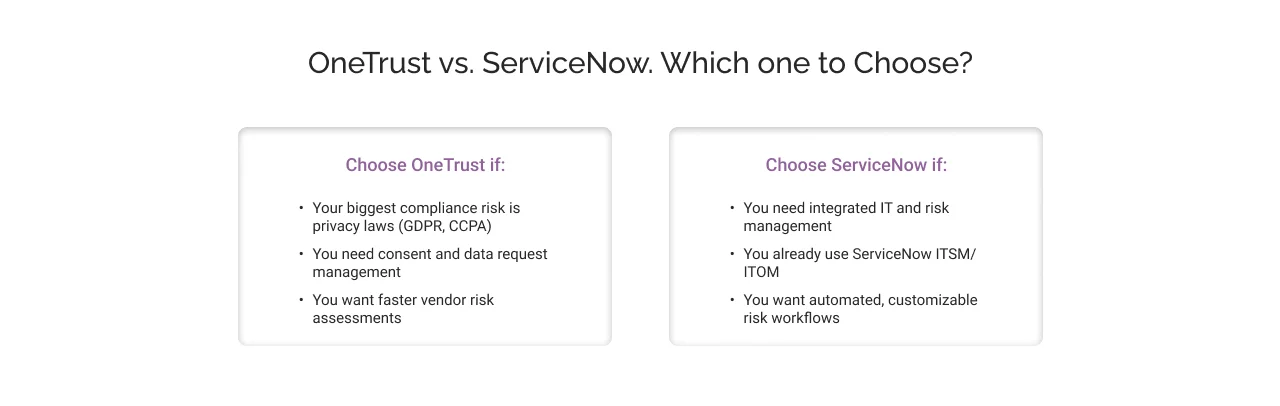
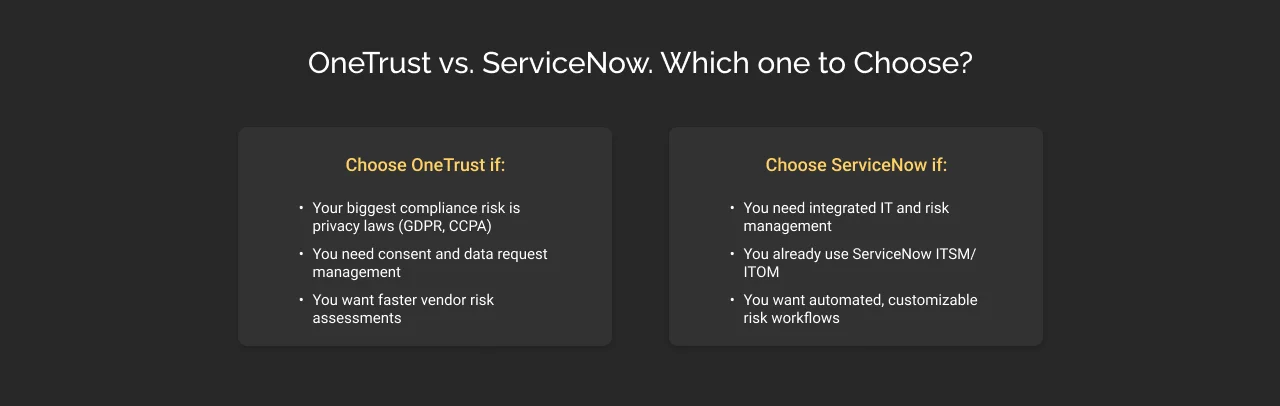
Choose OneTrust if:
- Your biggest compliance risk is external data privacy law (GDPR, CCPA)
- Your legal and compliance teams need a platform purpose-built for privacy consent and data subject requests
- You want fast vendor assessments backed by a pre-populated network of vendor security scores
Choose ServiceNow if:
- You want risk management aligned directly with IT operations and incident management
- You already run ServiceNow for ITSM or ITOM, making IRM a natural extension of your existing system of record
- You need highly customizable workflows that trigger automated remediation across internal servers and employee data


For many large enterprises, this is not an either/or decision. Since ServiceNow excels at IT operations and OneTrust excels at privacy intelligence, some organizations use OneTrust to capture consent and track regulatory change, then feed that data into ServiceNow through APIs to trigger the actual IT workflows that fix the underlying risks.
If you are evaluating which GRC approach fits your existing ServiceNow environment, or whether a hybrid setup makes sense for your compliance program, Cyntexa’s ServiceNow consulting experts can help you assess the right path forward.
Schedule a consultation call today!
Don’t Worry, We Got You Covered!
Get The Expert curated eGuide straight to your inbox and get going with the Salesforce Excellence.
Shruti is a ServiceNow Consultant with 5+ years of experience across ServiceNow ITSM, AWS, Salesforce Loyalty Management, and managed services. She blends technical expertise with strategic insights to deliver transformative IT services and CRM solutions that enhance efficiency and customer satisfaction.


Cyntexa.
Join Our Newsletter. Get Your Daily Dose Of Search Know-How