




Salesforce Agentforce Pricing in 2026: What You’ll Actually Pay
source on Google

Table of Contents
source on Google
Blog Summary
- Agentforce pricing spans four models at different price points. Conversation pricing at $2/conversation, Flex credits at $500/100000 credits, per-user licensing at $5 to $550+/month/user, and pay per resolution at $2 only if the agent fully resolves the issue.
- The cost of Agentforce depends on the model you pick, the actions triggered by each interaction, and the use case.
- Token overflow can multiply the charge of a single action. Mandatory data cloud and implementation are not in the headline rate and voice actions stacks, with telephony fees on top of AI credits.
Salesforce Agentforce has been in the spotlight for quite some time because of its autonomous actions across the Salesforce ecosystem. Its pricing has become one of the most talked-about topics and most misunderstood throughout the year.
Unlike other per-seat license models, Agentforce pricing is structured around consumption. This means the amount printed in your subscription package does not always match the amount on your invoice.
Salesforce announced four different Agentforce pricing models in two years, including conversational, flex credits, per-user licensing, and a recently announced pay-per-resolution model. All four pricing models are currently live for all users. The recently launched pay-per-resolution model is an outcome-based pricing structure where users are only liable to pay when an AI help agent autonomously resolves a customer issue from start to finish at a $2/ conversation fee.
If you’re looking to budget for Agentforce in 2026, make sure to understand which pricing model applies to your org’s use case and what it doesn’t cover.
This blog breaks down Agentforce pricing published on Salesforce’s latest page. We’ll also uncover the hidden costs and potential price implications for your org.
Let’s discuss why Agentforce pricing can feel complicated for most enterprises.
Why Salesforce Agentforce pricing looks complicated
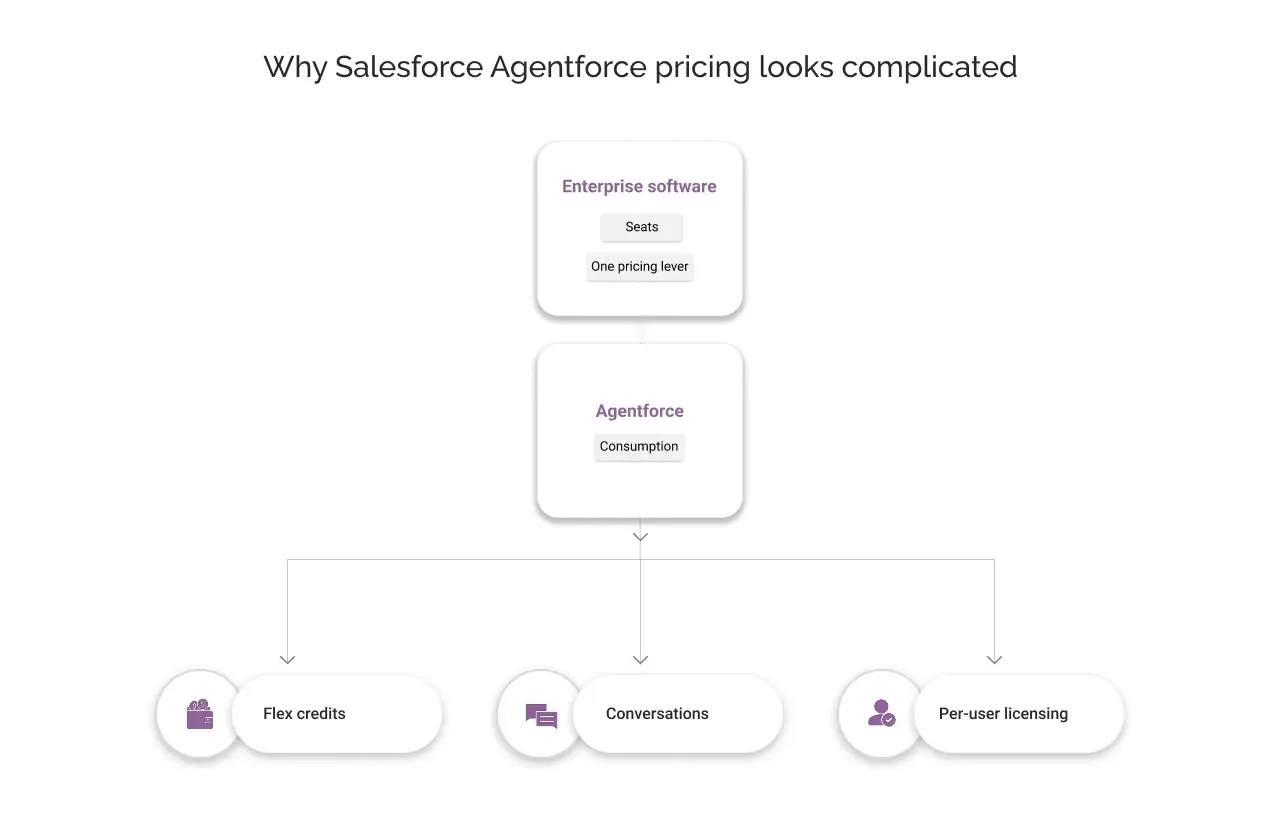
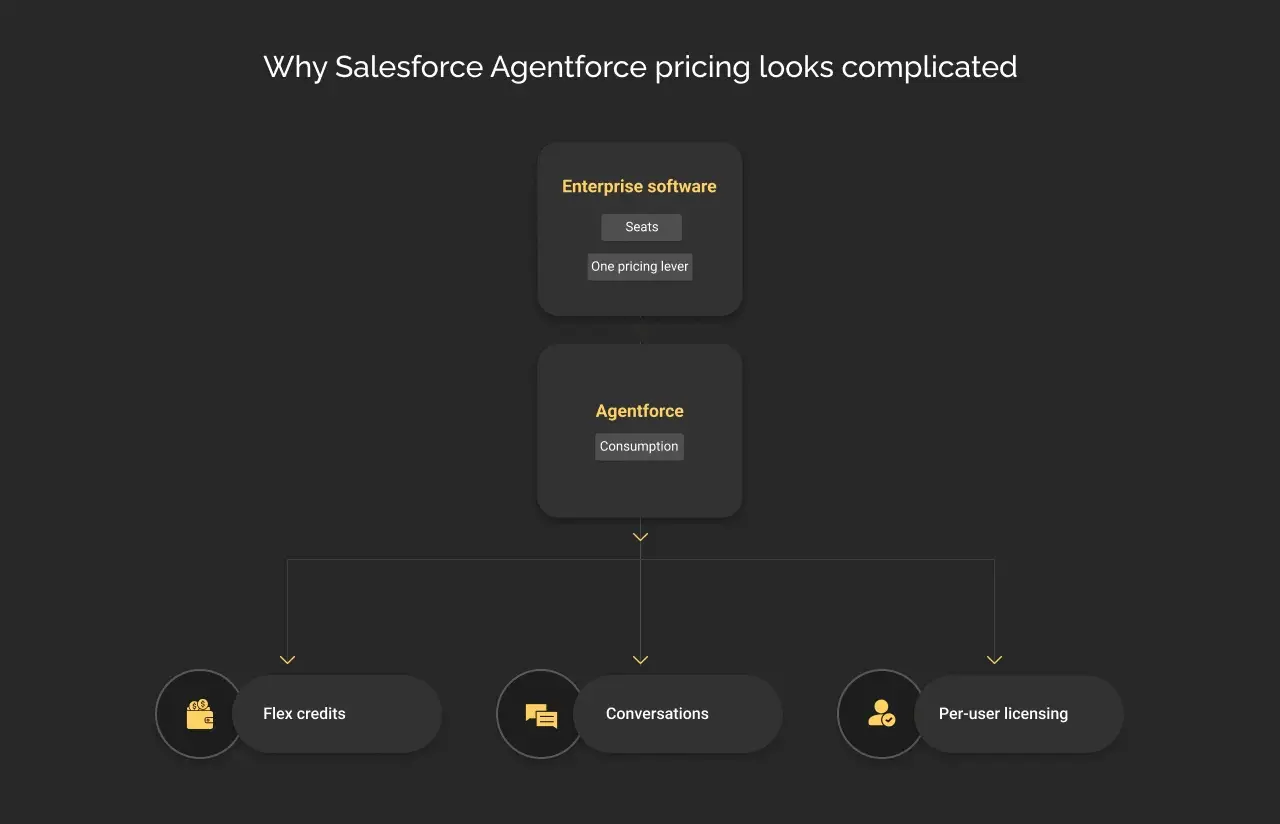
In most cases of enterprise software, organizations have one pricing lever: seats (number of users allowed access). Agentforce is different because it isn’t sold as a seat-based product; rather, it is sold on a consumption basis.
Salesforce’s own pricing page describes it as flexible pricing that you can scale on your terms. It is offered through consumption-based flex credits, conversations or per-user licensing.
Because of the flexibility offered, the pricing feels confusing, and enterprises are unable to assess their consumption. For example, a company with 60 or more employees running a high-volume customer service bot could easily outspend a 500-person company that uses Agentforce for internal Q&A.
Agentforce tracks the bill based on usage, not headcount. So the listed price on the official website tells part of the story until you track it against your actual workflow usage. To better understand Agentforce’s pricing model, have a look at how it’s listed on the official Salesforce website.
Salesforce Agentforce pricing in 2026: Current model pricing at a glance
As per Salesforce’s official pricing page, there are seven ways to access Agentforce, spanning a free tier, two consumption-based models, three licensing models, and one per-resolution-based model. Check the Agentforce rate card to fully understand how each model is billed and how you can optimise your consumption within limits.
| Agentforce plan | Price | Billed as | Best for |
|---|---|---|---|
| Salesforce foundations | 0 | Free tier |
|
| Flex credits | $500 to $1000 per 100k credits | Pay-per-action |
|
| Conversations | $2 per conversation | Pay-per-conversation |
|
| Agentforce user license | $5/user/month (requires flex credits) | Per user |
|
| Agentforce add-ons (sales, service, field service) | $125/user/month | Per user |
|
| Agentforce Industries add-ons | $150/user/month | Per user |
|
| Agentforce 1 edition | From $550/user/month | Per user |
|
How Agentforce flex credits work
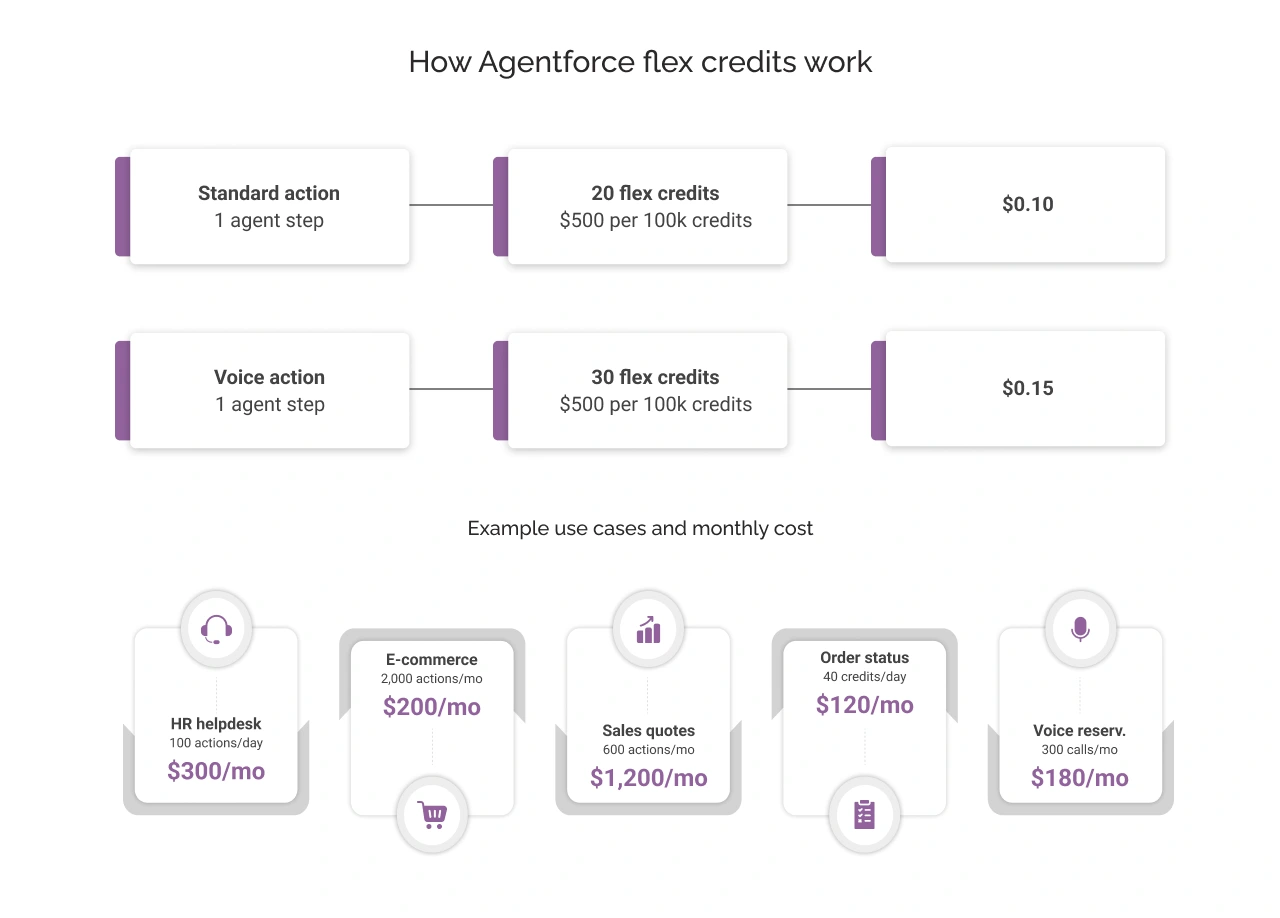
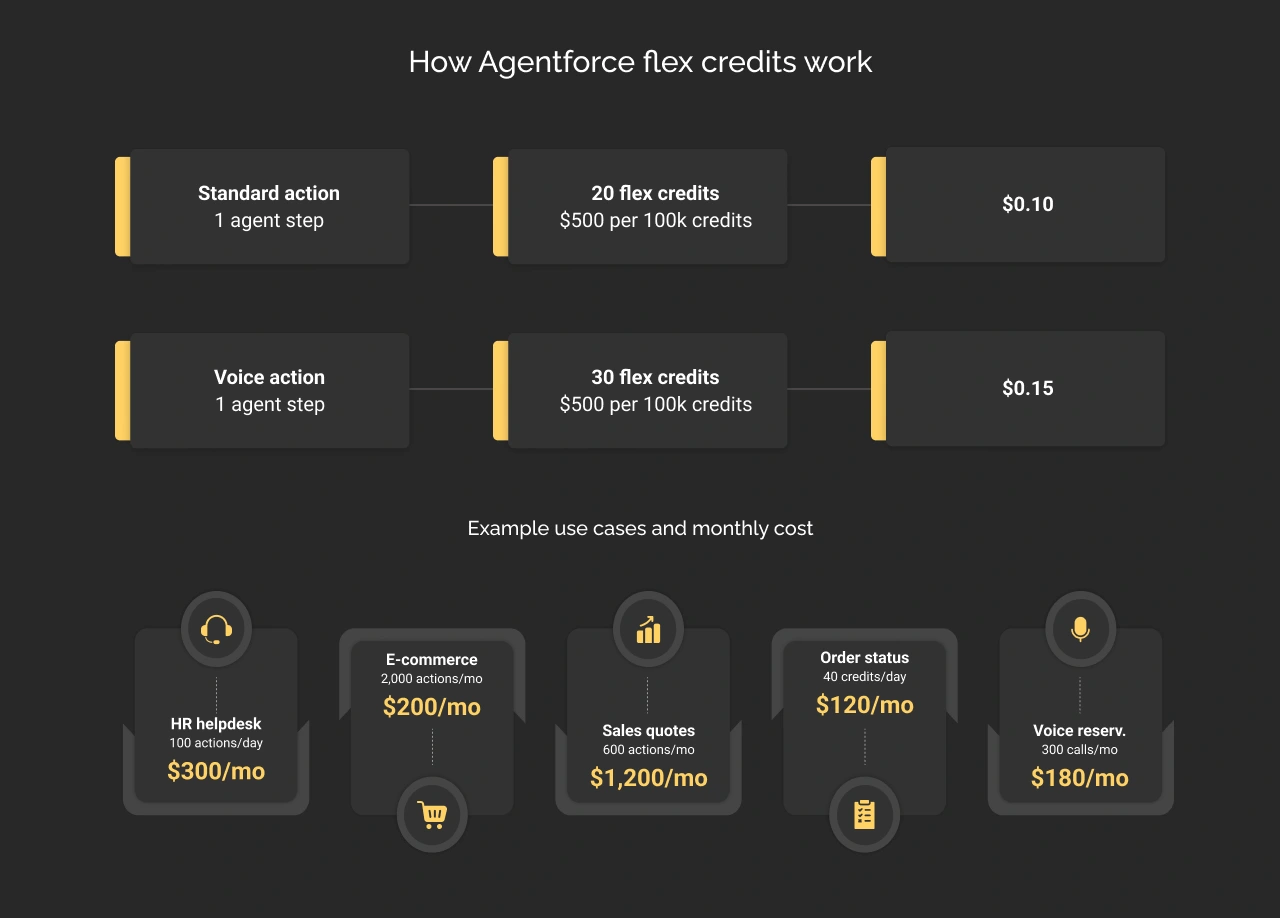
Salesforce launched flex credits as a consumption-based currency, and they are the most flexible for users. It is the most misunderstood part of Agentforce pricing. According to Salesforce, every standard Agentforce action costs 20 flex credits, and each Agentforce voice action costs 30 flex credits.
It is priced at $500 per 100000 credits, which amounts to roughly $0.10 per standard action and $0.15 per voice action. Check your Agentforce flex credits roadmap before signing up.
Here’s the catch: an action mentioned here is granular. Authenticating a customer record, pulling his case history, and drafting a detailed response can each be separate actions. In this case, a single customer conversation might consume anywhere from one to dozens of actions, depending on the complexity of the case.
Let’s take a look at some realistic examples that are worth quoting, as they reflect how fast a small per-action cost during your conversation can compound at scale.
- HR benefits helpdesk agent case– 50 employees asking questions/day. 2 actions for each employee amount to 100 actions per day – $300/month.
- E-commerce refund and return- Company gets 500 return requests per month, which amounts to 4 actions each (2000 actions/month)- $200/month.
- Generating a sales quote- 20 reps in the Salesforce ecosystem generating 5 quotes/day. This would make 6 actions per quote and amount to 600 actions/month- $ 1200/month.
- Knowing order status with self-service bot- Org receives 20 where is my order requests/ day. This leads to 2 actions each for every order, using 40 credits – $120/month.
- Voice reservation changes- Receiving 300 calls/month that lead to 4 actions/call – $180/month.
All calculations are made on the official rate of 20 flex credits at $0.10 per standard action, as mentioned on the Salesforce Agentforce pricing page (2026). The actual action count might vary depending on the agent design and the complexity of each conversation.
Agentforce Help Agent: Pay-per-resolution
Salesforce had launched three pricing models, and in June 2026, It added a fourth option based on pay-per-resolution. On June 25, 2026, Salesforce announced Agentforce Agent Help, which is a pre-packaged autonomous customer service agent priced at $2 per resolution.
The mode reached general availability in July, 2026. It is an outcome-based pricing approach in which users are charged only when the AI agent resolves an issue from start to finish. This pricing model is best suited for organisations with high-volume, repetitive customer support requests that want to tie their outsourcing costs to successful end-to-end outcomes.
What counts as an action
An action in the flex credit model relates to the step the agent takes. Its common examples include:
- Searching into a knowledge base or a document index
- Sending an email or message
- Calling an Apex call, external API or flow
- Escalating to a human agent
- Querying a Salesforce object, like reading a case record
A single end-to-end user interaction might involve multiple actions tied together.
“Where is my order?” might trigger the following actions
- Authenticate user
- Query order object
- Generate a natural language response
Totalling 3 actions that amount to 60 credits = $0.30
Hidden variables: Token overflow inside single action
Here are some details that you rarely find on a vendor’s pricing page. But from a practical perspective, it matters a lot in production. Salesforce caps each standard action at 10,000 tokens of processing. This cap is set to ensure we stay under this limit, as exceeding it can lead to token overflow. When you go above the prescribed limit, Salesforce counts the same action multiple times.
The threshold is evaluated per action and not pooled across conversations. So this is easy to miss until the bill is higher than expected.
| Scenario | Token Processed | Billed as | Cost |
|---|---|---|---|
| Small FAQ lookup | 3000 | 1 action | $0.10 |
| Detailed case summary | 15000 | 2 actions | $0.20 |
| Loading full policy document | 25000 (2 overflow blocks) | 3 actions | $0.30 |
An agent action that pulls a concise and summarised snippet costs $0.10. The same conceptual 1 action that instead loads an entire policy PDF into context can quietly cost 3 times more, not because Salesforce changed the rate, but because the agent design has pushed it past the token limit.
Keep the prompts and knowledge retrieval focused and summarised rather than dumping the entire document into the context. Make sure to use a digital wallet to track which actions are constantly overflowing.
Flex credit vs. conversation: Find the real break-even point
A standard action costs $0.10, and a single conversation costs $2. The math works out to a clear break-even point of 20 actions per interaction. Below that, flex credits win in any case, and above it, conversation wins.
When mapped to a real use case, the gap is dramatic at the low end.
| Use Case | Average Action | Flex Credit Cost | Conversation Cost | Cheaper Model |
|---|---|---|---|---|
| FAQ or knowledge management | 1 | $0.10 | $2.00 | Flex credits (95% cheaper) |
| Case management | 3 | $0.30 | $2.00 | Flex credits (85% cheaper) |
| Field service scheduling | 6 | $0.60 | $2.00 | Flex credits (70% cheaper) |
| Complex troubleshooting | 15 | $1.50 | $2.00 | Flex credits (25% cheaper) |
| Multi-email SDR outreach | 35% | $3.50+ | $2.00 | Conversation |
This is exactly why an organisation must not assume flex credit is always cheaper. A simple FAQ bot or case-management agent will always cost less under flex credits. But an SDR agent who sends an initial outreach email, followed by dozens of follow-up emails to the same lead, can blow past 20 actions per lead. At this point, a flat $2 conversation rate is a better deal.
Salesforce doesn’t allow both models in a single org, and this is worth modelling with your actual agent design before you pick a model, not after.
Conversation pricing: flat and limited
Salesforce launched conversation pricing as the original Agentforce billing model as a flat $2 per conversation, regardless of how many actions were triggered internally. It only applies to customer-facing agents, and Salesforce explicitly mentioned that conversation and flex pricing can not run in the same org at the same time. You can choose one pricing model at a time, which makes it an early and hard-to-reverse decision.
Real-world cases: Pricing Agentforce Voice for contact center
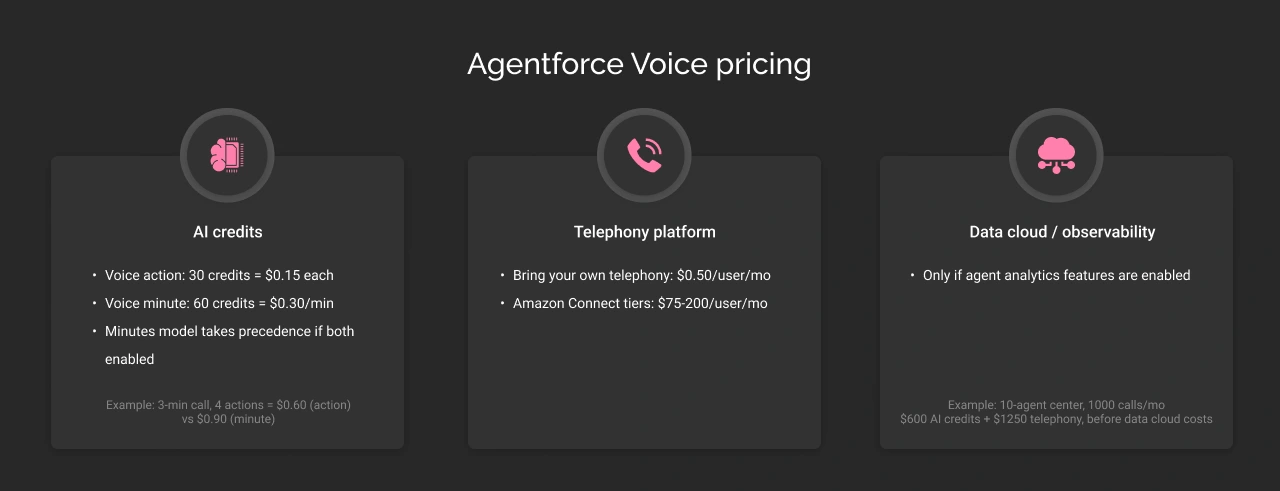
Agentforce Voice actions are an area where pricing gets layered. There isn’t one cost; there are three, and picking the wrong combination can double your cost without anyone noticing. Here are the layers that need your consideration.
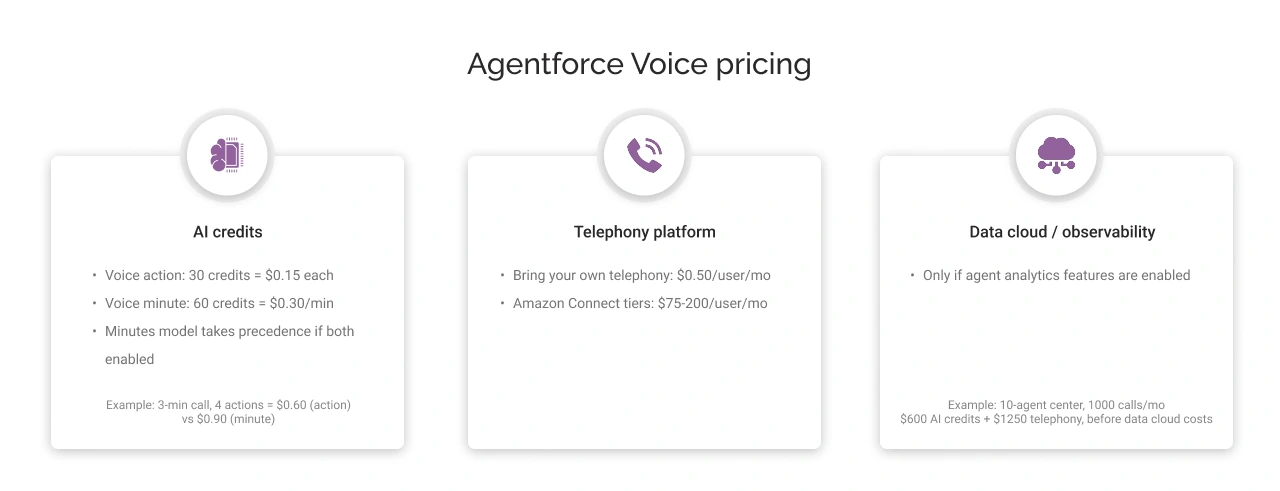
Layer 1(AI credits)
Salesforce measures voice through two mutually exclusive models. Voice actions (30 flex credits per discrete action- $0.15) and voice minutes (60 flex credits per minute of active all time- $.30/minute in production). If both models are enabled, then voice minutes automatically take precedence.
For example, a 3-minute call handling 4 actions (identify the caller, look up the reservation, respond to the question, and finalise the update) costs $0.60 under the voice action, but it is billed at $0.90 under voice minutes. This means the right model depends on whether your calls are short and simple or longer and unpredictable.
Voice action is preferred when a call requires fewer than two actions per minute of talk time. On the other hand, voice minutes win when one action density climbs higher than that.
Layer 2 (Telephony platform)
On top of the AI credits, you’ll still need a phone connectivity licence through Service Cloud Voice, and it’s entirely separate from Agentforce. Salesforce’s published rates run at $0.50/user/month for bring-your-own telephony. At the same time, $75 to $200/user/month for tiers of pre-integrated Amazon Connect minutes.
Layer 3 (Data Cloud/observability credits), if agent analytics and observability features are enabled
In case the contact centre puts together a 10-agent contact centre that handles 1,000 AI-handled calls in a month. Under the voice action model, it would land $600/month in flex credits. Plus, there would be a $1250 for a mid-tier Amazon Connect telephony license before any data cloud observability costs. It’s a reasonable check for any team pricing out a voice deployment where the AI credits are the smallest of the three line items, not the biggest.
Change in Salesforce Agentforce pricing: a quick timeline
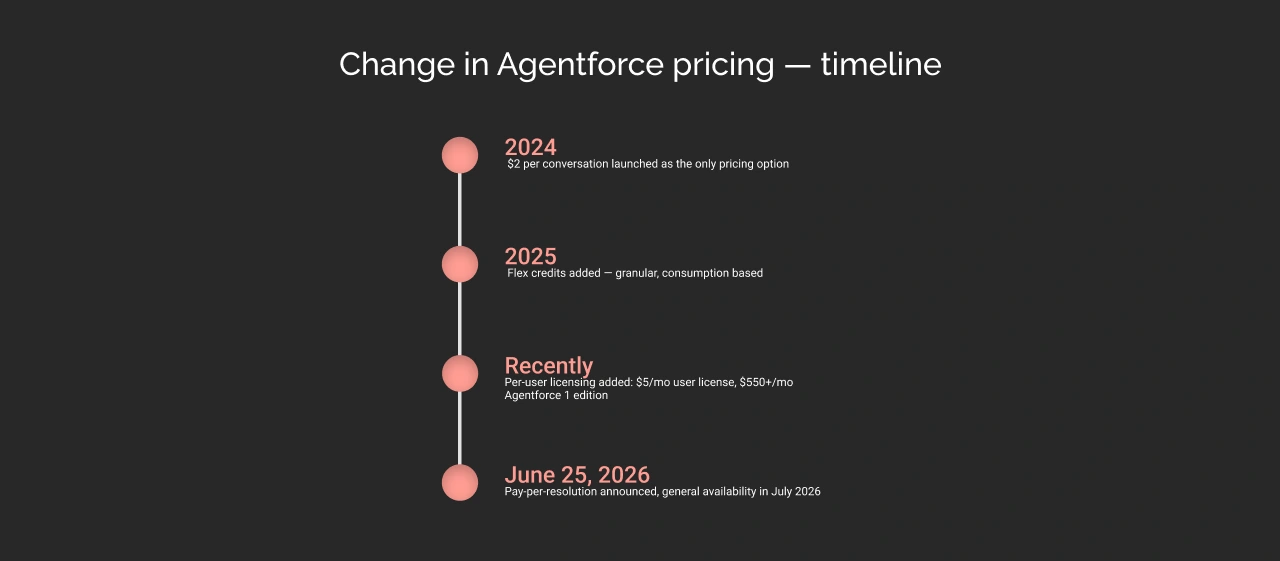
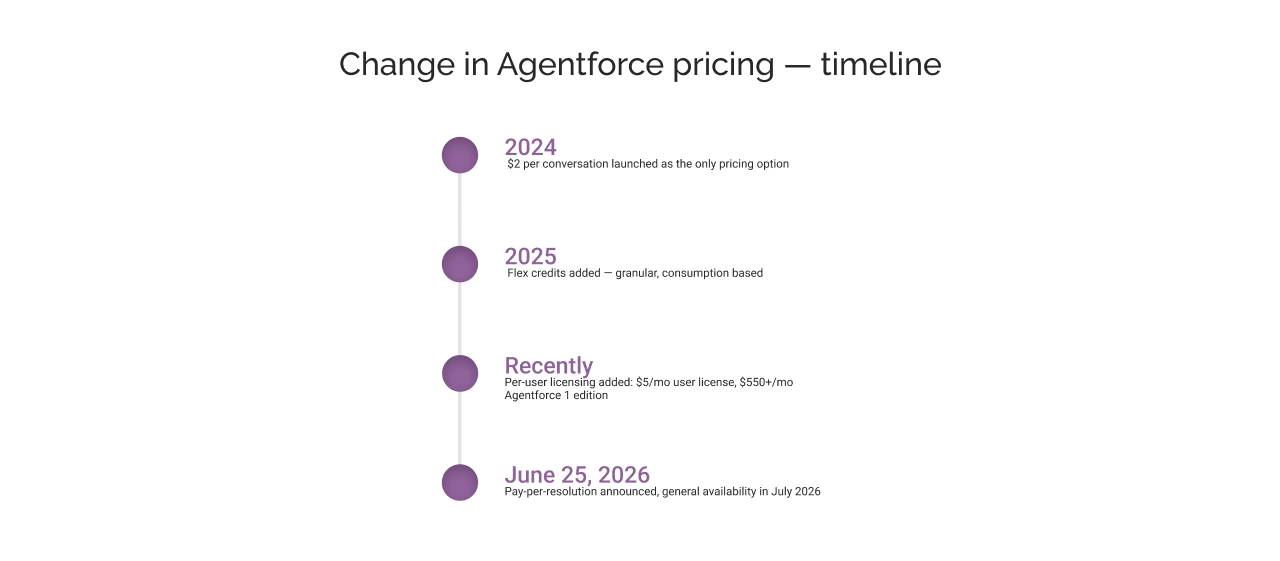
The history of Agentforce explains why so many users of the ecosystem feel like they are chasing a moving target. Agentforce was launched in 2024 with a $ 2-per-conversation plan as the only option. In 2025, Salesforce launched flex credits as a more granular and consumption-based alternative.
Recently, Salesforce added per-user licensing that includes a $5/month Agentforce user license and another $550+/momth Agentforce 1 edition. It provided the buyers with a flat-fee path for the company-wide employee-facing rollout.
The launch of three live models in two years feels like unusually fast iteration for enterprise software, and it reflects something crucial. Even Salesforce is figuring out how to translate AI agent work into a predictable bill that customers can rely on. You can see that the iteration hasn’t stopped, as Salesforce launched the pay-per-conversation model in mid-2026.
Here are two important rules to remember when negotiating Agentforce pricing.
- Unused flex credits do not roll over into the next month’s contract term, so accurate forecasting is important.
- There will be no punitive overuse penalty. If you exceed your entitlement, you’ll be billed monthly in arrears at the contracted rate. This can be tracked through Salesforce’s digital wallet.
Key practical ways to keep Agentforce usage under control
Beyond picking the right model for your business, here are some operational habits that can make a real difference to your monthly bill.
- Track consumption on the digital wallet, not in the invoice- Salesforce, for its flex credit and other models, has launched a free digital wallet that shows real-time, action-level credits for agents. Make sure to set alerts at 50%, 75% and 90% of the allotment to catch a misconfigured or looping agent before it consumes your monthly budget in a single day.
- Test in Sandbox before real production- Sandbox actions are billed at a discounted rate versus production rates. It can be done to ensure the batch testing is done there before it ever touches a live customer in production. It is cheaper to test in Sandbox and catch expensive design flaws like token-heavy prompts at an early stage.
- Design for token ceiling- Each action is capped at 10,000 tokens before it starts multiplying. Focus on concise prompts and summarised knowledge retrieval, and they are a direct lever on your Flex credit limit.
Is Agentforce worth it: a quick ROI check
None of the investment matters if it doesn’t pay you back. Here are a few things to notice before signing up.
- Customer service deflection math justifies Agentforce fastest- If your average cost/ human handled support case runs $15 to $25 and you’re handling meaningful monthly volume, then AI deflection can produce realistic savings. But this calculation works only at scale.
- Create special focus on governance- As per Gartner’s research, over 40% of Agentic AI projects in the current scenario would be cancelled by the end of 2027. This is driven primarily by escalating costs, an unclear business vision, and inadequate cost control. There’s no proof of technology failure, but because of ineffective governance, businesses are unable to proceed with agentic AI technology.
If you’re planning to deploy Agentforce in the current Salesforce ecosystem, then get a quick Agentforce ROI check. Optimise your current Salesforce Agentforce business environment based on a realistic ROI check.
Three questions to ask before you sign up
Get a reality check by asking the right questions about your data readiness.
1. Are your knowledge base and Salesforce data actually ready?
Poor input produces poor output, no matter how much you invest in the Salesforce ecosystem.
2. Which pricing model actually matches your real consumption pattern?
Audit your current use of agentic capabilities across different models.
- High volume and simple customer interactions would match the conversation model.
- Mixed use cases across different departments would match flex credit.
- Company-wide internal roll-out often matches the licensing model.
- You can evaluate the Help agent by obtaining a clear, contractual definition of what counts as a billable resolution.
3. If usage patterns change, what’s the exit plan?
Flex credits and conversation model can not run simultaneously in the same org. Make sure to negotiate flexibility into your contract before signing, not after.
The bottom line


The Salesforce Agentforce pricing isn’t confusing by accident. Each model has its own variables that initially look confusing. The pricing variables include token overflow within flex credits, layered voice billing, and action destiny break-even against conversations. In 2026, there is another undefined notion of resolution in the new pay-per-resolution model. Every org, based on its consumption architecture and behavioural model, needs to choose between the models.
The organisation that gets realistic ROI from Agentforce is the one that models its actual volume before signing up. Make sure to validate the results in a narrow pilot before committing to company-wide adoption. Agentforce’s complex pricing approach is not understood by organisations that rely on data published on websites.
This is exactly why Cyntexa provides hands-on experience in scoping, implementing and optimising Agentforce deployments across service, sales and voice use cases.
If you’re evaluating Salesforce Agentforce for your business, talk to our experts at Cyntexa about proposed pricing and a readiness assessment before your next renewal or pilot conversation.
Don’t Worry, We Got You Covered!
Get The Expert curated eGuide straight to your inbox and get going with the Salesforce Excellence.
Co-founder and CTO at Cyntexa also known as “VJ”. With 10+ years of experience and 22+ Salesforce certifications, he’s a seasoned expert in Salesforce Data Cloud & AI Products, Product Engineering, AWS, Google Cloud Platform, ServiceNow, and Managed Services. Known for blending strategic thinking with hands-on expertise, VJ is passionate about building scalable solutions that drive innovation, operational efficiency, and enterprise-wide transformation.


Cyntexa.
Join Our Newsletter. Get Your Daily Dose Of Search Know-How