






Salesforce Headless 360: How Salesforce Now Works Without a Browser
source on Google

Table of Contents
source on Google
Blog Summary
- Salesforce Headless 360, announced at TDX 2026, means you no longer need a browser to work inside Salesforce. Everything on the platform is now accessible as APIs, MCP tools, and CLI commands.
- The interface is no longer how work gets done. AI agents, systems, and developers can perform tasks without a human sitting in front of a screen.
- Every capability inside Salesforce, including data, workflows, and business logic, can now be accessed by AI agents without a UI.
- The platform includes components like Data 360, Agentforce Vibes 2.0, the Agentforce Experience Layer, Agent Fabric, and AgentExchange.
- Enterprises are running real workflows across voice, WhatsApp, Slack, and sales pipelines today, without anyone logging into Salesforce once.
For years, using Salesforce meant opening a browser. Logging in, navigating screens, and manually triggering actions. Salesforce Headless 360 changes that. AI agents, developers, and automated systems can now access data, trigger workflows, and execute business logic directly inside Salesforce without ever opening a UI.
In this blog, we cover what Headless 360 is, how it works, its core components, who it is built for, and what real-world enterprise workflows look like when agents take over.
What is Salesforce Headless 360?

Salesforce Headless 360 is a new Salesforce offering that lets you access your data, business logic, and workflows without opening a browser or navigating any UI.
You can look at the headless platform as a new architectural initiative and suite of tools by Salesforce that will turn the existing Salesforce Customer 360 ecosystem into an API-first infrastructure for AI agents.
Announced on April 15, 2026, at TrailblazerDX (TDX), it is one of the biggest platform changes in 25 years, which is redefining how enterprise agentic AI works. To put it simply, headless Salesforce is allowing AI agents, humans, and applications to call APIs, invoke tools, and execute commands directly.
How Does Salesforce Headless 360 Work?
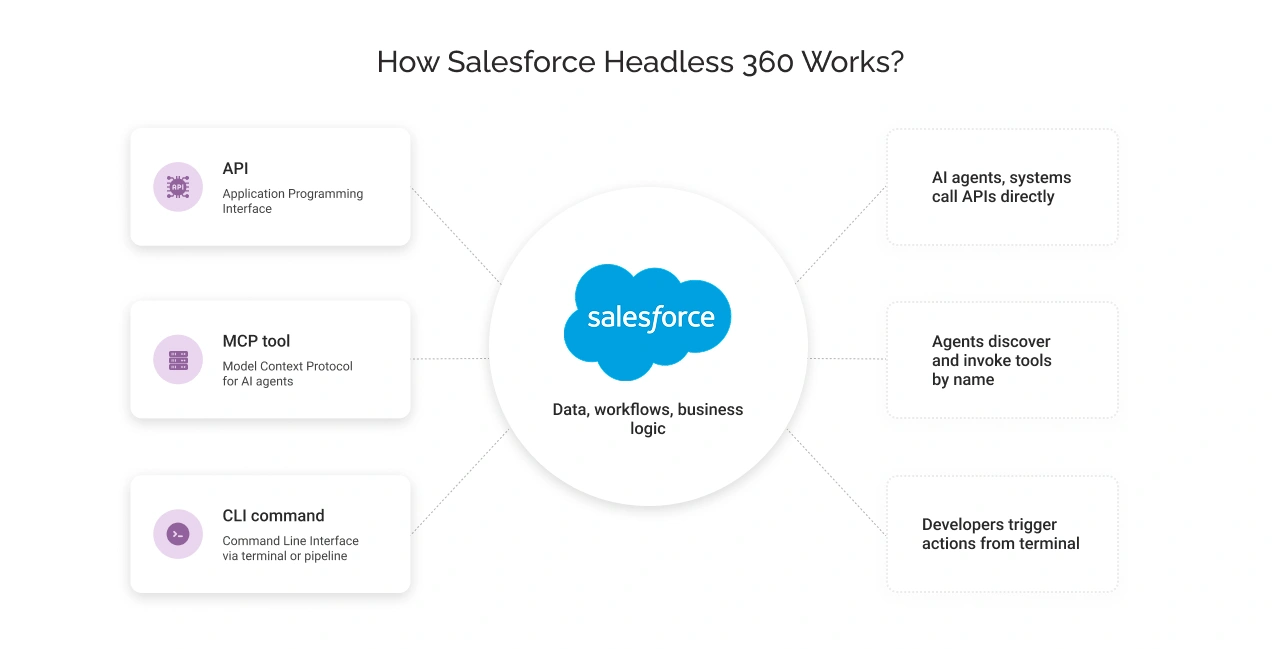
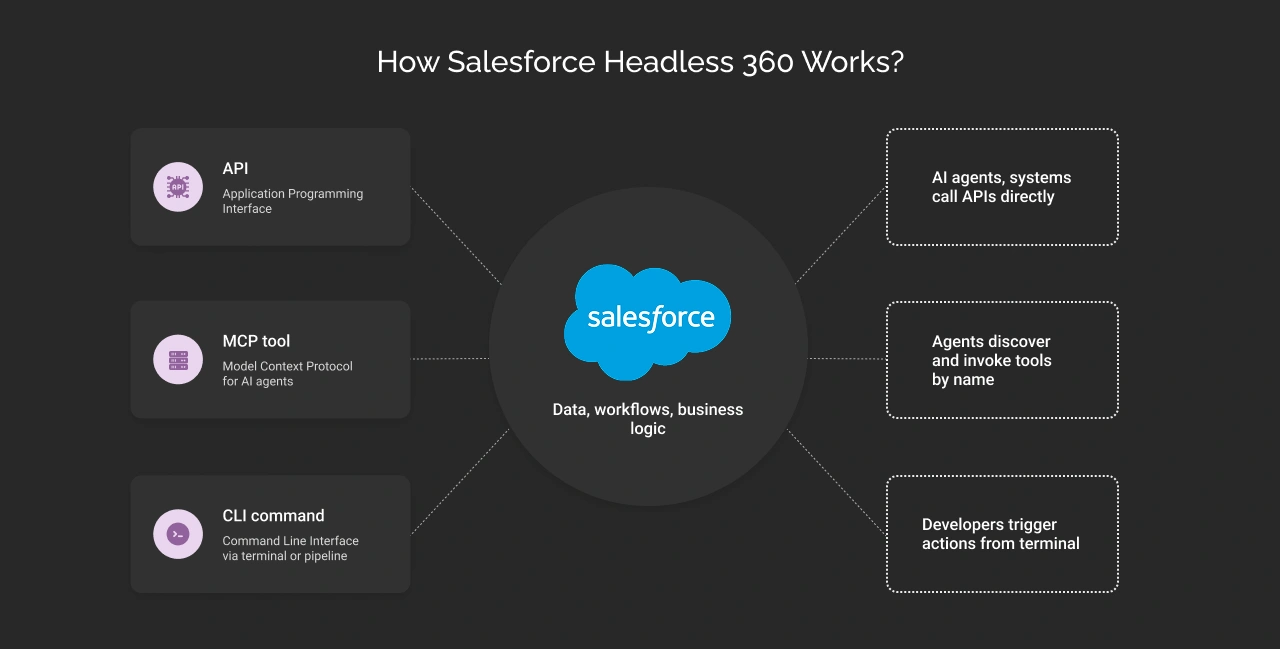
The entire platform is exposed as three access patterns, i.e., APIs, MCP tools, and CLI commands. Each access pattern serves a distinct purpose, but all three allow AI agents, developers, and automated systems to interact with Salesforce directly.
Let’s see how access patterns on headless Salesforce work
1. API (Application Programming Interface)
In this headless architecture, every capability on the platform is accessible through an API call. An API here is an application programming interface through which two systems can communicate with each other using a defined set of rules.
For instance, if an AI agent wants to retrieve a client record or update a complaint resolution case in Salesforce, it will send a request through the API. The requests are processed without any human involvement in the headless model.
2. MCP Tool (Model Context Protocol)
MCP is a standardized protocol that allows AI agents to discover and use capabilities on a platform. In the case of Salesforce Headless 360 for enterprise, it has purpose-built capabilities for every stage that AI agents can call by name.
For instance, an agent using Claude Code can call a Salesforce MCP tool to deploy a workflow, run a test, or retrieve data from the org without writing custom integration code from scratch.
3. CLI Command (Command Line Interface)
In Salesforce, AI agents and developers can trigger a workflow or other Salesforce action directly from a terminal or pipeline using a CLI agent command.
For instance, AI agents can run CLI commands from a terminal to pull metadata from a Salesforce org, including custom objects, field definitions, page layouts, permission sets, etc. AI agents can then make changes to the data and push it back, all without interacting with a user interface (UI).


Key Features and Components of Salesforce Headless 360
Here’s a list of features and inherent components of Salesforce API first architecture 2026
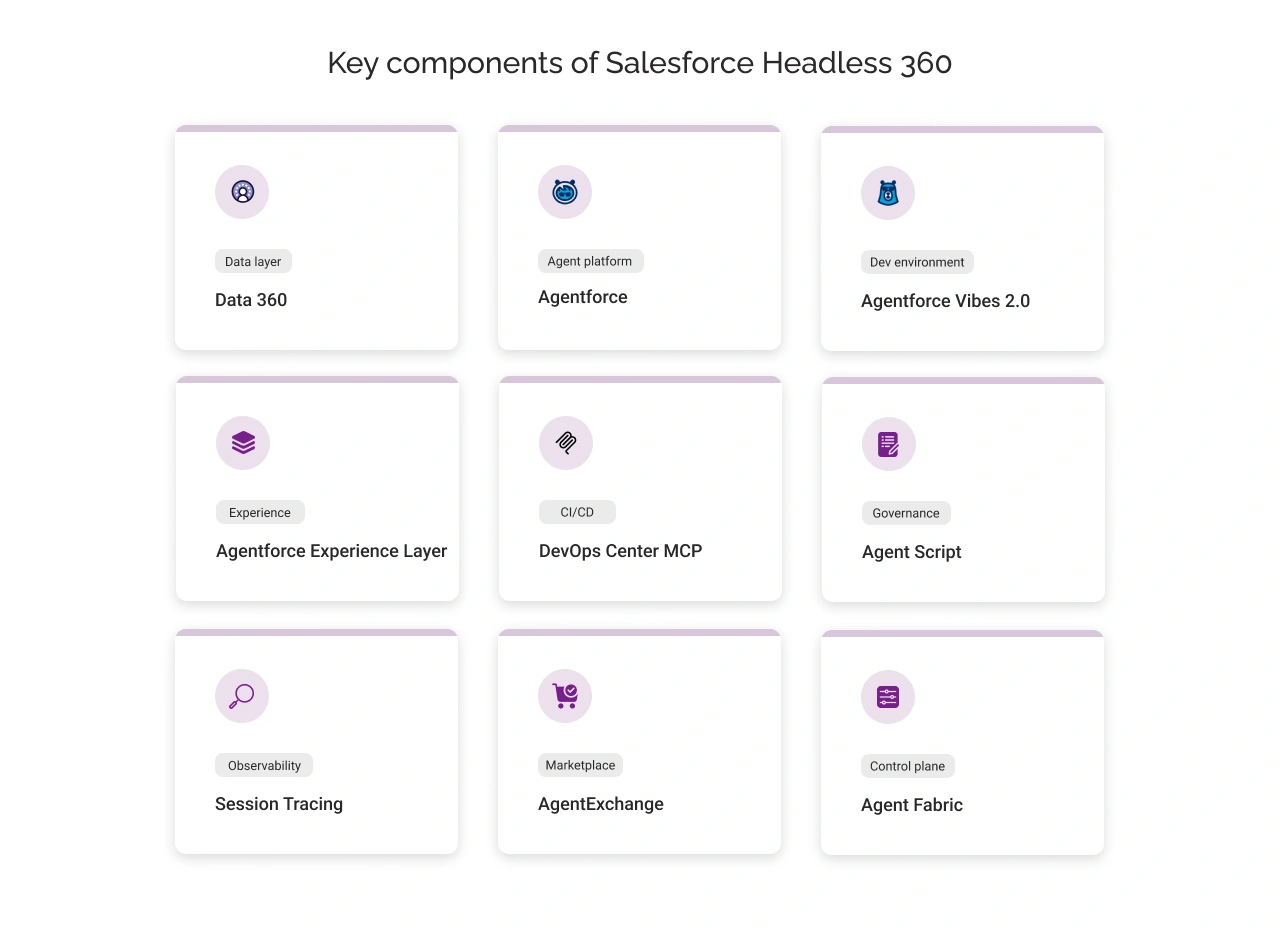
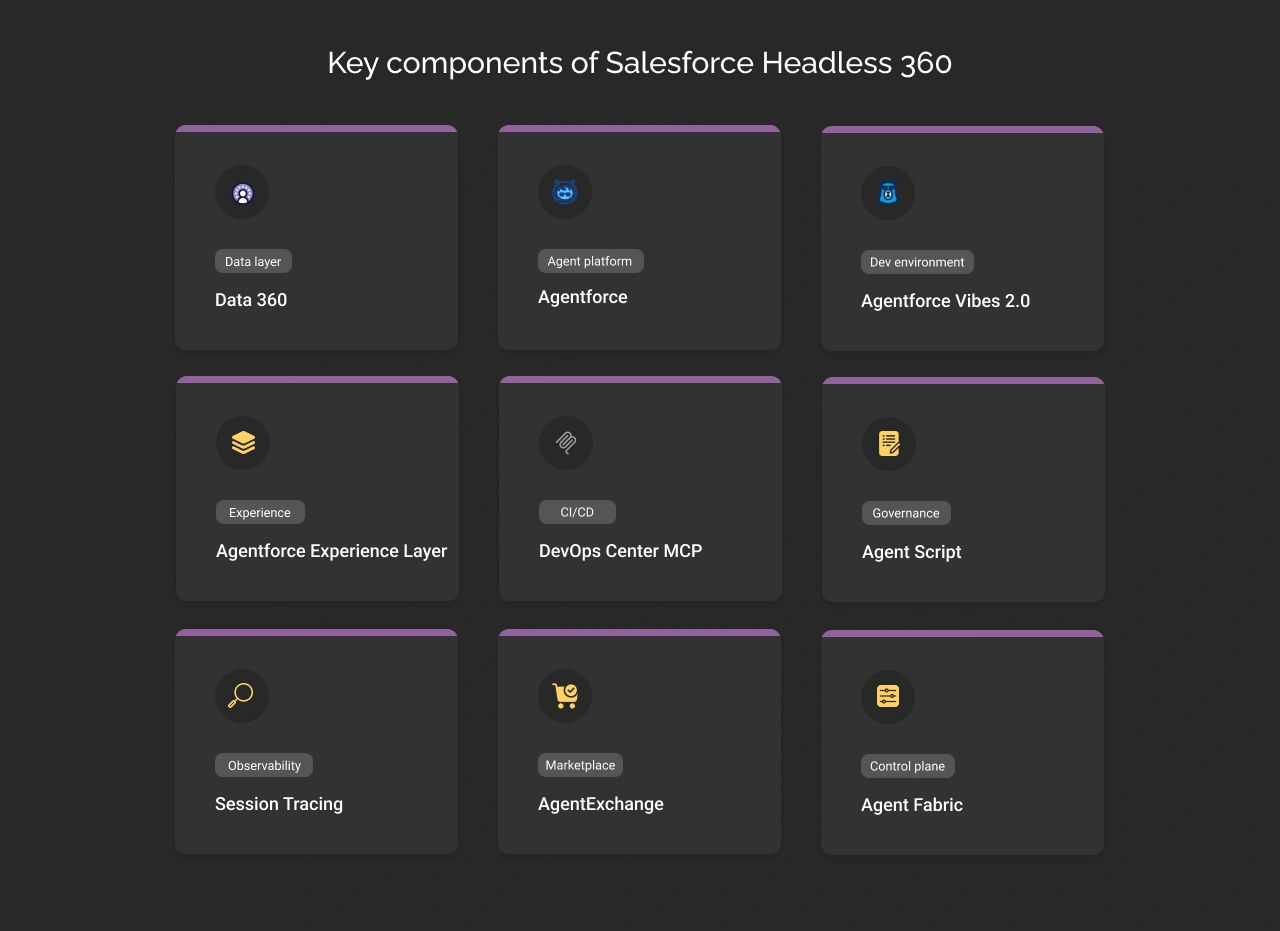
- Data 360: Being the data layer of the platform, Data 360 exposes trusted business data like open cases, transaction history, customer records, etc., as an API, MCP tool, or CLI command. This way, AI agents can access the real business data directly without even touching the UI.
- Agentforce: Agentforce is the layer within Salesforce that helps in building, managing, and deploying AI agents at scale. Additionally, Agentforce has the tools to define what the agent should do, how it should behave, and be connected to systems across the Salesforce platform.
- Agentforce Vibes 2.0: Agentforce Vibes 2.0 is the native-powered AI-development environment of Salesforce, having multi-model support, including Claude Sonnet and GPT-5. It means that developers can use any LLM model to write code and connect it directly to their Salesforce org, where AI understands metadata, data models, and overall business context.
- Agentforce Experience Layer: Salesforce provides an Agentforce Experience layer that separates the agent actions from how they appear to individual users interacting with it. On top of it, businesses only need to build the interaction once, and it works everywhere their teams already are (Slack, WhatsApp, etc).
- DevOps Center MCP: In the DevOps Center MCP, Salesforce can be connected directly to the CI/CD pipeline of developers using MCPs. Agents and developers can define what they want to build, and the agent handles the execution, including validation, testing, and deployment. So, instead of switching between multiple tools, you can work with one connected, agent-driven workflow.
- Salesforce Agent Script: Agent script is a Salesforce native tool that allows businesses to define how their agent must behave. The teams can define which parts of the agent must follow strict business rules and which parts the agent can reason through on its own.
- Session tracing and observability: Salesforce headless 360 enables businesses to use session tracing and observability tools through which they can track what an agent did and why it made each decision.
- AgentExchange: AgentExchange is the storefront, or a unified marketplace that brings together Salesforce AppExchange, Slack marketplace, and Agentforce ecosystem into one place. It has over 2,600+ Slack apps, 10,000 Salesforce apps, and 1,000+ Agentforce agents, tools, and MCP servers to provide support and go-to-market pathways to businesses to scale their solutions.
- Agent fabric: Agent fabric offers centralized governance over all agents, tools, and language models irrespective of where they come from. Hence, it can be considered a control plane that makes all the tools and agents visible, auditable, and controllable from a single place.
Who is Salesforce Headless 360 for?
Salesforce Headless 360 is for enterprises and developers, where AI agents don’t require a traditional user interface to perform actions, enabling businesses to switch to agent-first workflows.
Since Salesforce Headless 360 follows an API-first approach, it enables AI agents to bypass the UI layer and invoke APIs to pull up a customer record, update a case status, trigger an approval, or run a workflow. Because of this, the platform is relevant to a much wider audience than just developers.
Let’s see who it is for?
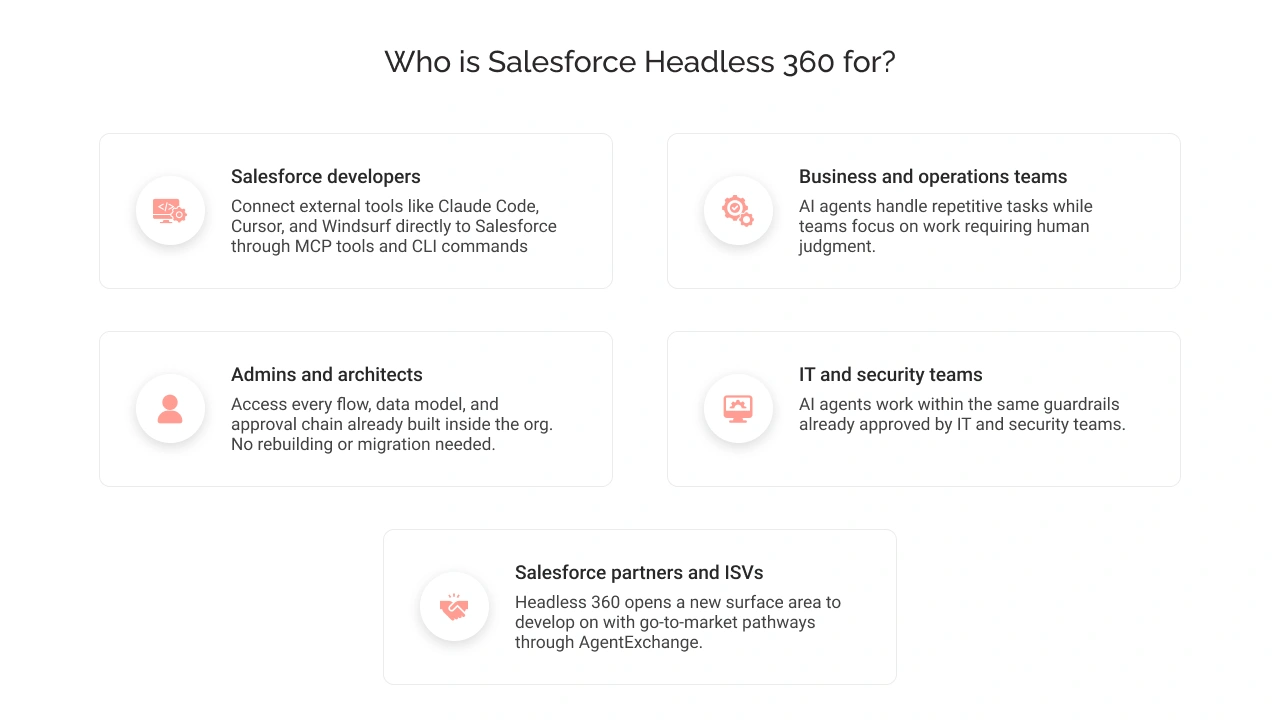
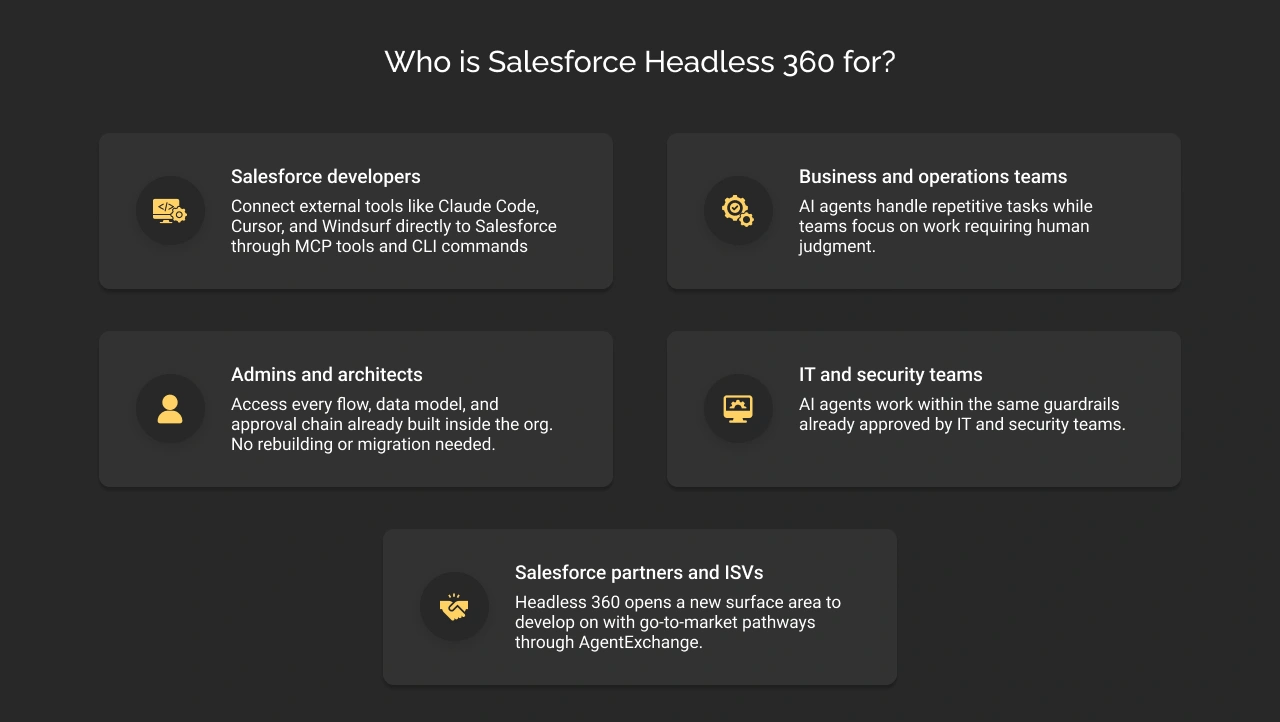
1. Salesforce developers
- Developers no longer need to work inside Salesforce’s proprietary environment to build and deploy on the platform.
- Instead, they can connect their preferred external tools, such as Claude Code, Cursor, Codex, and Windsurf, directly to their Salesforce org through MCP tools and CLI commands.
2. Admins and architects
- Admins, architects, and even AI agents can access very flow, data model, approval chain, and configuration already built inside your org.
- Hence, admins do not need to rebuild or migrate anything; they can inherit existing business logic and operate within it.
3. Business and operations teams
- Business and operations teams can manage customer cases, sales pipelines, or day-to-day operational processes more autonomously using Salesforce Headless 360.
- AI agents will handle the execution of repetitive, rule-based tasks while operations teams can focus on more complex tasks requiring human judgment.
4. IT and security teams
- There is no need to rebuild a governance or trust layer from scratch each time a new agent is deployed in your Salesforce org.
- AI agents work within the same guardrails already approved by your IT and security teams.
5. Salesforce partners and ISVs
- For Salesforce partners and ISVs, Salesforce Headless 360 opens a new surface area to develop on. In summary, if you build on Salesforce, sell on Salesforce, and run your business on Salesforce, this headless architecture will simplify the interaction of AI agents across the platform by eliminating the need to navigate via traditional, browser-based UIs.
Benefits of Salesforce Headless 360
1. Act without human triggers
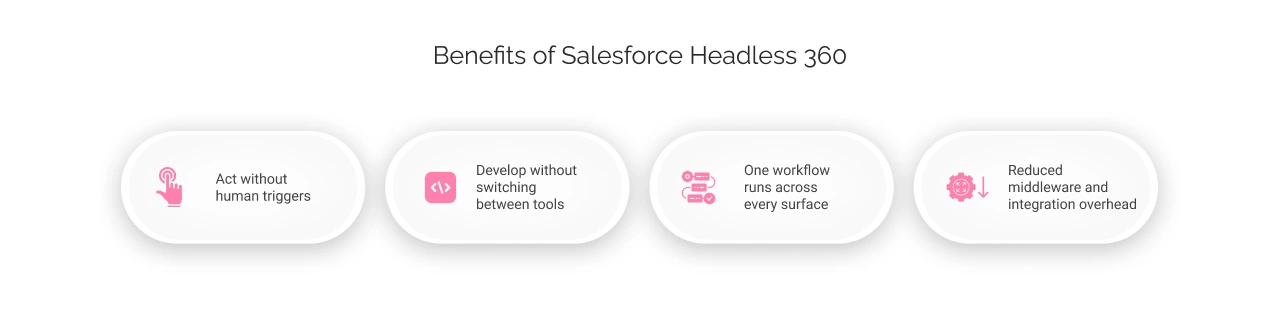
In headless Salesforce, AI agents can trigger actions without waiting for a human to log in and trigger the action manually. Whether it is updating a case, triggering an approval, or running a workflow, agents can execute these tasks on their own, at any time, without any human in the loop.
2. Develop without switching between tools
Developers can connect their coding agent (such as Claude Code, Cursor, or Windsurf) with Salesforce using an MCP tool, CLI command, or APIs to keep building and deploying apps on Salesforce.
3. One workflow runs across every surface
AI agents no longer need separate builds for each channel. Salesforce’s headless architecture, combined with Agentforce Experience Layer, will render the same interaction across various touchpoints (WhatsApp, Slack, etc) where teams already are.
4. Reduced middleware and integration overhead
Earlier, connecting external systems to Salesforce required custom middleware and separate integrations for each channel. However, with headless 360, this need is eliminated as everything is accessible through standardized APIs and MCP tools directly.


Real-world Use Cases of Salesforce Headless
Use case 1: Omnichannel commerce experience
A retail business that builds an order status and rebooking workflow will only need to do it once. This same workflow will automatically appear as a chat card on WhatsApp, a spoken response on a voice call, and an interactive button inside the mobile app through Agentforce Experience layer.
Use case 2: Sales pipeline management
An AI agent can monitor open opportunities across the sales pipeline to identify deals that have gone cold. It will trigger follow-up actions and reassign the workflows without requiring a sales manager to review the pipeline manually. Since the agent is working within the existing Salesforce workflow, it doesn’t need a separate logic configuration.
Use case 3: Voice-based case resolution
With the Agentforce Experience Layer, voice is now a native Salesforce surface. It means that an AI agent can talk directly to the Salesforce backend without requiring any custom middleware in between. Hence, when a customer calls for case resolution and speaks to a voice assistant, the AI agent will pull the customer record, read the open case, check the SLA status, and resolve the issue, all in the same conversation.
Bottom line
Headless Salesforce is going to transform the way agents manage workflows and trigger actions. This agentic infrastructure allows everything inside Salesforce to be accessed via APIs, MCP tools, and CLI commands.
If you’re a Salesforce customer, a partner, or a business running on the platform, this announcement directly affects how you work, build, and scale. Now is the time to evaluate what Salesforce without UI means for your org, your workflows, or your development pipeline. Cyntexa’s team of certified Salesforce architects can help you move from understanding to implementation. We have done it across industries, and we can do it for you.
Reach out to start the conversation!
Don’t Worry, We Got You Covered!
Get The Expert curated eGuide straight to your inbox and get going with the Salesforce Excellence.
Co-founder and CTO at Cyntexa also known as “VJ”. With 10+ years of experience and 22+ Salesforce certifications, he’s a seasoned expert in Salesforce Data Cloud & AI Products, Product Engineering, AWS, Google Cloud Platform, ServiceNow, and Managed Services. Known for blending strategic thinking with hands-on expertise, VJ is passionate about building scalable solutions that drive innovation, operational efficiency, and enterprise-wide transformation.


Cyntexa.
Join Our Newsletter. Get Your Daily Dose Of Search Know-How
Frequently Asked Questions
Salesforce Headless 360 is a platform shift announced by Salesforce on April 15, 2026, that makes every Salesforce capability accessible through CLI, MCPs tools, and APIs.
In terms of software, “head” means the user interface (screens, menus, and buttons a user interacts with). Headless Salesforce removes that UI dependency so agents and systems can access the platform directly.
With Salesforce Headless 360, developers and AI agents can access Salesforce without a browser or UI by invoking an API call, using MCP tools, or running CLI commands.
Agentforce is the layer built inside the Salesforce platform through which you can create, manage, and deploy AI agents. Headless 360 is the broader architecture of Salesforce, which makes the entire Salesforce platform accessible without a UI.