




Meet Salesforce Job-Ready Agents: Piper, Hunter, Casey, Paige, Fin, Carter, and Marshall
source on Google

Table of Contents
source on Google
Salesforce stopped asking businesses to build job-specific agents from scratch. It packaged seven new Agentforce agents, ready to deploy, each with a defined role and its own business context.
This move builds on real scale: Salesforce has already delivered 7 billion Agentic Work Units across Agentforce and Slack, including 3.2 billion in a single quarter. This is what pushed Salesforce toward job-specific agents instead of generic ones.
The seven agents span sales, service, commerce, IT, HR, and supply chain. Each comes built for a specific use case and can be configured to a company’s own permission sets and business rules, so enterprises start with an agent designed for the job, not a blank one they have to shape from scratch.
This article breaks down what each of the seven agents does, how they work together, how to customize them for your own workflows, and how to measure ROI once they’re live.
What are Agentforce agents?
An Agentforce agent is built around four things:
- a defined role
- context from company data
- a set of actions it can take
- and guardrails around what it can do without approval.
An Agentforce agent operates using a company’s actual business data and rules, not general knowledge. So its answers and actions are grounded in what’s true for that specific business.
These agents become reliable by using Agent Script. It is Salesforce’s language that combines AI reasoning with clear rules. This allows an agent to use judgment when needed while still following strict business logic.
Tying them together is Agentforce Coworker, giving employees a teammate across Slack, ChatGPT, Claude, and more. With this, you just ask the Coworker to perform a certain task without asking which agent should do it. That is Coworker’s responsibility to pull an agent and get your work done.
Now, let’s meet Salesforce seven Agentforce agents
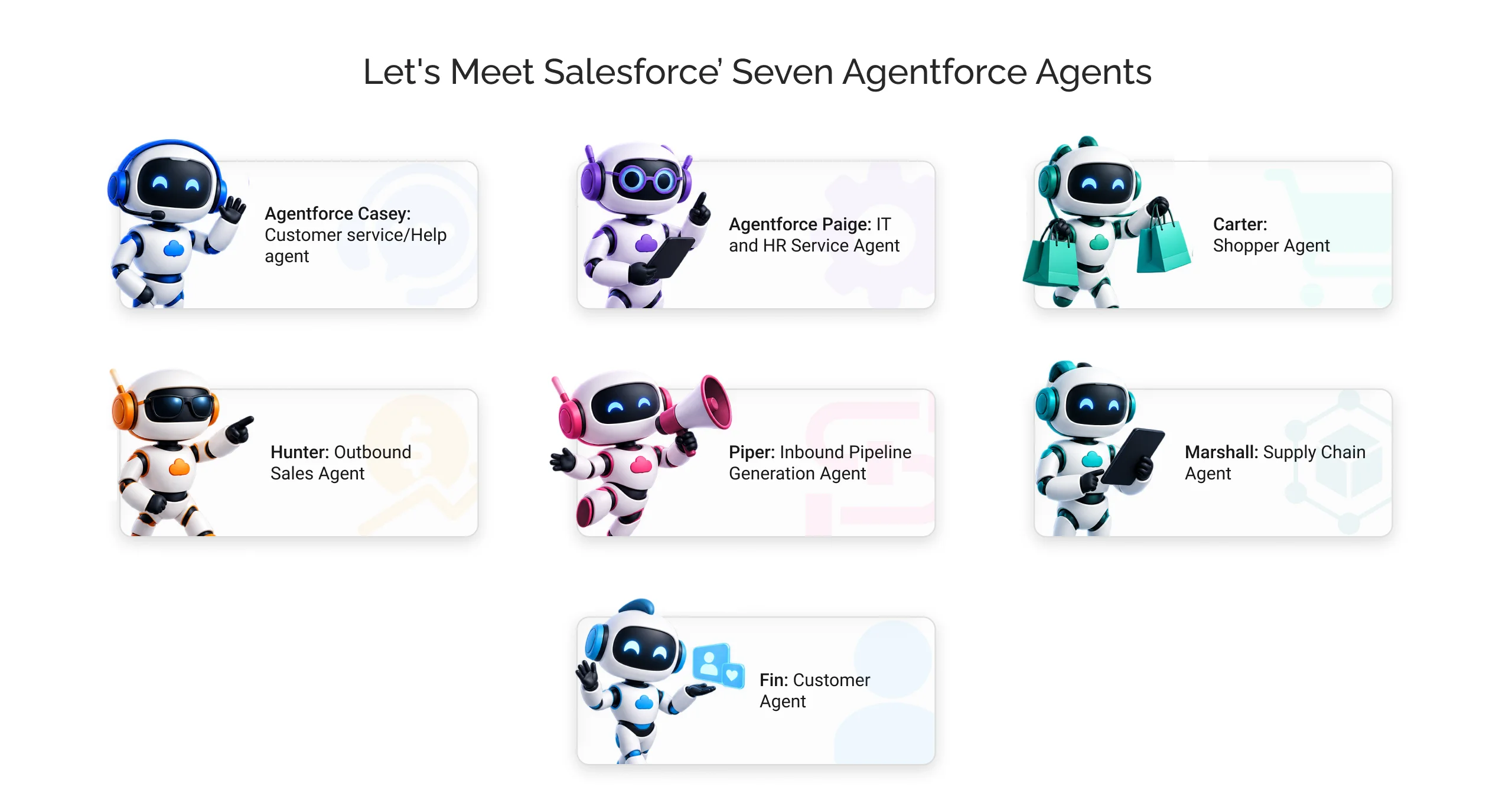
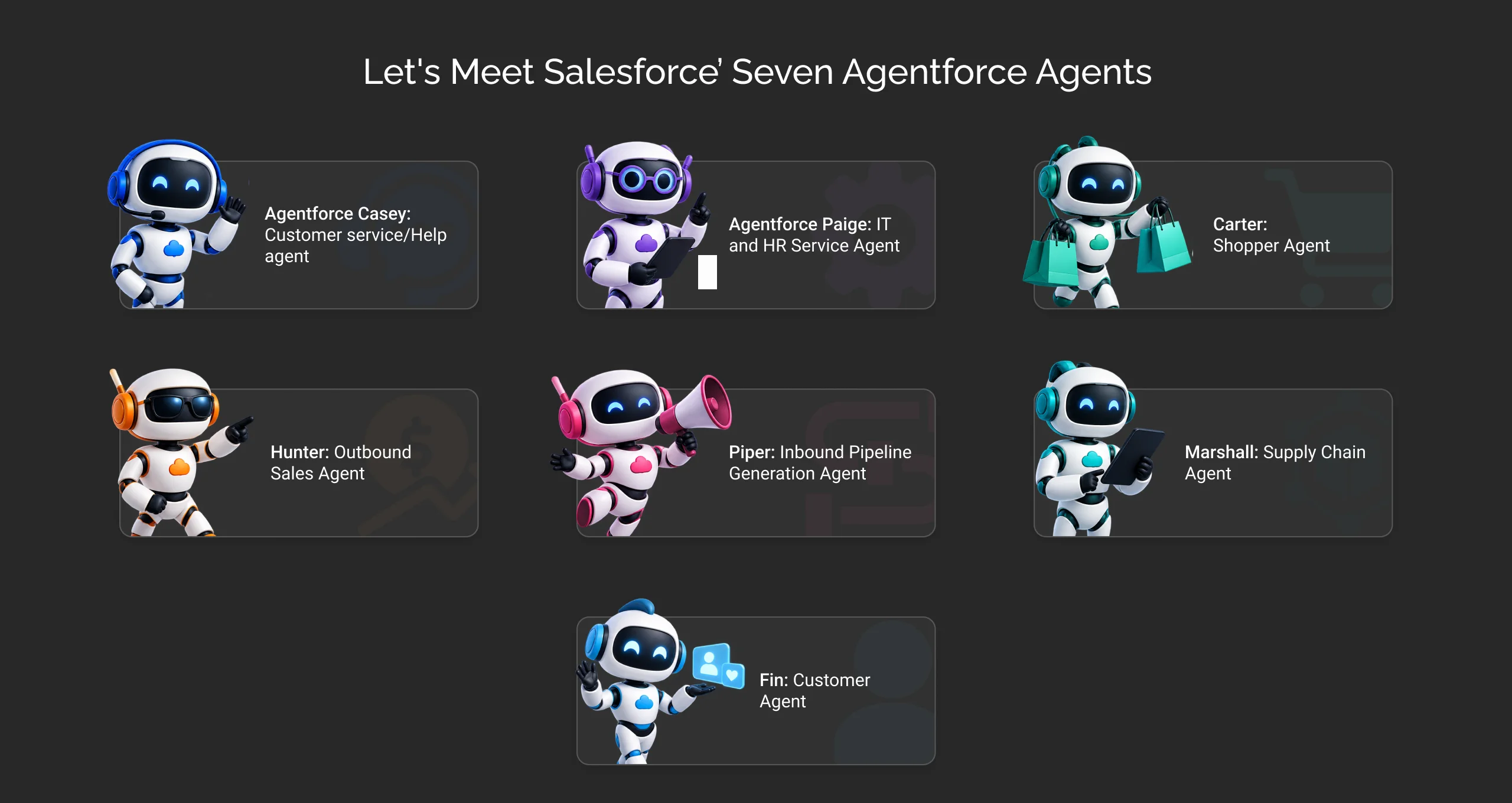
Agentforce Casey: Customer service/help agent
Casey handles customer issues across voice, SMS, WhatsApp, and web chat, with built-in support for FAQs, returns, account management, and escalation to a human when needed. It pulls answers directly from your existing knowledge base. So when it hands off a complex issue, it carries the full context with it, so your team doesn’t have to start from scratch.
Secondly, Casey is proactive in spotting issues from real-time signals and resolves them before a case is even opened (e.g., auto-offering rebooking on a canceled flight).
If you’re a small or mid-sized business without a big support team, this solves a real problem. Customers expect fast, round-the-clock service, even when you don’t have a large team to support it.
Agentforce Paige: IT and HR service agent
Paige handles employee IT and HR requests right inside Slack, your internal portals, and other tools your team already uses, eliminating the need to go through the ticket queue.
Paige typically manages requests such as password resets, benefits inquiries, and onboarding tasks. These requests come in at a high volume that accumulates faster than most IT and HR teams can address them.
Instead of employees submitting a ticket and waiting in a queue, Paige resolves the request proactively, often before it needs to be escalated.
Autism Queensland, a well-known education, therapy and support services company, leverages Paige to handle 70% of its administrative requests.
Agentforce Carter: Shopper agent
Agentforce Carter helps shoppers discover products, compare options, get their questions answered, and check out, all inside the same chat, without sending them off to browse on their own.
If you run an ecommerce or retail business, you already know that the longer it takes to answer a question, the more likely the customer is to leave without buying. Carter also pushes AI in shopping a step further. It’s not just recommending anymore, it’s helping close the sale.
Carter is generally available now, and it handles 90% of Hibbett’s shopper journeys.
Agentforce Hunter: Outbound sales agent
Hunter runs outbound sales, researching accounts, building outreach, and following up on pipeline, all as one continuous motion instead of three separate jobs sales reps manage.
It’s also the first agent Salesforce built on its new long-horizon runtime, which gives it memory, durable execution, and dynamic steering.
Simply put, Hunter keeps working toward a goal over weeks or months, it doesn’t reset the moment a chat window closes.
Hunter is currently in pilot, with general availability planned for November 2026. Salesforce reports that Hunter builds 60% of Perk’s sales pipeline.
Agentforce Piper: Inbound pipeline generation agent
Agentforce Piper is Salesforce’s inbound pipeline agent, built to engage with leads the moment they show up on your website or in your inbox. Piper asks the right questions and qualifies them before they ever reach a rep’s inbox.
If you run high-volume marketing campaigns, a B2B SaaS business, or any company where leads come in faster than reps can keep up, Piper closes that gap. It follows up on leads quickly and keeps them engaged, so nothing goes cold waiting in a queue.
Piper is generally available now. As per Salesforce’s report, Asana saw a 4x increase in conversation volume after deploying Piper. The same report says it takes an average of 45 days to deploy Piper.
Agentforce Marshall: Supply chain agent
Agentforce Marshall is Salesforce’s supply chain agent. It automates back-office and supply chain processes end-to-end, handling manual tasks with predictable execution instead of uncertain reasoning.
Every action comes with a full audit record. If a shipment, order, or compliance step goes wrong, you can see exactly what happened and why. Marshall is generally available now for Salesforce customers.
Agentforce Fin: Customer agent
Fin is Salesforce’s customer agent. It handles the more complex customer service conversations across every channel, going beyond scripted FAQ responses.
Fin came to Salesforce through the Intercom acquisition, the customer support platform it was originally built on. Intercom rebranded itself to Fin first, then Salesforce acquired it. That means Salesforce brought Fin’s agent capabilities directly into its broader customer service platform instead of building something comparable from scratch.
Fin is generally available now. Salesforce reports that 79% of Anthropic’s conversations are resolved by Fin autonomously.
How do Agentforce agents work together?
Most enterprises run several agents, not one, and a customer journey rarely stays inside a single job. It moves across roles. Until now, the handoff between agents was the missing piece.
That’s what Multi-Agent Orchestration solves. It routes work between specialized agents as a journey moves from role to role, passing full context between systems and agents so nothing gets lost.
For instance:
- In sales, that looks like Piper qualifying a lead, handing it to Hunter for outbound follow-up, who hands the deal to a human seller once it’s ready to close.
- In service, a retail customer messages about a delayed order. Casey checks the status; the customer decides to return the item instead; Carter handles the return; and Marshall processes the refund in the background, all without the customer repeating themselves.
How do you customize Agentforce agents?
Every agent in the Agentforce portfolio is meant to be customized around a specific business, not deployed exactly as-is. That customization comes from a company’s data, workflows, and permissions, so an agent only acts within the boundaries a business sets for it.
Two main mechanisms make this possible:
- Agent script: Businesses can combine AI reasoning with rules to keep agent behavior predictable while it works through a task.
- AI skills: Teams can teach an agent how they handle specific tasks, so it follows their processes instead of relying only on generic, out-of-the-box behavior.
In the end, businesses add human approval steps and industry-specific settings on top of both, so they control when an agent can act on its own and when it needs a person to sign off first.
Businesses can also rename each agent to match their own brand. So instead of “Casey” or “Hunter,” employees and customers interact with an agent that carries the company’s own identity.
How do you measure Agentforce ROI?
For an enterprise, the ROI question should begin with the task an agent is performing. Simply put, since a sales agent and a service agent do not create value in the same way, they should not be measured by the same metric.
Businesses can measure Agentforce ROI by looking at metrics such as:
- Revenue generated: Pipeline created, deals influenced, or revenue attributed to the agent.
- Cost saved: Reduction in support, sales, or operational costs through automated work.
- Time saved: Hours of employee time freed from repetitive tasks.
- Productivity: Increase in the number of cases, leads, or other tasks handled by the same team.
- Autonomous completion: Percentage of tasks the agent completes without human intervention.
- Conversion or resolution rate: Whether the agent improves outcomes such as lead conversion or case resolution.
- Speed: Reduction in response, resolution, or process completion time.
So, before deploying an Agentforce agent, set a baseline and decide how you will measure the success of an agent. Track the same metrics at regular intervals after its launch. Salesforce’s results show what Agentforce can achieve, but your ROI should be tied to the specific process, cost, and business outcome the agent is responsible for.
Agentforce and the future of AI agents
For enterprises, deploying an AI agent is only the starting point. Once an agent handles real business processes, teams need to continuously track its performance and improve it as those processes change.
This becomes even more important as Agentforce takes on complex, multi-step work through long-horizon agents and multi-agent orchestration. The focus shifts from simply asking whether an agent works to whether it continues to deliver the expected outcome.
That is where Agent Optimizer fits in. It helps teams test agents, review session traces, identify performance gaps, and refine how agents work.
Salesforce plans to make Agent Optimizer generally available in October 2026. For enterprises, the practical approach is to treat agent deployment as an ongoing cycle: deploy, measure, identify gaps, and improve rather than considering the job finished at launch.


To summarize
Knowing what Agentforce can do is one thing. Knowing where it belongs in your business is another. That is where we come in. Cyntexa’s Agentforce consultants help enterprises turn these opportunities into practical implementations, from use-case discovery and agent configuration to Salesforce integration and success measurement.
Don’t Worry, We Got You Covered!
Get The Expert curated eGuide straight to your inbox and get going with the Salesforce Excellence.
Co-founder and CTO at Cyntexa also known as “VJ”. With 10+ years of experience and 22+ Salesforce certifications, he’s a seasoned expert in Salesforce Data Cloud & AI Products, Product Engineering, AWS, Google Cloud Platform, ServiceNow, and Managed Services. Known for blending strategic thinking with hands-on expertise, VJ is passionate about building scalable solutions that drive innovation, operational efficiency, and enterprise-wide transformation.


Cyntexa.
Join Our Newsletter. Get Your Daily Dose Of Search Know-How