




Salesforce Marketing Cloud Pricing in 2026: Plans, Hidden Costs, and What You’ll Actually Pay
source on Google
Table of Contents
source on Google
Many businesses don’t discover their true Marketing Cloud cost until their first invoice. Salesforce Marketing Cloud doesn’t offer a single price as it’s not a single product. If you budget the pricing based on the license cost alone, you’ll probably end up paying 2x to 3x more by including variables like implementation, SMS credits, contact volume, and add-ons.
Hence, this guide will help you break down every layer of what Salesforce Marketing Cloud actually costs in 2026. It includes published prices, implementation costs, add-ons, and hidden costs for features you may need for your business. By the end, you’ll know whether the total cost of ownership justifies the investment for your business size.
So let’s get started!
How Salesforce Marketing Cloud pricing actually works
Salesforce Marketing Cloud pricing works on a modular, usage-based model. You start with a base edition, and every channel, contact tier, add-on, and support plan you activate adds its own separate charge on top. If you’re an existing customer of Salesforce Marketing Cloud Product, the pricing plan will change completely.
Here’s a complete breakdown of factors through which you can determine how much Salesforce Marketing Cloud costs:
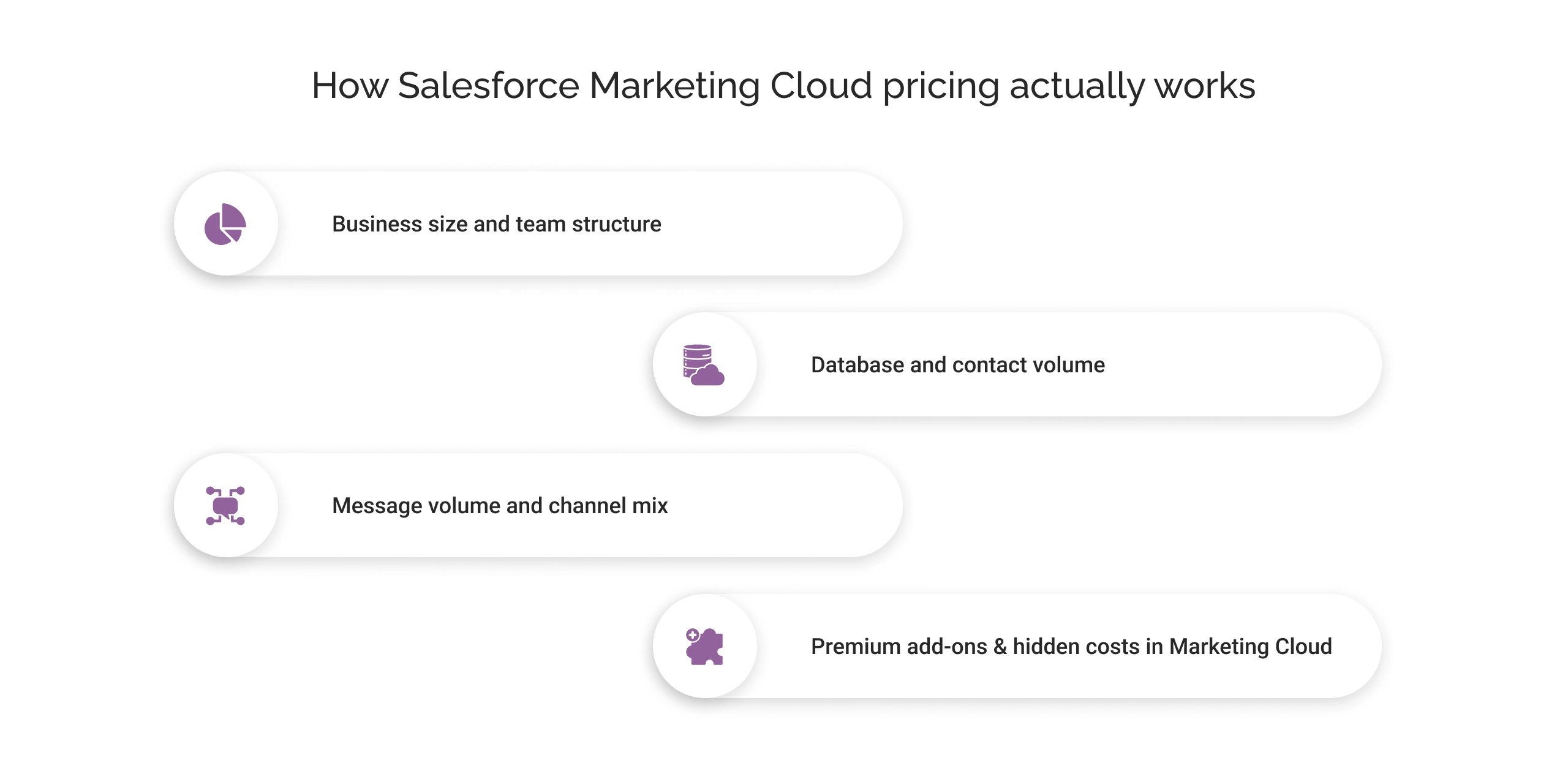
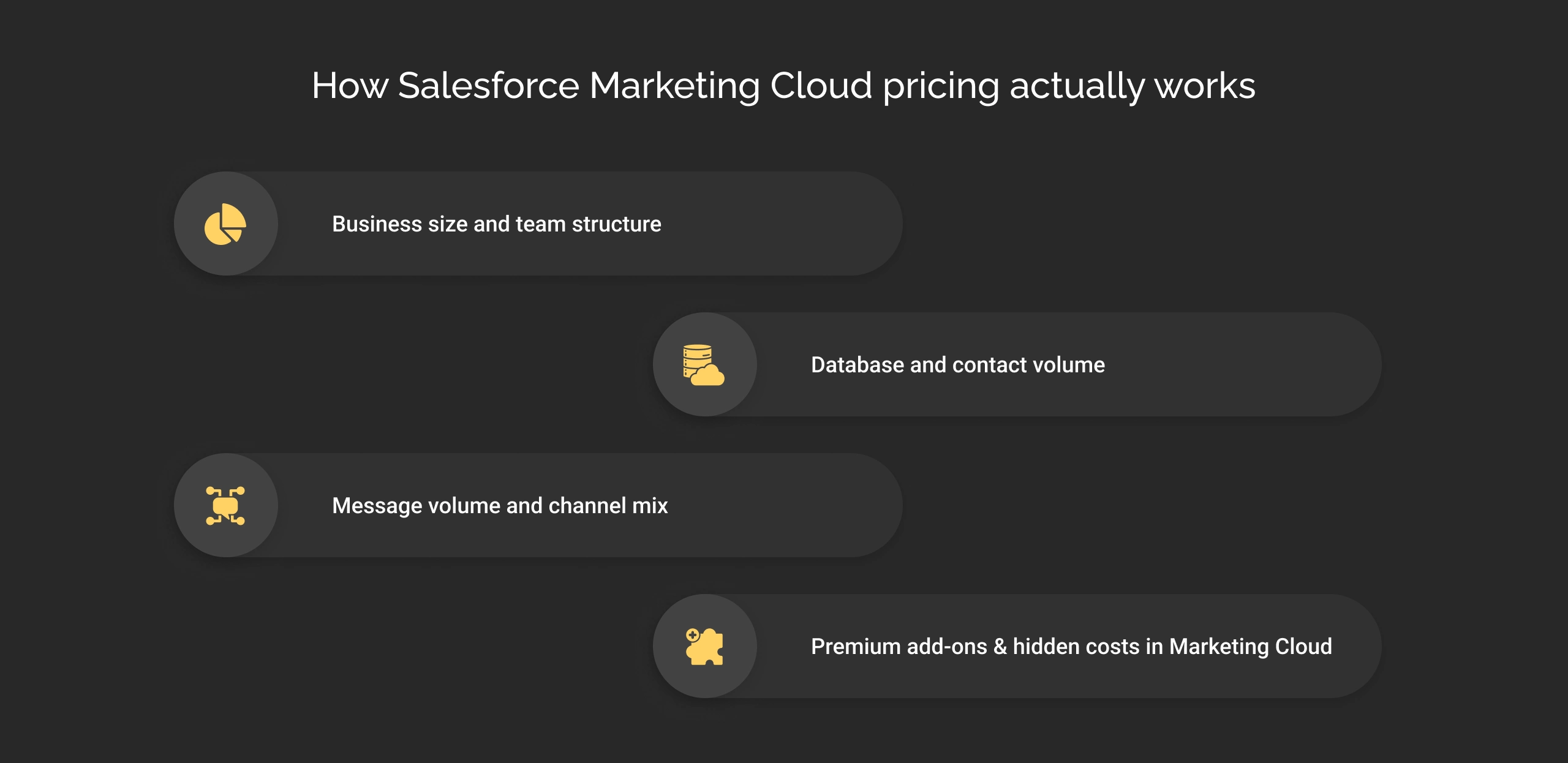
1. Business size and team structure
Smaller teams with simple journeys fit within the Salesforce Marketing Cloud Edition, where pricing depends on org, not per user. However, larger operations needing multiple business units, advanced personalization, or path experimentation require the Advanced Edition. Hence, the right edition will depend on how large and complex your operation is.
2. Database and contact volume
A baseline volume is offered by each Marketing Cloud edition. Once your database grows beyond that limit, you pay for additional contact blocks or Data 360 profiles. The number of contacts or active subscribers an enterprise stores directly affects the cost of the Marketing Cloud edition.
3. Message volume and channel mix
In the base license, Email is included, but SMS, WhatsApp, and extra sends require separate credit pools. Enterprises can determine the credit consumption from the number of messages they send and across channels (email, SMS, WhatsApp), which directly affects the final Marketing Cloud Salesforce pricing.
4. Premium add-ons & hidden costs in Marketing Cloud
Any add-on, bundle, success plan, operational, or implementation cost enterprises add on top of the base license will be billed in your final Marketing Cloud cost. These are priced and billed as separate products, not as a percentage of your license.
Salesforce Marketing Cloud pricing plans
Salesforce offers several packages, including a starter package, Salesforce Pro, Marketing Cloud Growth Edition, and Marketing Cloud Advanced Edition. As we move further up, the packages offer more features and add-ons that give marketing, sales, service, and commerce teams more control over how they reach and convert customers.
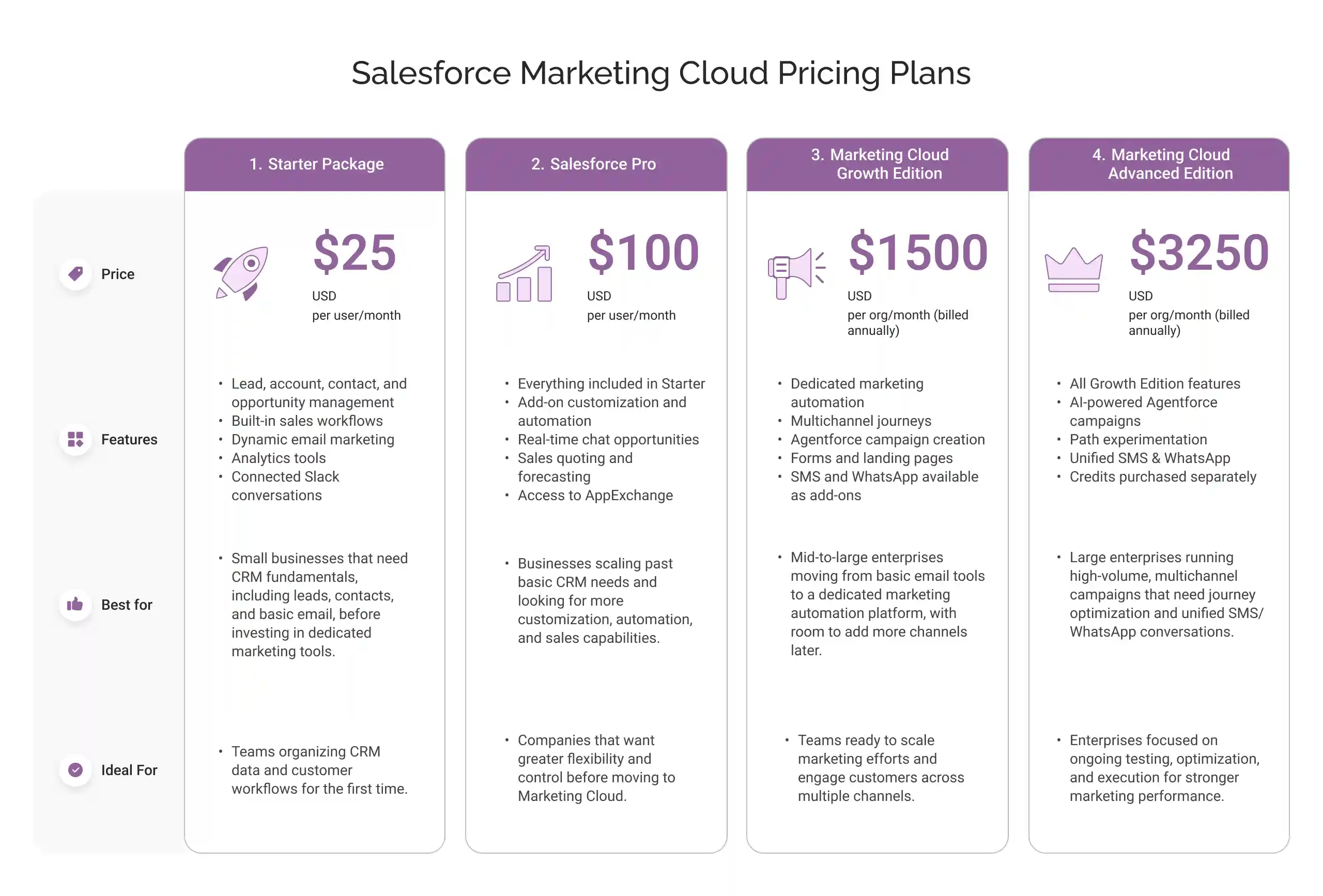
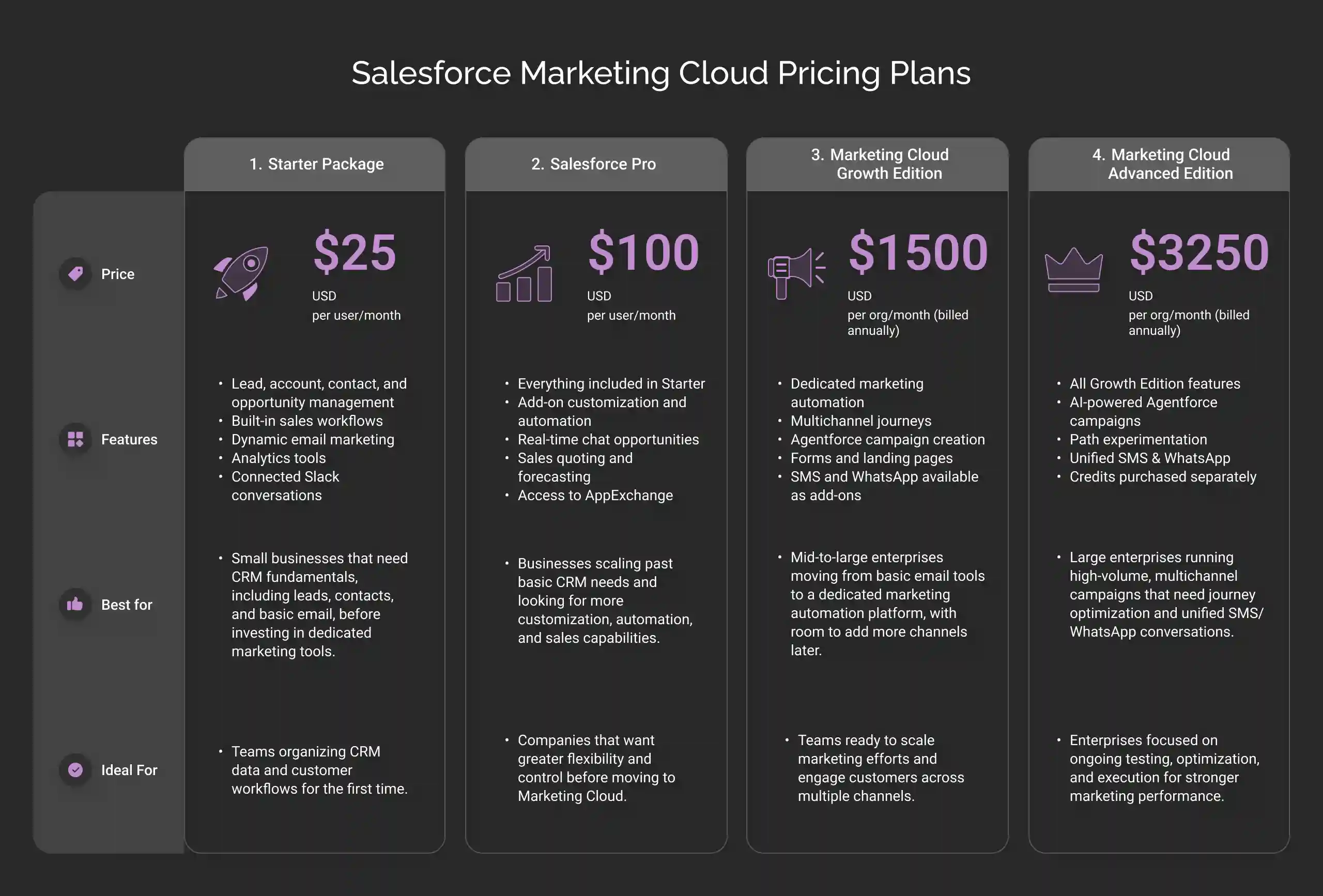
Here’s a complete breakdown of all the base packages offered by Salesforce for Marketing Cloud:
1. Starter package
Salesforce Starter is a lighter CRM suite option at an entry level that starts at $25 USD per user per month.
Features: It offers multiple features to help businesses in lead, account, contact, and opportunity management. Additionally, it includes built-in sales workflows, dynamic email marketing, analytics tools, and support for connected Slack conversations.
Best for: This suite is best for small businesses that need CRM fundamentals, including leads, contacts, and basic email, before investing in dedicated marketing tools. The teams organizing their CRM data and customer workflows for the first time choose the Salesforce Starter package.
2. Salesforce Pro
Salesforce Pro is also an entry-level package, but much more flexible than the Salesforce starter suite. It is priced at $100 USD per user per month. It builds directly on top of everything in the Starter package.
Features: It provides add-on customization and automation possibilities, like real-time chat opportunities, sales quoting, and forecasting, as well as access to AppExchange.
Best for: Businesses scaling past basic CRM needs and looking for more customization, automation, and sales use Salesforce Pro before moving to Marketing Cloud.
3. Marketing Cloud Growth Edition
The Marketing Cloud Growth Edition comes with the agent marketing automation tools that cost $1500 USD per org per month, which can be billed annually.
Features: This suite is where dedicated marketing automation begins. It includes support for multichannel journeys, Agentforce campaign creation, forms, and landing pages. SMS and WhatsApp are available as add-ons, not included in the base price.
Best for: Mid to large-scale enterprises can use Marketing Cloud Growth Edition, where teams rapidly move from basic email tools to a dedicated marketing automation platform, with scope to add channels later.
4. Marketing Cloud Advanced Edition
Marketing Cloud Advanced Edition is the highest-priced base edition overall, which costs $3,250 USD per org per month, to be billed annually.
Features: The Advanced Edition adds capabilities that Growth doesn’t offer. It includes Agentforce campaigns with AI scoring, path experimentation, and unified conversations for SMS and WhatsApp. However, like Growth Edition, SMS and WhatsApp credits are purchased separately.
Best for: Marketing Cloud Advanced Edition is a good fit for large-scale organisations running high-volume, multi-channel campaigns that need journey optimization and unified SMS/WhatsApp conversations. It is highly recommended for enterprises whose marketing performance needs ongoing testing and optimization, along with execution.
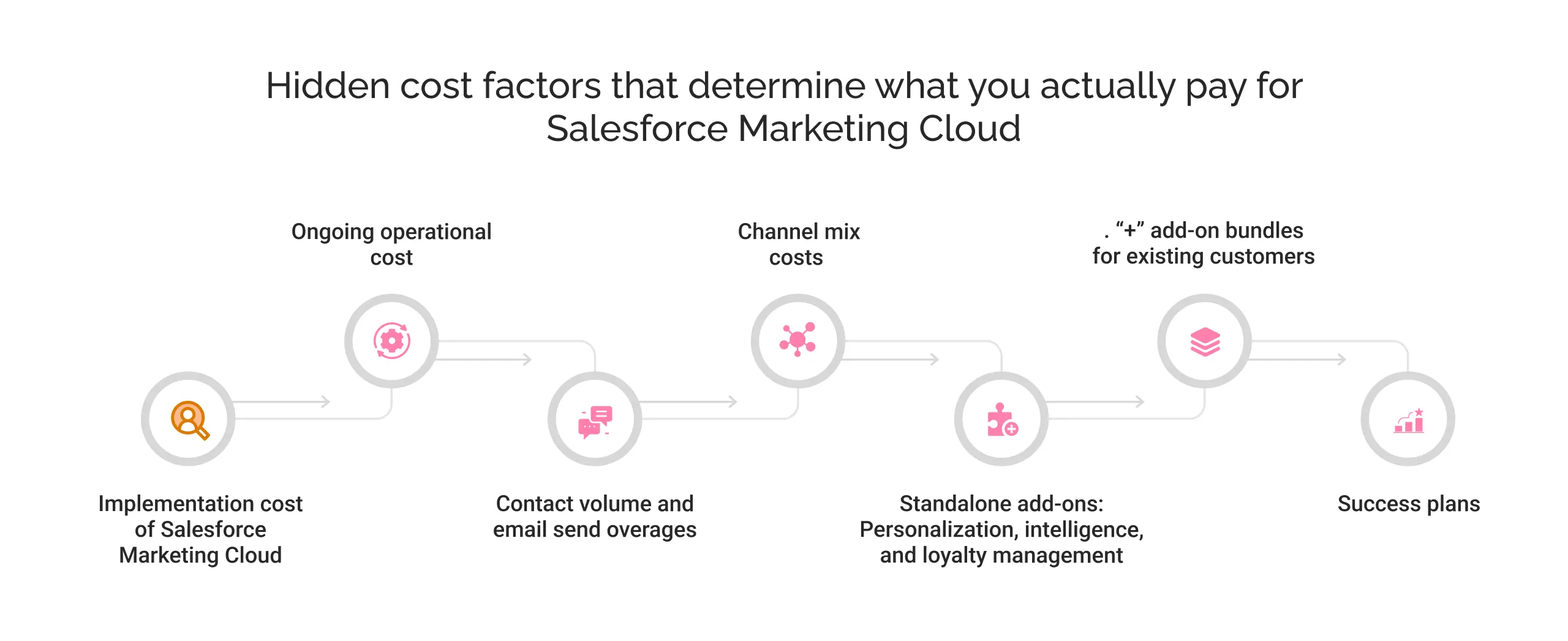
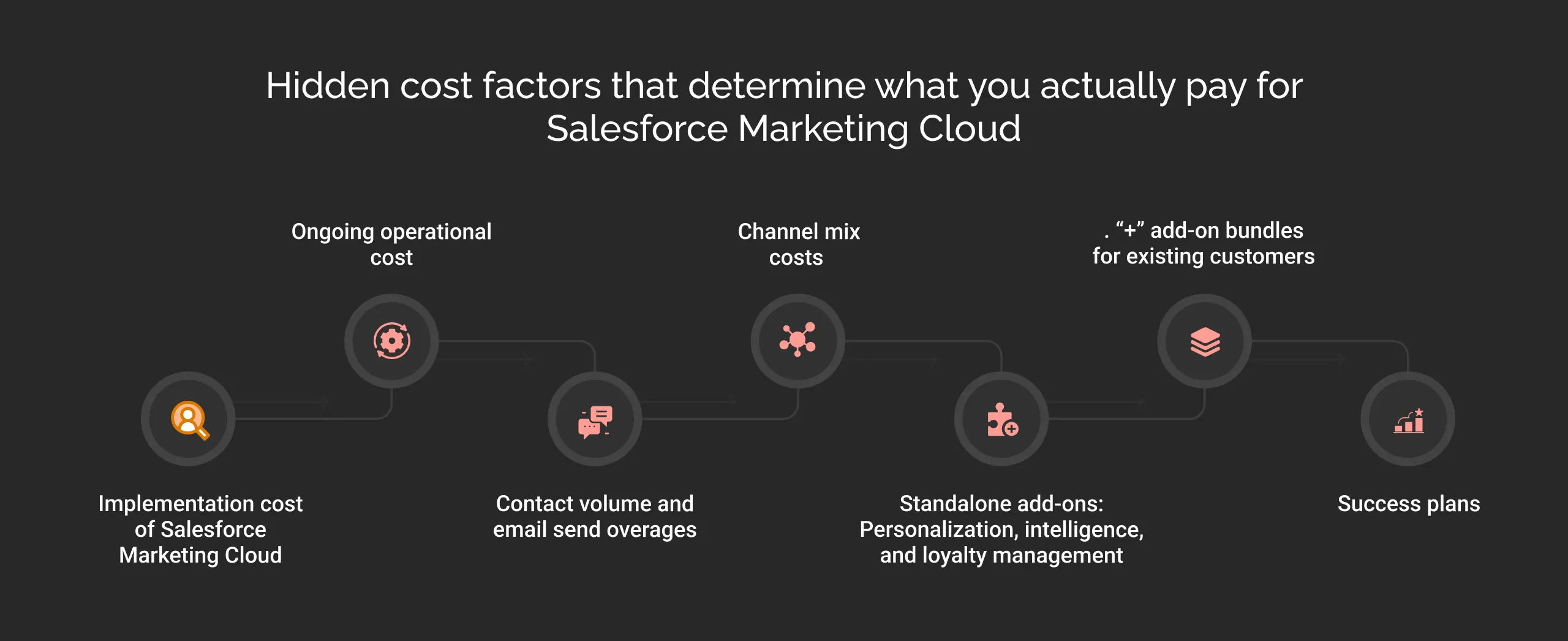
Hidden cost factors that determine what you actually pay for Salesforce Marketing Cloud
The only number you can predict in Salesforce Marketing Cloud pricing 2026 is the license fee. Everything else, including channels, contacts, support, and implementation, scales with how you use the platform. These costs are not visible on the pricing page because they’re not fixed. They depend entirely on how your business uses the platform.
Without seeing each cost individually, it’s easy to underestimate how quickly they add up. Hence, here’s a complete breakdown of all the hidden costs in Salesforce Marketing Cloud, including implementation cost, operational cost, add-ons, “+” bundles in Growth and Advanced Editions, and more.
One-time cost
1. Implementation cost of Salesforce Marketing Cloud
Marketing Cloud configuration requires a trusted implementation partner who can connect your CRM data, set up journeys, build templates, configure tracking, and train your team members.
The implementation cost is the one-time cost that depends widely on the scope of your Marketing Cloud product. The basic Growth Edition setup will require approximately $10,000-$30,000 USD. Although the implementation is a one-time cost, it often exceeds the first year’s license fee for smaller deployments.
If you’re working with more advanced data migrations, custom integrations, and multi-channel journeys, the deployment becomes more complex and hence can reach up to $100,000 or more. Salesforce does not publish implementation rates, meaning this cost remains hidden for businesses.
Recurring costs
2. Ongoing operational cost
Once the product goes live, businesses will need marketing operations resources, whether in-house or outsourced, to run the platform.
The hired team will be responsible for managing journeys, monitoring send limits, maintaining data quality, and handling new campaigns. If the businesses do not have a dedicated marketing operations function, they will need to either hire a Marketing Cloud specialist or retain a managed services partner. Hiring a mid-level Marketing Cloud specialist in the US costs between $60,000 and $100,000+ annually.
3. Contact volume and email send overages
Marketing Cloud doesn’t include unlimited email sends. In each edition, the base send volume is fixed, and additional sends will cost $10 per 1000 credits. (Source)
If your database scales over time or you need more send volume, you will have to buy additional credits. You can top up your credits as required, which means this cost remains variable and will be added to the final cost.
On top of it, the prices for Data 360 Profiles are separate. Businesses using Data 360 Profiles have to pay an additional $240 per 1,000 profiles. In that case, your Marketing Cloud budget will also include this price, and the final cost will depend on how you scope and define those profiles.
Watch out: Active subscribers vs. total contacts
Salesforce bills on active subscribers, not just your sending list. Unsubscribed records, suppression lists, and imported legacy contacts can all count toward your tier. A business that signs for 50,000 contacts but imports a 90,000-record list is already over the limit before sending a single email. Always confirm how Salesforce defines “active subscriber” in your contract before signing.
4. Channel mix costs
In the base license package, emails are included. Everything else will cost extra.
Here’s a complete breakdown of every additional cost to be incurred by the business when adding extra channels (Source):
| Tier | Price |
|---|---|
| SMS credits | Starting at $10 per 1,000 credits |
| WhatsApp credits | Starting at $10 per 1,000 credits |
| Additional email sends | $10 per 1,000 credits |
| Flex Credits (universal credits for Agentforce interactions) | $500 per 100,000 requests |
In the Growth and Advanced Marketing Edition, push notifications are included through mobile app messaging, but SMS and WhatsApp are listed as add-ons for which you have to pay for credits.
5. Standalone add-ons: Personalization, intelligence, and loyalty management
Standalone add-ons are full products, which are priced independently of your base edition.
a. Salesforce Personalization
Salesforce Personalization helps businesses in handling real-time, cross-channel personalization using AI recommendations. You can choose the right personalization solution from these tiered pricing models (Source):
| Tier | Price |
|---|---|
| Growth | $96,000 USD/org/year ($8,000/month) |
| Premium | $300,000 USD/org/year ($25,000/month) |
| Salesforce Personalization (full) | Request a quote |
The growth tier provides capabilities like experimentation, web and email personalization, and product and content recommendations. The Premium model includes the features of the Growth tier and also provides mobile app personalization.
For full accessibility and more advanced features, you can request a quote from the sales team or connect with Salesforce consulting partners.
b. Marketing intelligence
Marketing Intelligence pricing includes the base model and Marketing Cloud Intelligence+, which covers paid media analytics, attribution, and campaign performance reporting. Here’s a complete breakdown of Marketing Intelligence pricing tiers (Source):
| Tier | Price |
|---|---|
| Base Model (Marketing Intelligence) | $10,000 USD/org/month |
| Marketing Cloud Intelligence+ | $300,000 USD/org/year ($25,000/month) |
The Marketing Intelligence base model includes features such as Agentforce paid media optimization, AI campaign summaries, automated data management, and segment intelligence. The primary difference between the two is in data scope. In Marketing Intelligence, paid and owned media are included in its pre-built marketing data model, while Intelligence+ builds on the base model to include earned media as well.
However, you must know that Data 360 is required to run Marketing Intelligence, but businesses can access it at no cost through Salesforce Foundations. Additional Data 360 credits may cost extra depending on usage (you can check Data 360 pricing here).
c. Loyalty Management
The Loyalty Management add-on is for businesses running formal loyalty programmes.
Here’s a complete breakdown of Loyalty Management pricing tiers (Source):
| Tier | Price |
|---|---|
| Starter | $20,000 USD/org/month |
| Growth | $35,000 USD/org/month |
| Advanced | $45,000 USD/org/month |
The starter tier of Loyalty Management add-on costs more than 13 months of Marketing Cloud Growth Edition. It marks a significant investment for any business, which is why it is most suitable for enterprises having an established loyalty strategy.
6. “+” add-on bundles for existing customers
The enterprises running a legacy Marketing Cloud product can upgrade to Growth or Advanced using “+” editions. This is so they don’t have to fully migrate from their old products and leverage the features of Growth and Advanced Editions.
a. Account Engagement+
Account Engagement+ is for enterprises using Marketing Cloud Account Engagement (formerly known as Salesforce Pardot), whose pricing tiers are divided as follows (Source):
| Tier | Price |
|---|---|
| Growth+ | $1,250 USD/org/month |
| Plus+ | $2,750 USD/org/month |
| Advanced+ | $4,400 USD/org/month |
| Premium+ | $15,000 USD/org/month |
Here’s what you can expect from each of these Account Engagement+ Editions:
- In the Growth+ Edition, enterprises get Marketing Cloud Next Growth Edition, Agentforce campaign creation, lead nurturing, and scoring.
- In the Plus+ Edition, enterprises get Marketing Cloud Next Advanced Edition, AI-powered scoring, and B2B marketing analytics.
- In the Advanced+ Edition, enterprises can access Marketing Cloud Next Advanced Edition, business units, and a dedicated IP address.
- In the Premium+ Edition, enterprises get Marketing Cloud Next Advanced Edition, inclusive of all capabilities of the Premier Success Plan.
You must also note that SMS and WhatsApp are listed as add-ons across all four Account Engagement+ tiers, including Premium+. So, enterprises will need to make a separate purchase for mobile messaging credits, even at $15,000/month, which gets added to the final Salesforce Marketing Cloud cost.
b. Engagement+
Engagement+ is for existing Marketing Cloud Engagement customers, which was previously known as ExactTarget.
Here’s a full breakdown of the Engagement+ bundle pricing (Source):
| Tier | Price |
|---|---|
| Pro+ | $2,000 USD/org/month |
| Corporate+ | $5,500 USD/org/month |
| Enterprise+ | $30,000 USD/org/month |
The primary difference in the pricing of Pro+, Corporate+, and Enterprise+ is because of the key email and contacts volume. For instance, the Pro+ Edition has an email volume of 2.5M messages and 15K contacts. In Corporate+ Edition, there are 10M messages and 45K contacts. Finally, the Enterprise+ Edition provides 150M messages and 500K contacts.
Engagement+ is available to both new and existing customers, which makes it different from Account Engagement+. Hence, enterprises can choose this if they need the scale of Engagement+ to get more email and contact volume.
7. Success plans
A success plan is Salesforce’s support and guidance package. The Marketing Cloud license includes the Standard Success Plan at no extra cost. With this, enterprises get access to documentation, Trailhead, and the Trailblazer community. For any additional support and guidance, enterprises would need a Premier or Signature success plan.
Here’s a complete breakdown of success plans (Souce):
| Tier | Price |
|---|---|
| Standard Success Plan | Included in all licenses |
| Premier Success Plan+ | Costs 30% of your net license fees annually |
| Signature Success Plan | Negotiate with your account executive |
Businesses using the standard success plan can seek help from Salesforce’s published resources. To get more guidance and support, enterprises would need to upgrade their success plan.
For instance, Salesforce claims customers on the Premier Success Plan see up to 115% ROI (per Salesforce’s own research) where they get 24/7 support for business-critical issues, expert guidance sessions, proactive recommendations, health checks, and more.
In the signature success plan, enterprises will get a designated customer success manager and the fastest 24/7 support response times.
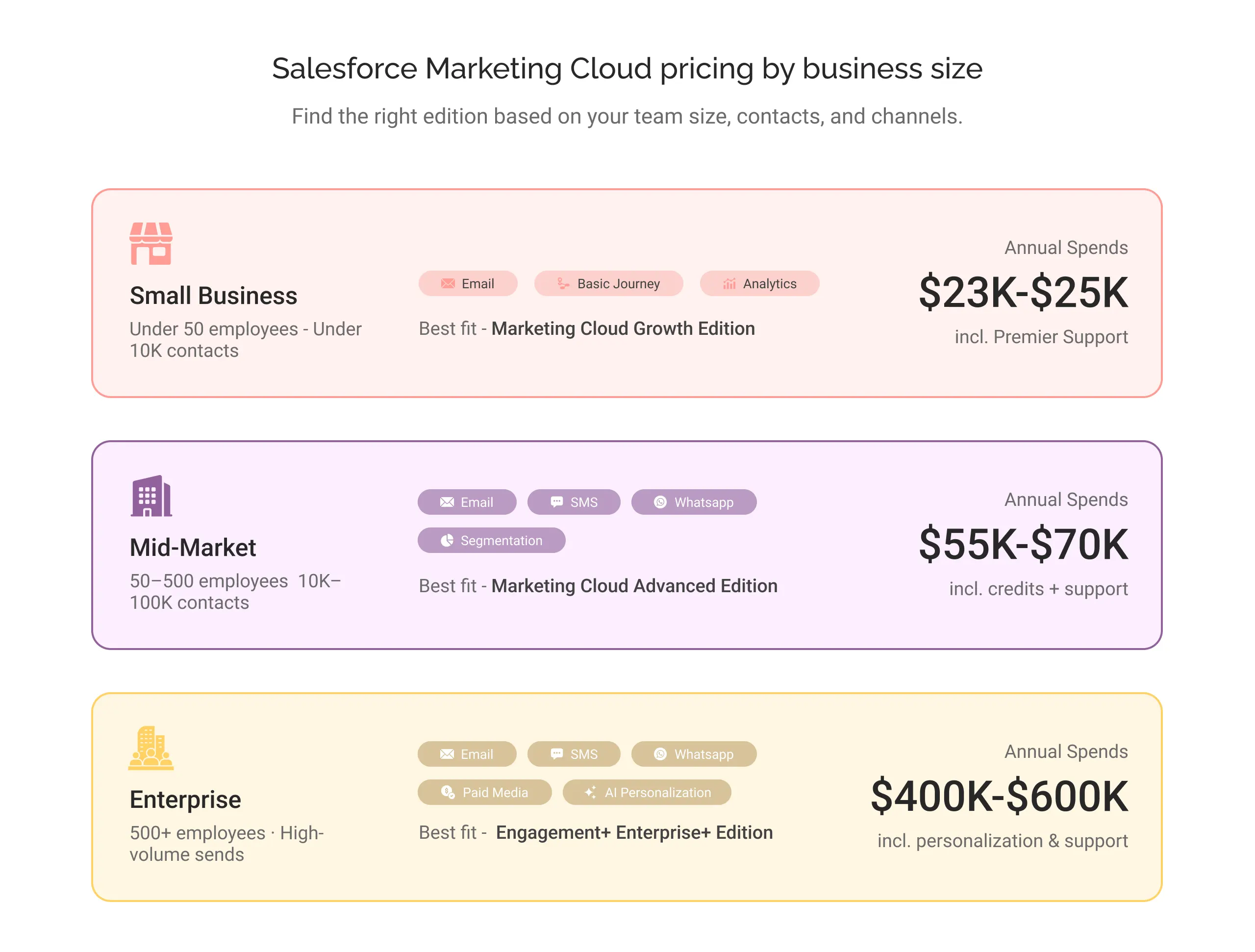
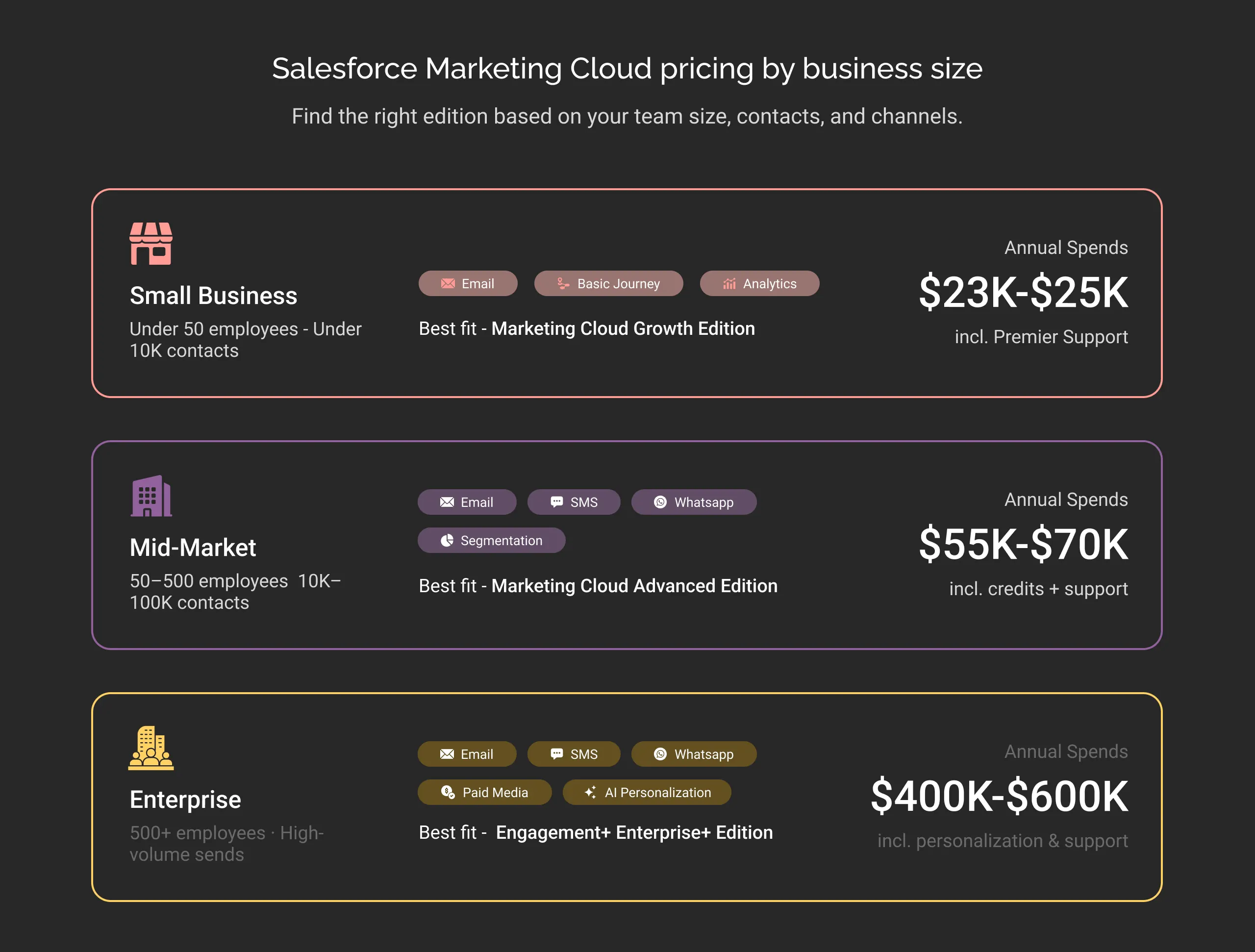
Salesforce Marketing Cloud pricing by business size
Next, let’s identify which cost factors apply to your business. It depends on how large your database is, how many channels you run, and how much sending volume your campaigns need.
Small businesses (under 50 employees, under 10K contacts)
A small 30-person DTC brand working with 6000-8000 contacts sends weekly promotional emails. This use case can be covered by the Marketing Cloud Next Growth Edition.
This DTC brand can add a Premier Support success plan at 30% of net license fees. Hence, the total Salesforce Marketing Cloud Growth Edition cost will fall between $23,000 and $25,000 without adding any SMS credits or overages.
If they already have Account Engagement, they can compare the cost of the Growth+ tier at $1,250/month with the standalone Growth Edition.
Mid-market (50–500 employees, 10K-100K contacts)
A mid-level enterprise that manages between 50,000 and 100,000 contacts opts for the Advanced Edition. Suppose a retail brand with 150 employees is running email, SMS, and WhatsApp campaigns across three customer segments.
With the Advanced Edition, this retail brand can buy additional SMS and WhatsApp credits and a Premier success plan, which will add 30% on top, making the annual spend between $55,000-$70,000. However, the total pricing for Salesforce Marketing Cloud Advanced Edition will also depend on the total send volume and overall credit usage.
If the mid-market teams are already working with legacy Engagement, they can also evaluate the Engagement+ Corporate+ Edition, priced at $5,500/month. It will bundle 10M email messages and 45K contacts into the base price.
Enterprise (500+ employees, high-volume sends)
A large-scale enterprise running campaigns across email, SMS, WhatsApp, and paid media with multiple business units evaluates the full cost stack. It includes the cost of the base license, business units at $2,500/month each, Salesforce personalization at $8,000/month, marketing intelligence at $10,000/user/month, premier or signature support, as well as implementation costs.
If the enterprise is already on Marketing Cloud Engagement, they opt for a more cost-efficient structure provided by the Engagement+ Enterprise+ Edition at $30,000/month. It includes 150M email messages, 500K contacts, and the Marketing Cloud Advanced Edition.
Hence, the total Marketing Cloud annual spend at this scale can cost between $400,000 and to $600,000 or more once personalization, intelligence, and signature support are added to the pricing.
Is Salesforce Marketing Cloud worth it?
Salesforce Marketing Cloud justifies its cost when an enterprise has outgrown its existing marketing tools and platforms. If your team is managing over 50,000 contacts, running campaigns across various channels, and requires marketing and CRM data to work together, Salesforce Marketing Cloud delivers that at a scale that basic tools cannot.
For businesses where hiring marketing specialists is expensive or slow, Salesforce Agentforce reduces how much of that work depends on headcount. A smaller team can run campaigns that would otherwise need dedicated specialists for copywriting, segmentation, and scheduling. Marketing Cloud has AI agents that are capable of building campaigns, writing email copies, creating audience segments, and suggesting send times, all from a natural language prompt.
With Salesforce Marketing Cloud, enterprises also get compliance controls, consolidated reporting, and data handling built right into the platform. However, don’t invest in Marketing Cloud if your needs are limited to simple email campaigns and a small contact list. But if you’re running multi-channel campaigns, managing complicated customer journeys, and are scaling fast, this is where the Salesforce Marketing Cloud cost is more justifiable for your business.


Bottom line
The pricing of Salesforce Marketing Cloud is complex, but it’s navigable once you know what each layer actually costs. For small to large-scale enterprises, getting the edition right matters. Getting the implementation right matters even more.
A misconfigured Marketing Cloud setup can cost enterprises more to fix than it did to build. This is why you need the right Salesforce partner who can work with you at every stage of your Salesforce journey. Our Salesforce experts will cut through that complexity to help you build a realistic Marketing Cloud budget before signing anything.
Get a consultation with our Marketing Cloud specialists now!
Don’t Worry, We Got You Covered!
Get The Expert curated eGuide straight to your inbox and get going with the Salesforce Excellence.
Co-founder and CTO at Cyntexa also known as “VJ”. With 10+ years of experience and 22+ Salesforce certifications, he’s a seasoned expert in Salesforce Data Cloud & AI Products, Product Engineering, AWS, Google Cloud Platform, ServiceNow, and Managed Services. Known for blending strategic thinking with hands-on expertise, VJ is passionate about building scalable solutions that drive innovation, operational efficiency, and enterprise-wide transformation.


Cyntexa.
Join Our Newsletter. Get Your Daily Dose Of Search Know-How
Frequently Asked Questions
The Salesforce Starter suite is for small to mid-scale businesses, priced at $25 USD/User/Month.
In the Salesforce Marketing Cloud Growth Edition, enterprises get the tools to run campaigns, while the Advanced Edition gives them the intelligence to optimise them, at $1,750/month more per org.
Enterprises use Salesforce Marketing Cloud Account Engagement for B2B lead nurturing and pipeline alignment, while Marketing Cloud Engagement is used for high-volume, multi-channel B2C campaigns. Put simply, if you're marketing to businesses and filling a sales pipeline, choose Account Engagement (formerly Pardot). But if you're marketing to consumers at scale, go with Marketing Cloud Engagement.
No, Data Cloud isn't required for the base license. However, to access Marketing Cloud Next features, you will need to use Salesforce Foundations, which provides access to Data 360 at no cost.