




ServiceNow Autonomous Workforce Explained: Features, Benefits, How it Works & More
source on Google
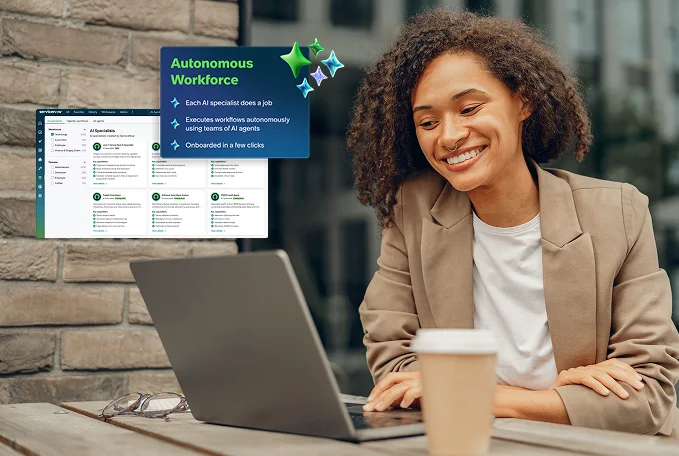
Table of Contents
source on Google
Blog Summary
- ServiceNow Autonomous Workforce is a suite of purpose-built AI specialists that execute complete business processes from intake to resolution without waiting for a human to finish the work.
- Unlike standard AI tools that advise and assist, Autonomous Workforce specialists triage, decide, act across systems, escalate when needed, and only stop when the work is completed.
- Announced at Knowledge 2026, it spans four enterprise domains: IT, CRM, Employee Experience, and Security & Risk. It is already resolving IT cases 99% faster and handling 90% of employee requests autonomously.
- It is built on ServiceNow's workflow and governance foundation, with the AI Control Tower ensuring every action is role-scoped, auditable, and compliant.
Most enterprise AI currently only surfaces suggestions, draft responses, and flags anomalies. But human agents still make the calls, click the buttons, and close the tickets.
At the Knowledge 2026 conference, ServiceNow took a different approach. The company announced a major expansion of its Autonomous Workforce of AI specialists.
These AI specialists don’t just recommend actions; they complete entire business processes. From intake to resolution, Autonomous Workforce completes end-to-end work without waiting for a human to handle the final steps.
Within ServiceNow’s own help desk, IT cases are getting resolved 99% faster than with human agents.
This blog covers what ServiceNow Autonomous Workforce is, how it works, and how your business can benefit from it.
What is ServiceNow Autonomous Workforce?
ServiceNow Autonomous Workforce is a suite of purpose-built and role-specific AI specialists that can execute end-to-end business processes independently.
Simply put, the Autonomous Workforce is like your digital colleagues with a defined job title, a clear set of responsibilities, and the platform authority to actually get things done.
While a standard AI agent performs a single task, like summarizing this ticket, an Autonomous Workforce executes the entire process. It triages the request, decides the right action, acts across systems, escalates to a human when needed, logs everything, and only stops when the issue is fully resolved, not when a task is complete.
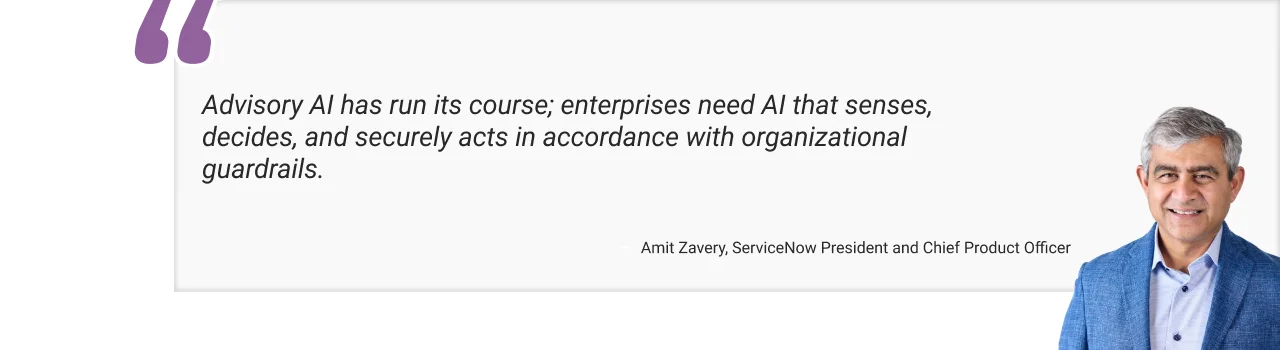
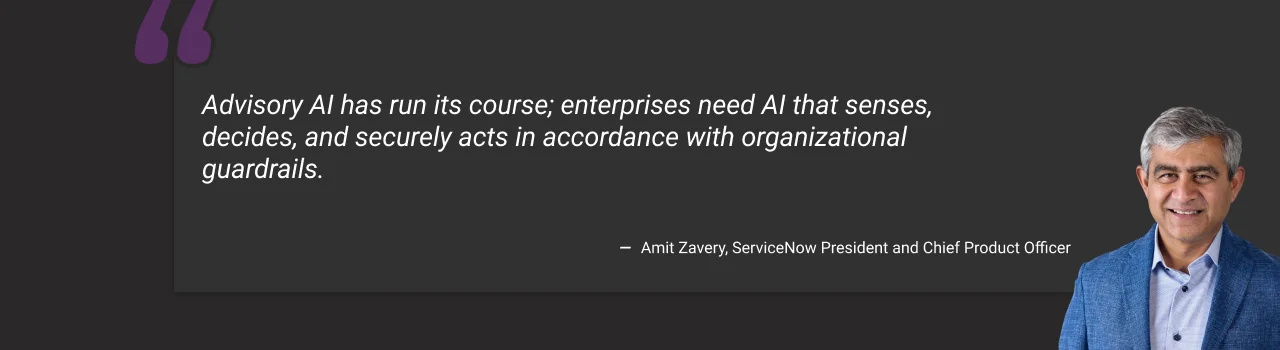
As ServiceNow President and Chief Product Officer, Amit Zavery, put it at Knowledge 2026: “Advisory AI has run its course; enterprises need AI that senses, decides, and securely acts in accordance with organizational guardrails.”
How Does the ServiceNow Autonomous Workforce Work?
Understanding the Autonomous Workforce process helps you understand how it differs from standalone AI tools.
The Foundation: Probabilistic Intelligence Meets Deterministic Workflow
Most AI models are probabilistic; they reason, predict, and generate, but they can produce different answers to the same questions. Also, they cannot be held accountable for outcomes. However, enterprise operations require deterministic results, which means the right action with a clear audit trail.
ServiceNow combines both approaches. AI specialists use intelligence to understand what needs to happen, then execute that decision through ServiceNow’s workflow and governance layer. Every action is traceable because governance policies are embedded in the workflow itself.
How a Request Moves Through the System
Here’s what happens when an employee needs software access, one of the most common IT requests in any organization.
1. The employee asks Otto: ServiceNow’s unified conversational AI using plain language, like I need access to Salesforce.
2. Otto routes the request to the Level 1 IT Service Desk AI Specialist, the right specialist for this type of work.
3. The AI specialist checks context: Using Configuration Management Database (CMDB) and the Workflow Data Fabric, the Autonomous Workforce understands who the employee is, what they’re entitled to, what approvals are required, and whether similar requests have been made before.
4. The specialist provisions the access: Acting directly across systems with role-scoped permissions, completing what would have been a multi-step manual process.
5. The action is logged and audited: Every step is recorded and governed by the AI Control Tower, with a full audit trail available immediately.
How AI Specialists Access Enterprise Context
AI specialists use two core data sources that ServiceNow has built over decades of enterprise operations:
- The Configuration Management Database (CMDB): A comprehensive record of every technology asset, relationship, and dependency across the enterprise.
- The Workflow Data Fabric: It is a unified data layer that connects more than 200 enterprise systems, including SAP, Salesforce, AWS, and Microsoft, so AI specialists can understand what’s connected, what’s dependent on what, and what has happened before.
This context enables an AI specialist to make the right decision.
The AI Control Tower: Governance Built In
The AI Control Tower is ServiceNow’s central governance engine, built around five dimensions: discover, govern, secure, observe, and measure. It continuously identifies AI agents operating across the enterprise, risk-scores them, enforces least-privilege access (meaning each AI specialist only has permission to do what its role requires), maintains full audit trails, and tracks business impact against compliance standards.
AI Control Tower capabilities are now included across every ServiceNow product package by default, not sold separately.
ServiceNow has also extended this governance to cover third-party AI agents operating in Microsoft environments, including Outlook, Word, and PowerPoint. It gives IT and compliance leaders a unified view of the entire AI estate, regardless of where agents were built.
Otto: The Front Door to the Autonomous Workforce
Announced at Knowledge 2026, ServiceNow Otto is the unified conversational AI experience that gives every employee access to the Autonomous Workforce. Otto brings together the intelligence of Now Assist, Moveworks, and AI Experience into a single interface. You ask Otto, and the right AI specialist picks up the work.
What Are the Key Features of the ServiceNow Autonomous Workforce?
Here’s how Autonomous Workforce ServiceNow is valuable for businesses:
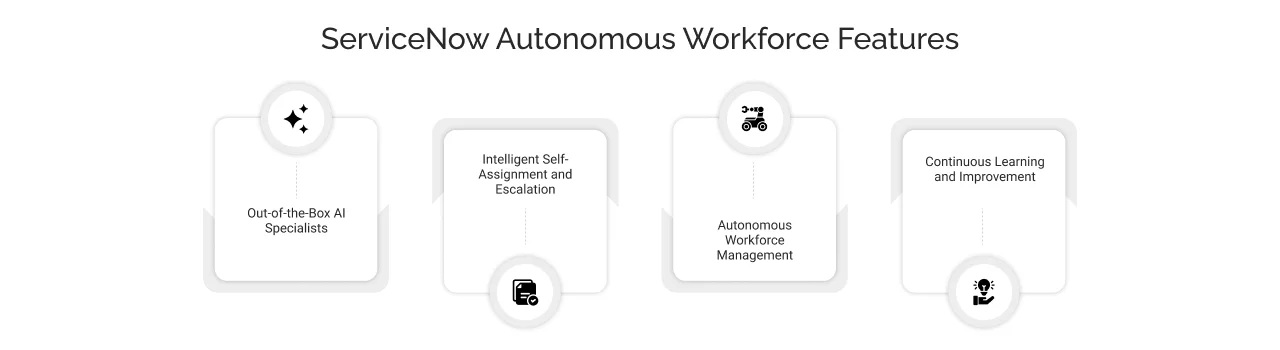
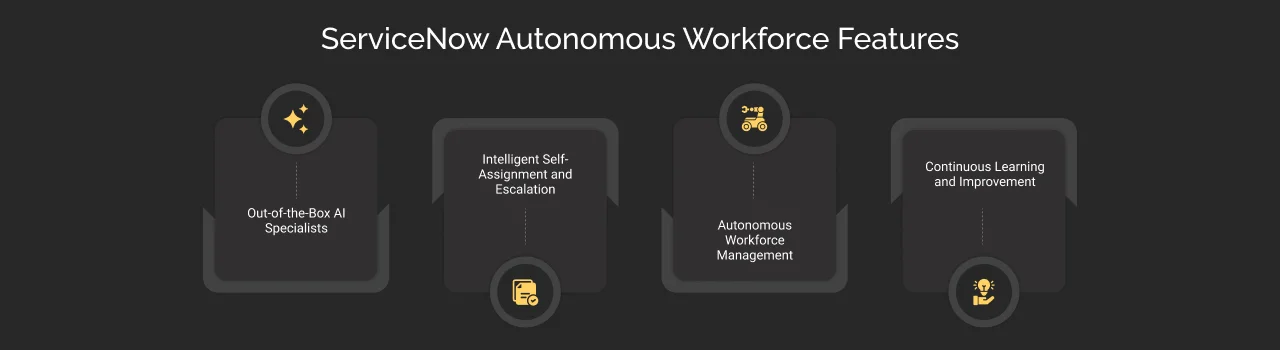
Out-of-the-Box AI Specialists
AI specialists are pre-built and ready to use for major business functions, with no major configuration required. Each specialist inherits the right assignment groups, permissions, and skills for their domain automatically. They can operate 24/7 against enterprise knowledge bases and historical incident data from day one.
Intelligent Self-Assignment and Escalation
AI specialists automatically assign the work to themselves based on a defined skillset and authorization. When a case exceeds the AI specialist authority or complexity threshold, it seamlessly escalates to a human with a full compiled context.
Autonomous Workforce Management
ServiceNow provides a real-time dashboard so enterprises can monitor AI specialists’ performance in real-time and provide feedback to agents. This visibility gives organizations the confidence to expand autonomous work over time and continuously improve how specialists perform.
Continuous Learning and Improvement
AI specialists learn from feedback and outcomes with every interaction. The longer they are deployed, the more accurate and effective they become. This is not static automation; it is a workforce that compounds in value the longer it runs.
Benefits of ServiceNow Autonomous Workforce for Enterprises
Scale Operations without Scaling Headcounts
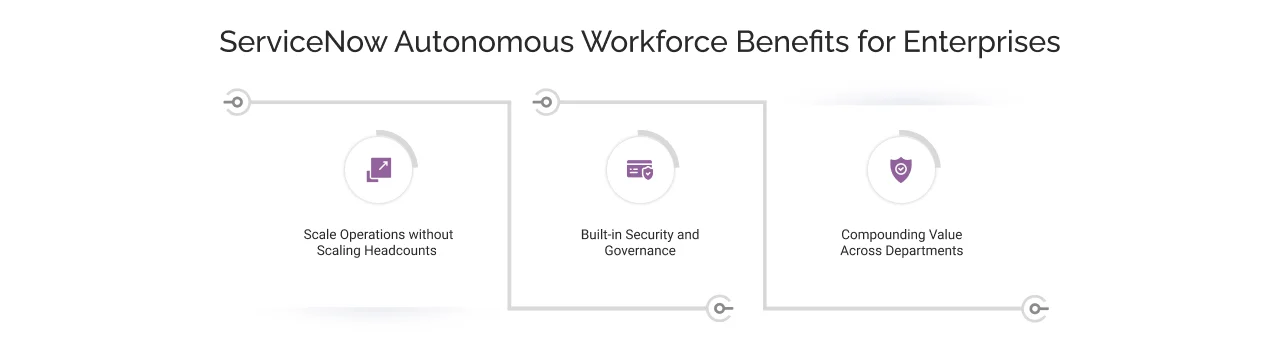
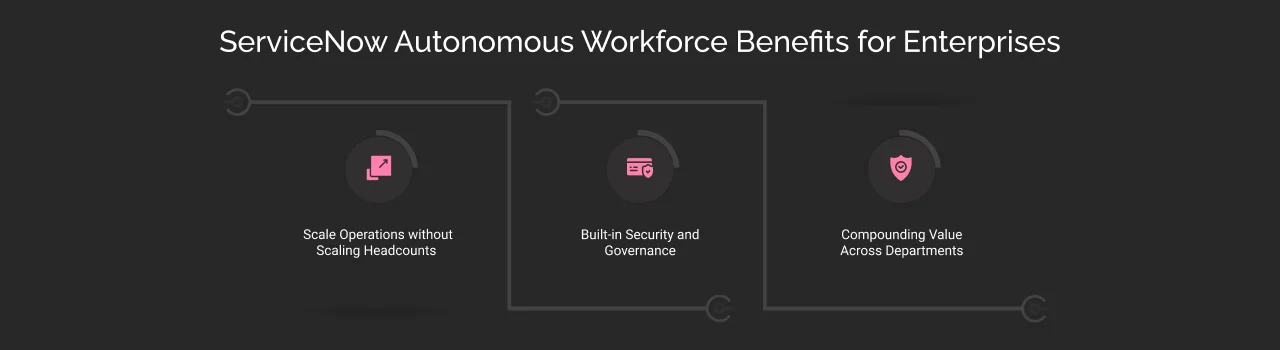
High volumes and repetitive processes consume most of the time of the service team. It is where AI specialists deliver immediate, measurable impact. ServiceNow’s own internal IT team now handles 90% of employee IT requests autonomously.
Built-in Security and Governance
ServiceNow Autonomous Workforce operates within governance as it is embedded within the platform. Role-scoped permissions representing AI specialists only have access to what they need for their job. In full audit trails, every action is traceable and auditable. The AI control tower enforces these standards continuously and provides real-time visibility into AI specialists’ behavior across both ServiceNow’s native and third-party agents.
Compounding Value Across Departments
Autonomous Workforce AI specialists run on the same platform; they share the same data, governance layer, and conversational front door. These AI specialists learn from feedback and interactions continuously, which means the longer they are deployed, the more value they add.
Industry-Specific AI Specialists
The Autonomous Workforce currently spans four major enterprise domains:
IT
IT teams spend too much time on problems that repeat themselves, such as the same password resets, access requests, and infrastructure alerts. Autonomous IT specialists handle the full cycle: diagnosing and resolving common service desk requests, correlating infrastructure anomalies, and connecting resource demand in real time. Within ServiceNow’s own help desk, IT cases are already being resolved 99% faster than with human agents.
CRM
Sales and service teams often function as manual bridges between disconnected systems, such as quoting in one tool, fulfilling in another, and resolving disputes in another one. Autonomous CRM specialists close that gap, handling the full customer lifecycle from qualifying leads to generating quotes and managing orders, all end-to-end.
Employee Experience
HR, finance, legal, and procurement teams face a volume problem that headcount alone can not solve. Autonomous Employee Experience specialists handle the workload of onboarding requests, policy questions, procurement approvals, and workplace service tickets.
Security & Risk
Security teams manually correlate threats across fragmented tools. The new Autonomous Security & Risk product, with ServiceNow’s acquisitions of Armis and Veza, gives security teams a unified graph of every identity, every permission, and every connected asset across the enterprise. AI specialists detect threats, contain incidents, and document responses autonomously.
Note: General Availability: The Level 1 IT Service Desk AI Specialist and CRM and Employee Experience specialists are available now. IT AI specialists are expected to be available in June 2026. Security and Risk specialists are expected in preview in June, with general availability in September 2026.
Autonomous Workforce vs Enterprise AI Tools
The enterprise AI market has different AI tools. Microsoft, Salesforce, Workday, and SAP all have AI agent strategies. So what makes ServiceNow’s approach distinct?
The core difference is the foundation each approach is built on.
| Comparison Factor | Traditional Enterprise AI Tools | ServiceNow Autonomous Workforce |
| What It Does? | Assist human employees with individual tasks. | Executes complete jobs from start to finish. |
| Execution | Require manual execution to complete end-to-end processes. | AI inherits the authority and accountability structure of ServiceNow’s proven workflow. |
| Architecture | Built on top of existing systems, adding AI capability without changing the underlying architecture. | Operates with enterprise-grade permissions, audit trails, and compliance built into every action. |
| Governance | Breaks down at the governance and permissions layer, because those were not designed for autonomous AI | Governed by AI Control Tower, managing both ServiceNow-native and third-party agents in one view |
| Data | Create integration complexity: more AI tools often mean more data silos | Single platform with a unified data model, intelligence compounds across functions, not silos |
ServiceNow positioned Autonomous Workforce, not as a new AI feature, but as a new operating model. The question for business leaders is not “should we use AI to assist our workflows?” It’s “Are we ready to let AI own the workflow, with governance built in?”
That’s a meaningful shift in how organizations think about AI investment, workforce planning, and operational design.
Real-World Results of Autonomous Workforce (Early Deployments)
The numbers from early adopters highlight what’s possible at scale with Autonomous Workforce:
- ServiceNow internally: 90% of employee IT requests handled autonomously; IT cases resolved 99% faster than with human agents.
- City of Raleigh: 98% deflection rate on employee IT requests via AI-powered virtual agent; saving the equivalent of a full month of staff time.
- DocuSign: Targeting autonomous resolution of 90% of all IT tickets.
What Does This Mean for Business Leaders?
- On workforce planning: If AI specialists can handle 90% of routine service requests, it means you can strategically relocate your staff. ServiceNow AI specialists freeing your human staff for work that requires judgment, relationships, and expertise.
- On technology architecture: ServiceNow Autonomous Workforce enables you with an approach where AI, data, workflows, and governance are unified. It reduces integration complexity and creates compounding returns as automation expands.
- On governance and trust: ServiceNow’s AI Control Tower manages every AI agent, whether native or third-party, and provides you with real-time visibility, risk scoring, and enforced policies. For CIOs and compliance leaders, this matters more than the AI capability itself.
Conclusion
ServiceNow Autonomous Workforce solves the gap between intelligent insights and governed, auditable action.
This gives enterprises AI to get work done while governing every action through the AI Control Tower.
For business leaders like you, evaluating where AI fits in your strategy, the question is no longer whether AI can assist your workflows. It’s whether you are ready for AI to execute them.
If yes, Cyntexa, a leading ServiceNow consulting & implementation partner is here to help you implement ServiceNow’s Autonomous Workforce and get the predictable, governed outcomes your enterprise needs.
Schedule a consultation call today!
Don’t Worry, We Got You Covered!
Get The Expert curated eGuide straight to your inbox and get going with the Salesforce Excellence.
Shruti is a ServiceNow Consultant with 5+ years of experience across ServiceNow ITSM, AWS, Salesforce Loyalty Management, and managed services. She blends technical expertise with strategic insights to deliver transformative IT services and CRM solutions that enhance efficiency and customer satisfaction.


Cyntexa.
Join Our Newsletter. Get Your Daily Dose Of Search Know-How