





ServiceNow Context Engine Explained: Features, Benefits, How it Works & More
source on Google
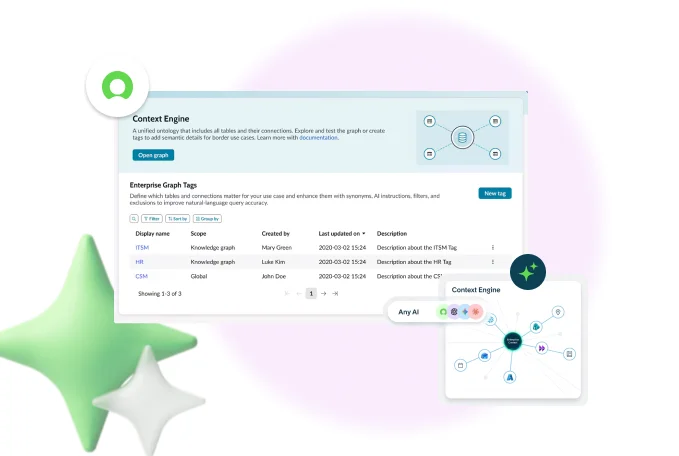
Table of Contents
source on Google
Blog Summary
- ServiceNow Context Engine is the intelligence backbone that gives AI agents a deep understanding of how your business works.
- It provides outcomes based on business policies, relationships, history, and decisions, so AI agents can act with precision instead of guesswork.
- Announced in April 2026, it highlights ServiceNow's focus on becoming the AI operating system for the enterprise.
Imagine hiring the most talented employee in the world. But on day one, they know nothing about your company, including your approval workflows, your vendor history, your compliance rules, and the right person to call when something escalates. How useful are they?
This is the reality of enterprise AI today. Most AI tools are capable, but without business context, they are flying blind inside your organization. They can answer questions, but they can not make judgment calls.
ServiceNow‘s answer to this problem is the Context Engine.
This blog breaks down what it is, why it matters for your organization, how it works, and what business outcomes it enables.
What is ServiceNow Context Engine?
Context Engine is the enterprise intelligence layer embedded within the ServiceNow AI platform that gives AI agents a comprehensive understanding of your organization before they take any action.
Announced in April 2026, ServiceNow describes it as an enterprise context solution that connects relationships, policy, and decision history behind every AI agent decision.
It is not a separate dashboard or add-on. It is woven into the workflows and experiences your team already uses every day.
Simply put, ServiceNow Context Engine is the institutional memory of your enterprise that is usable by AI.
What Problem Does ServiceNow Context Engine Solve?
To understand why Context Engine matters, you need to understand the problem it’s solving, and it’s one that nearly every large organization is running into right now.
The Context Gap in Enterprise AI
Most AI tools available today are trained on general knowledge. They are powerful at understanding language, summarizing documents, and generating content. But when you deploy them inside your enterprise, they start from scratch. They do not know your org chart, your vendor relationships, your regulatory requirements, or the institutional history behind why certain decisions were made.
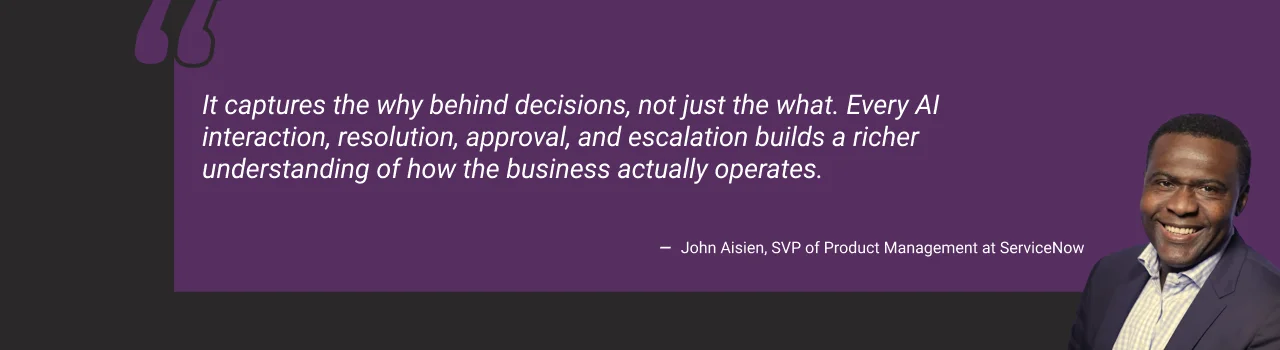
As John Aisien, SVP of Product Management at ServiceNow, put it when describing Context Engine: “It captures the why behind decisions, not just the what. Every AI interaction, resolution, approval, and escalation builds a richer understanding of how the business actually operates.”
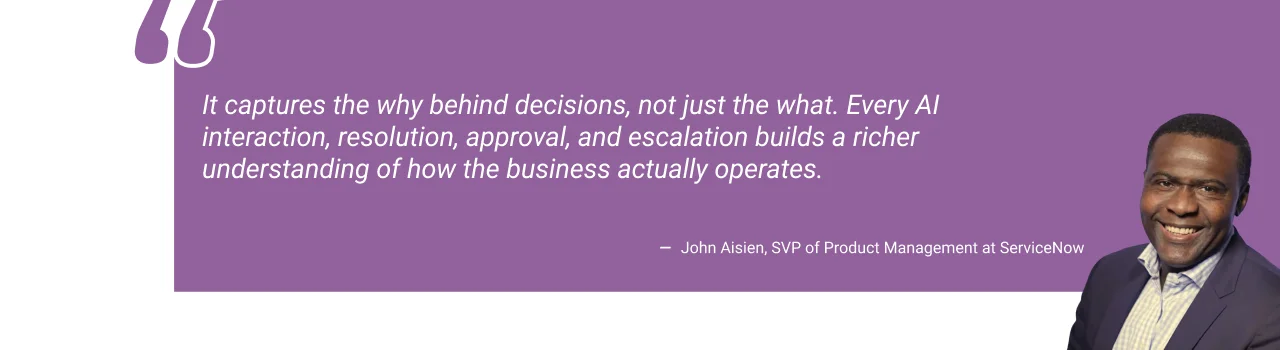
This is the gap. Traditional AI only captures what happened. Context Engine captures why it happened and uses that to inform what should happen next.
The Data Silos Problem
Most organizations have their enterprise data scattered across systems, including an HR platform, a procurement tool, a security system, and a CRM. When an AI agent needs to make a decision, like approving a $25,000 purchase at 4 am, it needs information from multiple systems simultaneously. Who is making the request? Do they have the authority to approve this amount? Does this vendor have a history of compliance issues? Is this within budget policy?
Without a single, unified view of this data, the AI either guesses, escalates to a human, or makes an error.
The traditional fix? Build that unified view manually, mapping systems, defining data relationships, assessing the pieces one by one. ServiceNow notes that this process alone can take months. And by the time it is done, the business has already moved on to a different problem.
Context Engine eliminates this problem and brings all of that context together automatically, in real time, at the moment a decision is being made.
The AI as Sidecar Problem
ServiceNow has declared the end of what it calls the “sidecar AI era.” A phase in enterprise software where AI was an optional add-on built on top of existing platforms, requiring extra licenses, additional configuration, and separate management. ServiceNow Context Engine makes AI default, not optional, embedded in every workflow rather than layered on top of it.
How Does ServiceNow Context Engine Work?
Context Engine operates across four layers:
1. It Unifies Four Enterprise Graphs Into One
Context Engine brings together four interconnected maps of your enterprise that together give AI a complete picture of your organization:
- Enterprise Knowledge Graph: Captures your policies, playbooks, and compliance rules. When an AI agent needs to know what the data privacy requirements are for a specific vendor, the Knowledge Graph has the answer.
- Security Graph: Tracks actual permission paths, access rights, and real-time asset visibility across your organization. It tells AI agents not just who should have access to something, but who actually does, and what systems are involved when something changes, powered by Veza (for identity and access management).
- Decision Graph: It’s the institutional history of what happened when similar decisions were made in the past. It includes the outcome, the chain of actions that led there, what worked, and what didn’t. Crucially, it does not just record outcomes; it tracks which actions succeeded. Every decision on the ServiceNow platform contributes to this graph.
- User Graph: Maps your organizational structure: who works with whom, who has what responsibilities, and how your teams collaborate day to day. This gives AI agents a blueprint of your human organization.
Beyond all four graphs, Context Engine works on a shared ontology layer. Think of it as a universal dictionary for your business data. It ensures every AI agent is working from the same definitions, no matter which system the data came from.
Together, these four graphs enable AI agents to replicate real organizational experience. And this depth is further extended through Workflow Data Fabric, which connects to data from over 350 external systems without copying or moving it, giving Context Engine both native depth and enterprise reach.
2. It Reasons in Real Time
Context Engine learns continuously. Every new decision, approval, and resolution adds to its intelligence. The system gets smarter every time it acts, which ServiceNow calls a compound intelligence advantage.
3. It Works Across Your Existing Systems
Context Engine does not require replacing your existing systems. Your HR system and your ERP stay exactly where they are. Through Workflow Data Fabric, Context Engine creates a live, unified view across all of them, giving AI agents the complete business picture at the moment of execution, with no data migration required.
4. It Operates Within the AI Control Tower Framework
Context Engine is one piece of a four-part AI decision architecture ServiceNow presented at its Knowledge 2026 conference:
- Sense: Connect and contextualize all your enterprise data
- Decide: Apply full business context through the Context Engine
- Act: Execute governed workflows end-to-end with AI agents
- Secure: Protect every agent, identity, and asset
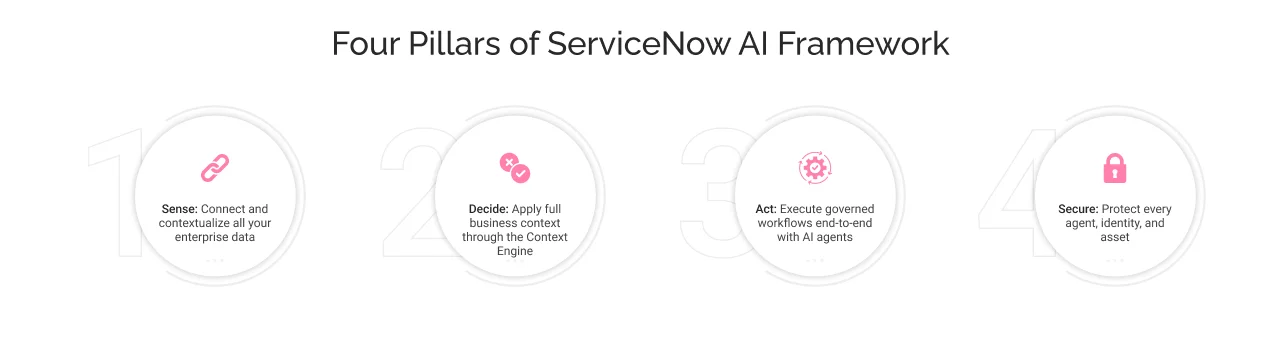
Context Engine handles the decide layer, ensuring that once the AI has all the relevant data, it applies the right judgment before acting.
What Are the Features of Context Engine in ServiceNow?
Here are the four core features of Context Engine:
Compounding Decision Memory
Every successful AI action and decision is recorded as an auditable record of what happened, why, and what the outcome was. Over time, this builds an ever-growing institutional memory that makes the Context Engine more intelligent with every interaction.
What this means for your business: Your AI does not start over every time. It gets better with use, without requiring manual retraining or engineering intervention.
Unified Business Ontology
Enterprise data is messy. Different departments define the same thing in different ways. What a customer means in sales is different from what it means in legal. The unified business ontology translates your enterprise data into a shared language so that AI agents understand not just what your data says, but what it means, how different pieces relate to each other, and where that information came from.
What this means for your business: AI agents can move across departments and systems without losing context or making errors caused by definitional inconsistencies.
Multigraph Reasoning
Context Engine reasons across all four enterprise graphs simultaneously to make a decision. It interprets the intent behind a request, searches across identity, policy, knowledge, and historical decision data, and surfaces exactly what is relevant.
What this means for your business: Your AI makes decisions the way a seasoned executive would, by considering the full picture, not just one angle.
Context as a Service
Context Engine is designed to be open. It can expose your enterprise context to any third-party AI agent or large language model (LLM), regardless of which vendor it comes from. This is ServiceNow’s commitment to avoiding vendor lock-in: your business context works with the AI ecosystem you choose to build.
What this means for your business: You are not forced to use only ServiceNow’s AI tools. The context layer serves as an open intelligence foundation that any AI in your stack can benefit from.
Who Benefits from ServiceNow Context Engine?
Context Engine has direct implications for a specific business function:
For IT Leaders
When a server goes down at 3 AM, AI agents with Context Engine detect the incident. They immediately understand the affected business processes, notify the right people, identify historical resolution patterns, and flag compliance implications, all simultaneously.
For HR and Employee Experience
When an employee asks about their benefits or submits a request, AI agents can pull their role, location, employment type, and relevant policies to give a precise, personalized answer, without routing them through three systems and a human agent.
For Procurement and Finance
When a purchase order is submitted that exceeds a certain threshold, Context Engine knows the approval chain, the vendor’s history, the budget status, and any compliance flags. It can route, approve, flag, or escalate automatically with an auditable explanation for every decision.
For Security
Context Engine integrates with Veza (for access governance) and Armis (for asset visibility). It enables security teams with a unified view of every AI agent’s identity, permissions, and potential exposure if something goes wrong. It addresses the critical governance challenge that comes with deploying autonomous AI at scale.
Conclusion
The debate in enterprise AI is no longer just about which AI model is most capable. It is about which AI has enough business context to be trusted with business decisions.
ServiceNow Context Engine is a direct response to that shift. It brings together your organization’s policies, relationships, permissions, and decision history into a unified intelligence layer. It transforms AI agents from capable assistants into reliable, accountable decision-makers that understand how your business actually works.
For business leaders evaluating AI strategy in 2026, the question to ask is “Does our AI understand our business well enough to do it right?”
That is what Context Engine is built to meet, and the one your AI strategy should be around.
To help you deploy right, we at Cyntexa offers ServiceNow implementation services. Our experts ensure your AI agents work with your business context.
Schedule a consultation call today!
Don’t Worry, We Got You Covered!
Get The Expert curated eGuide straight to your inbox and get going with the Salesforce Excellence.
Shruti is a ServiceNow Consultant with 5+ years of experience across ServiceNow ITSM, AWS, Salesforce Loyalty Management, and managed services. She blends technical expertise with strategic insights to deliver transformative IT services and CRM solutions that enhance efficiency and customer satisfaction.


Cyntexa.
Join Our Newsletter. Get Your Daily Dose Of Search Know-How