




ServiceNow CSM vs ITSM: Which Solution is Right for Your Business?
source on Google

Table of Contents
source on Google
If you’re comparing ServiceNow ITSM vs CSM, chances are you’re already familiar with one of the solutions, or you’re trying to figure out whether your organization needs one, the other, or both. Either way, you’re really trying to answer a much more practical question: which solution does my business actually need?
The short answer is that ITSM and CSM are not competing products. They’re complementary solutions built for different users and different service challenges. Some organizations only need ITSM to streamline internal IT operations. Others need CSM to improve customer support.
Both solutions are designed to improve service delivery, but they tackle different business challenges. Both ensure a smooth flow of operations, one in IT service, the other in customer service, by streamlining workflow management. Either way, these solutions deliver long-term business benefits and strengthen internal workflows. ServiceNow‘s own Now on Now initiative demonstrates this impact in practice, with the company achieving 85% IT self-service adoption and saving more than 215,700 employee hours through self-service automation by using its own ServiceNow platform internally.
Understanding CSM vs ITSM isn’t just about comparing features. It’s about figuring out what service challenge you’re actually trying to solve.
Let’s first understand what challenges ServiceNow ITSM vs CSM solve for your business?
What Business Challenge Does ServiceNow ITSM Solve?
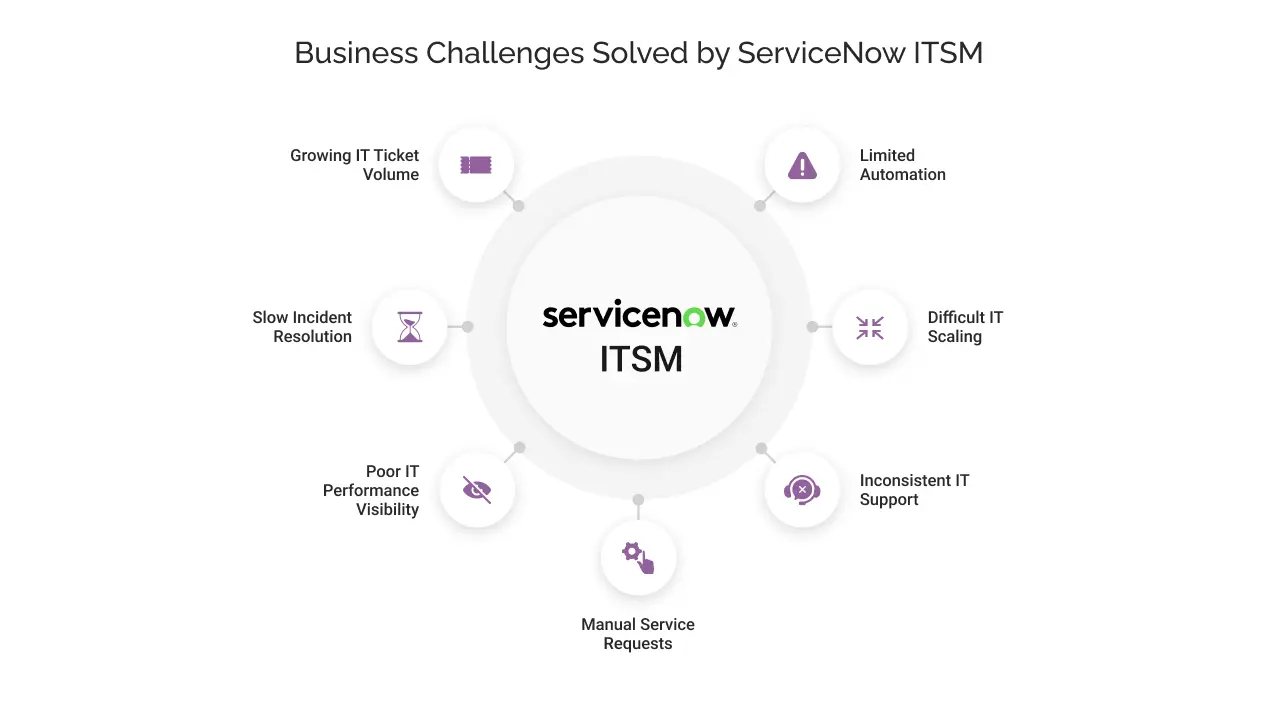
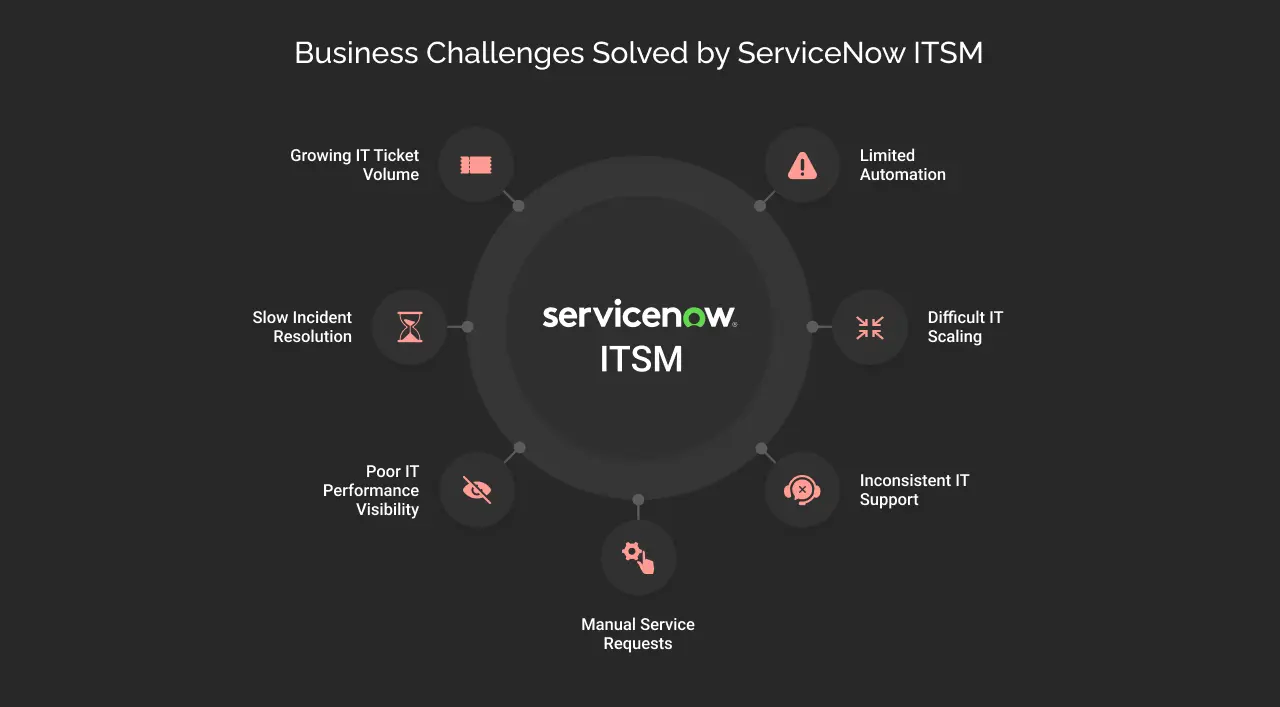
The ServiceNow ITSM is focused on IT service management solutions, providing IT teams with a unified platform to manage and track incidents, problems, changes, and request workflows. ITSM, as ServiceNow’s core solution, solves the following problems.
- Resolving the issue of growing IT tickets with your increasing team size, which overwhelms the support team and slows down service delivery.
- Long incident resolution time impacts employee productivity and business operations.
- Lack of visibility into IT performance makes it difficult to identify potential bottlenecks and improve service quality.
- Manual service request process that consumes IT resources and creates inefficiencies.
- Inconsistent support experiences faced by teams, departments, and locations.
- Challenges IT scaling support as companies grow and service demand increases.
- Limited automation prevents IT teams from focusing on strategic innovation and initiatives.
If your business has been facing any of the challenges or any internal inefficiencies because of a lack of internal IT service management, then ITSM is the right choice for you.
As analyzed by Devtools, ServiceNow ITSM has helped businesses reduce 70% of event noise, increase operational time by 50%, and provide up to 190% ROI with streamlined predictive delivery.
What Business Challenges does ServiceNow CSM solve?
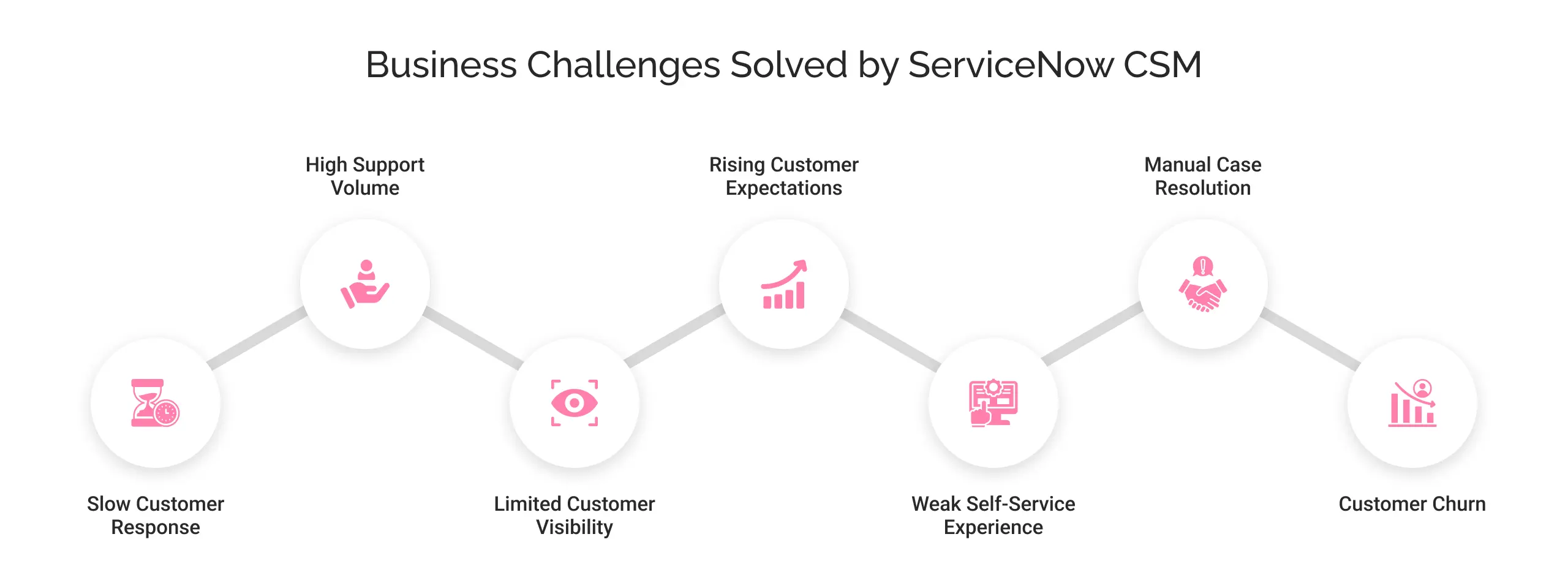
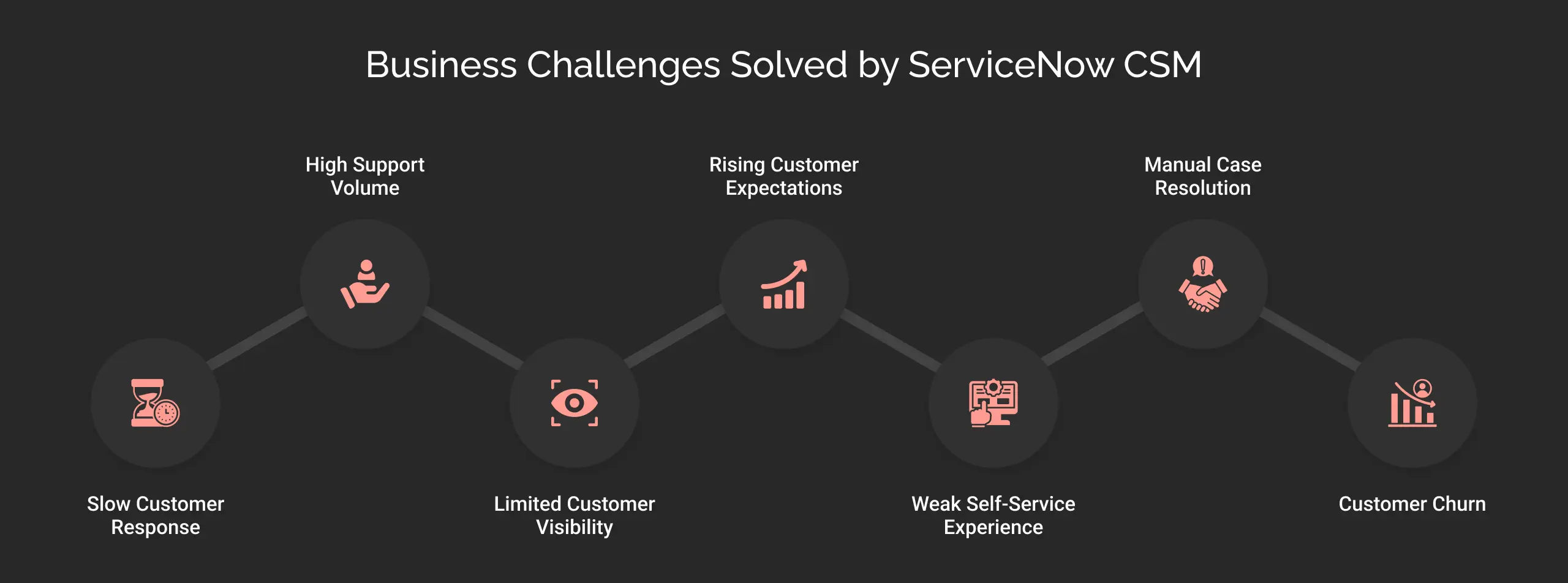
ServiceNow CSM serves different operational challenges related to customer-focused service management solutions. IT helps organizations provide support and service to external customers. As a strategic solution, streamlining internal processes with external stakeholders, CSM resolves the following challenges.
- Slow response and resolution times are impacting customer satisfaction.
- Increasing customer support volume that is difficult to manage with limited resources.
- Limited visibility into the issues of customers, case status, and service history.
- Difficulty meeting customer expectations for fast and personalized support.
- Limited self-service options lead to increased dependency on the customer support team.
- High case resolution time because of manual processes and lack of automation.
- Rising customer churn because of poor customer experience
CSM is specifically designed to ensure a seamless customer experience by connecting customer service teams with the rest of the business. It focuses on external pain points faced in B2B and B2C scenarios, with the management of technical issues, subscription inquiries, and customer requests in one connected flow.
Companies adopting the ServiceNow CSM solution noted a positive outcome of a 25% reduction in manual ticket volume and a 15-20% increase in agent productivity, as reported by ServiceNow.
Let’s compare the features of each so that you can decide which one fits your requirements.
ServiceNow ITSM vs CSM: Feature-by-feature comparison
Both ITSM and CSM has its own benefits and drawbacks, but any organization can decide the implementation based on the features both offer. Here is a feature-by-feature comparison that organizations can utilize while making decisions about selecting between the two.
| Features/Capabilities | ServiceNow ITSM | ServiceNow CSM |
|---|---|---|
| Primary stakeholders | IT/operations team and employees | Customers and the customer support team |
| Record type | Problems, incidents, service requests, change requests | Customer case with SLA tracking for customers |
| Use case | Internal service delivery for IT support and infrastructure | External customer support for case resolution and enquiries |
| Example activities | Deploying changes, resolving system outages, and fulfilling employees’ requests | Answering customer product queries, handling returns, resolving technical issues |
| Workflow automation | Change approvals, email notification, change, incident triage, and automated escalations | Case routing to appropriate agents, proactive alerts, and customer notification |
| Self-service portals | Employee service portal, such as an IT catalogue and a knowledge base | Customer service portal for cases and knowledge base |
| Knowledge management | IT knowledge articles for troubleshooting | FAQs and customer-facing articles |
| SLA and metrics | SLA on incident resolution time, service request fulfillment | SLA on response time, customer reported satisfaction (CSAT) |
| AI/Automation | AI-based ticket routing and virtual agents for IT issues | AI chatbots and now assist for agents, predictive case routing |
| Reporting and dashboard | Incident trends, IT service health, change request fulfillment | Customer satisfaction, channel usage, case backlog |
| Implementation | CMDB for assets, DevOps tools, and monitoring system | CRM/ERP, product data, field service, integrated with ITSM for escalation |
| Teams involved | IT operations, Help Desks, change management | Product support, customer service, field service |
The table highlights that ITSM is designed around IT processes and incidents, while CSM is built around cases and customer experience. Despite both having overlapping features like knowledge bases and portals, their primary objectives are fundamentally different.
Primarily, both are designed to serve different stakeholders, but having overlapping features can seem confusing; however, when connected to a single ecosystem, these can create great value for the business. To make your decision more viable, let’s explore the use cases of both ITSM and CSM.
ServiceNow CSM vs. ITSM: Use Cases for Enterprises
For businesses, deciding between ITSM and CSM can be a complex choice, but it simply depends on the use cases each product provides. The use cases of ITSM and CSM depend on where the bottleneck exists.
ITSM has the use case of reducing manual work, standardizing service operations, and improving employee support. Since it brings problems, incidents, changes, and service requests in one platform, the teams get more control and better visibility across IT service delivery.
CSM has different use cases related to customer satisfaction by providing the teams with a clear view of the customers and better tools to manage cases across the channels. ServiceNow highlights that CSM supports case management, communication, dashboards, and generative AI assistance for better productivity and faster resolution.
This is why discussion around ITSM and CSM should always start with business outcomes, not the feature list.
Implementation considerations: Factors to consider when implementing ITSM and CSM
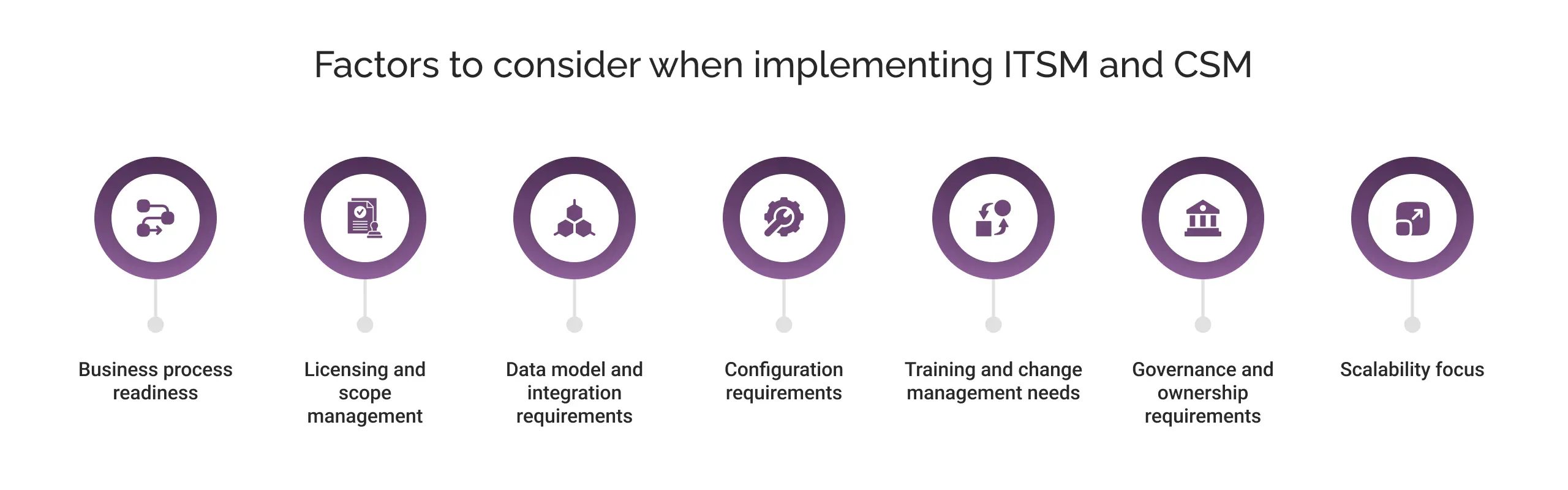
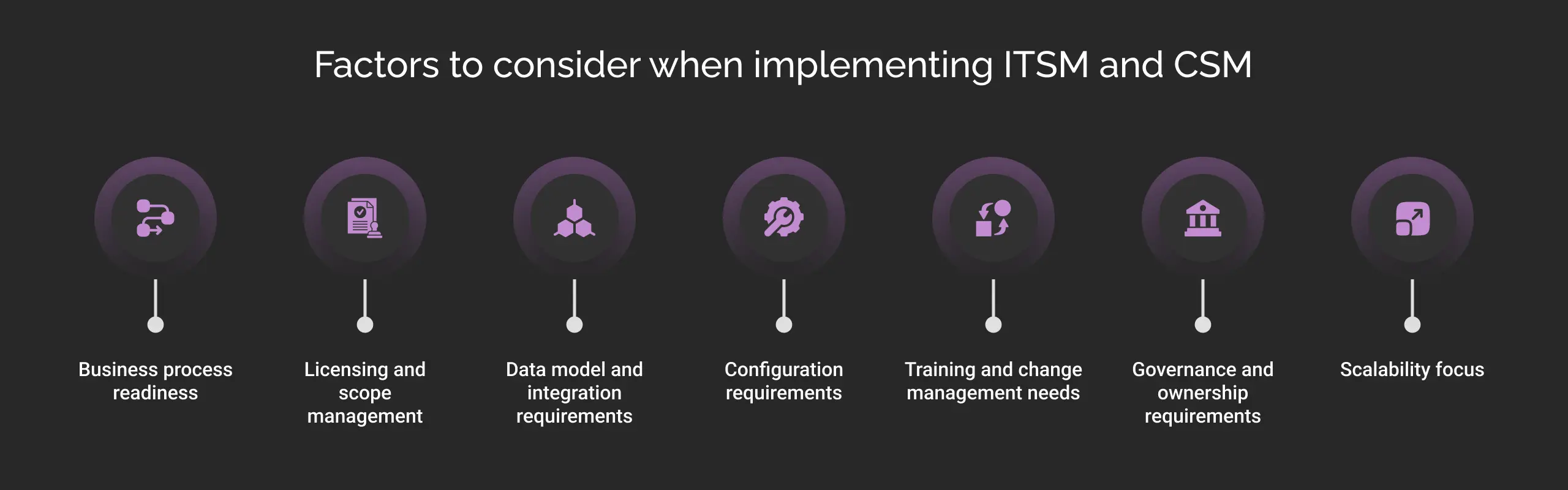
When you have decided to implement ITSM vs CSM into your business, the next step is the implementation. For a careful implementation plan for both, here are the important factors that need close attention.
- Business process readiness– Based on individual business outcomes, you need to evaluate the current IT/Customer support processes and whether there is any relevance. Are they documented? Identifying the current gaps in the process and getting stakeholders on the same page is critical. If your existing process is aligned with the requirements of the solution, then you can ensure seamless implementation across different channels.
- Licensing and scope management– ServiceNow provides licenses separately for ITSM and CSM both. Based on your current business requirements, you have to decide if you’ll only license ITSM, only CSM, or both. There are some features that overlap, but licensing dictates availability.
- Data model and integration requirements: ITSM heavily relies on asset data and CMDB, while CSM relies on customer data/account. The business needs to decide what data needs migration from the legacy system, like HR/AD for employees, CRM for customers, and plan the integration points. These points can revolve around billing, CRM, ERP, and monitoring tools. The success of ITSM and CSM depends on how seamlessly ServiceNow connects with existing business systems. Without a reliable data flow, your company may face issues of duplicate records, manual workarounds, and limited visibility, leading to reduced value of both solutions.
- Configuration requirements- If you are too conscious about security, access, and individual capabilities, then both solutions are highly configurable based on the requirements of the business system/processes. In the case of ITSM, configure around approval workflows, incident types, etc. For CSM, configure SLA, case types, and customer roles. Make sure to align customization as per business requirements to avoid any technical debt in the future.
- Training and change management needs– Each rep needs conscious training of the platform. There will be users of ITSM, such as technicians and help desks, who are totally different from CSM users like customer service reps. As per the requirement, plan the role-based training and support material. For better outcomes, communicate the change in process to both internal employees and external stakeholders.
- Governance and ownership requirements– Based on the needs of the business, define who owns the process. ITSM might be owned by the IT department, while CSM includes both customer service and line-of-business owners. Set clear ownership of the master data related to customer records and configuration items to streamline the implementation.
- Scalability focus– If you’re focused on incremental growth, then both the modules grow as your team grows with business alignment. Make sure to think about future needs, like multilingual support for customers and more complex IT workflows like DevOps integration. The ServiceNow platform is scalable as your team grows, but planning the initial scope vs phase 2 enhancement can be a wise choice.
By this stage, the business must have a clear understanding of the challenges each solution addresses, the use cases offered, and implementation factors influencing the success of the solution.
In many of the cases, the decision is straightforward; organizations focusing on internal service delivery lean on ITSM, and those prioritizing customer satisfaction choose CSM for a better fit.
However, business operations are rarely that simple. Customer issues constantly require support from the internal IT team, and service requests span across various departments. It raises a crucial question: does the business need to choose between ITSM and CSM, or can both solutions work together to create a more connected customer experience?
To answer the question, let’s explore how both CSM and ITSM can work together to ultimately deliver value to customers.
How to determine the right service management approach for your business?
Understanding the differences is only a part of the decision-making process. What matters is identifying which solution aligns with your organization’s service challenges, operational goals, and long-term strategy. Let’s explore some real-world scenarios to understand when ITSM, CSM, or a combination of both is the right choice.
Choose ITSM when the challenge is internal service delivery
ITSM is intended to address internal IT service delivery challenges such as data migration and over-customization. ServiceNow, in its Now on Now initiative, is using its own IT service management solution to transform the IT service delivery. With a strong foundation for ITSM in its IT desk capabilities, the brand has been able to save thousands of hours of employee time from self-service automation.
As reported by ServiceNow in its internal process management, an achievement of 85% adoption of IT self-service ultimately saved $42 million in operational and resource costs.
It is evident that if you have a goal to streamline internal support, automate routine requests, and give employees a fast service request, then ITSM is an ideal choice.
Choose CSM when the challenge is customer-facing support
Leading organizations have utilized ServiceNow’s CSM capabilities to enhance customer experience. CSM is consistently the right fit, as it helps businesses manage cases, centralize communication, and improve response quality across touchpoints.
If your business is facing the challenge of delayed service delivery from 100 or 1000 of customer, CSM can ensure faster response times. In such a case, ServiceNow CSM has provided positive outcomes to global entities in overcoming these challenges.
As a reference, the case of Nexon Asia Pacific shows how the brand utilized ServiceNow’s CSM capabilities to elevate its customer satisfaction score to 96%. With Now Assist for Customer Service Management, Nexon has a single view of SLA for each customer to take faster action for customer resolution. 1000 organizations like Nexon have utilized CSM capabilities to improve the customer experience and ultimately drive a better customer relationship.
How do ITSM and CSM complement each other across the service lifecycle?
Yes, both CSM and ITSM are built on the Now platform, so they can be tightly integrated. In fact, many businesses benefit from this connected model in which customer issues seamlessly trigger IT work, and vice versa.
For example, Fonterra, a New Zealand-based dairy company with operations in 140 countries and more than 16400 employees, utilized ServiceNow’s AI platform to integrate both ITSM and CSM into its business processes.
As a result, Fonterra achieved a 90% reduction in event incident tickets and a 95% CSAT score for closed requests and incidents. For many enterprises, the decision is not about choosing one over another. Instead, organizations often implement both solutions to create a unified service ecosystem that supports employees and customers alike.


Final Words
The choice between ITSM and CSM ultimately comes down to service direction. It always ends with who you serve and what outcomes you need. If your goal is to optimize the internal IT services related to incidents, changes, and employee requests, then ITSM is the right choice. Or if you need to elevate the customer support and experience, CSM will meet those needs with case management. In many cases, organizations benefit from using both solutions, leveraging a unified platform to connect customer cases to IT resolution.
By now, you must have a clear understanding of where ITSM and CSM fit within your service strategy. The next step is to turn this understanding into an actionable implementation plan that aligns with your organizational objectives and current processes. For the next step, get a consultation call from a ServiceNow consulting services provider like Cyntexa. Connect with us to get a detailed roadmap for ITSM vs CSM implementation based on your personalized business requirements.
Don’t Worry, We Got You Covered!
Get The Expert curated eGuide straight to your inbox and get going with the Salesforce Excellence.
Co-founder and CTO at Cyntexa also known as “VJ”. With 10+ years of experience and 22+ Salesforce certifications, he’s a seasoned expert in Salesforce Data Cloud & AI Products, Product Engineering, AWS, Google Cloud Platform, ServiceNow, and Managed Services. Known for blending strategic thinking with hands-on expertise, VJ is passionate about building scalable solutions that drive innovation, operational efficiency, and enterprise-wide transformation.


Cyntexa.
Join Our Newsletter. Get Your Daily Dose Of Search Know-How