





ServiceNow Financial Services Operations (FSO): Everything You Need to Know
source on Google

Table of Contents
source on Google
Blog Summary
- ServiceNow Financial Services Operations (FSO) is an AI-powered solution built on ServiceNow CSM that helps banks and insurance providers automate workflows, streamline operations, and deliver better customer experiences through industry-specific applications.
- This blog explains how ServiceNow FSO works, explores its core features and specialized applications, and showcases real-world examples of how organizations use it to modernize financial operations.
Financial Services Operations (FSO) is an AI-powered, cloud-based ServiceNow product that brings AI-powered automation to banking and insurance workflows. It is built for financial institutions where slow, manual processes directly cost customer trust and operational efficiency.
In this blog, we will break down how FSO works, its core model, and the full range of FSO apps and their features to help you evaluate how you can use it for your institution.
How does ServiceNow Financial Services Operations work?
ServiceNow Financial Services Operations connects fragmented departments of financial institutions into a single, coordinated workflow. It can seamlessly perform various banking operations, like loans, payments, deposits, client lifecycle operations, treasury operations, complaint management, and card operations, using AI-powered intelligence.
Financial institutions can integrate ServiceNow’s FSO into their existing technology ecosystem to get a 360-degree view of customer accounts. This enables them to track open dispute cases, measure inbound complaints, resolve customer complaints, and personalize customer service, all through a single FSO Financial Services Workspace.
Core Financial Services Operations Application
FSO is the layer built on top of ServiceNow Customer Service Management (CSM). It empowers financial institutions to make customer-centric decisions related to banking, insurance, risk, and compliance.
In simple words, the core FSO model extends the capabilities of the CSM model to streamline banking and insurance-related workflows.
The core ServiceNow CSM model offers self-service portals, allows omnichannel communication, workflow automation, case management, and knowledge bases to improve overall customer service. In addition to the core features, the FSO app leverages data models and pre-built functionalities of CSM to better align with finance industry operations.
Features of Core FSO Application
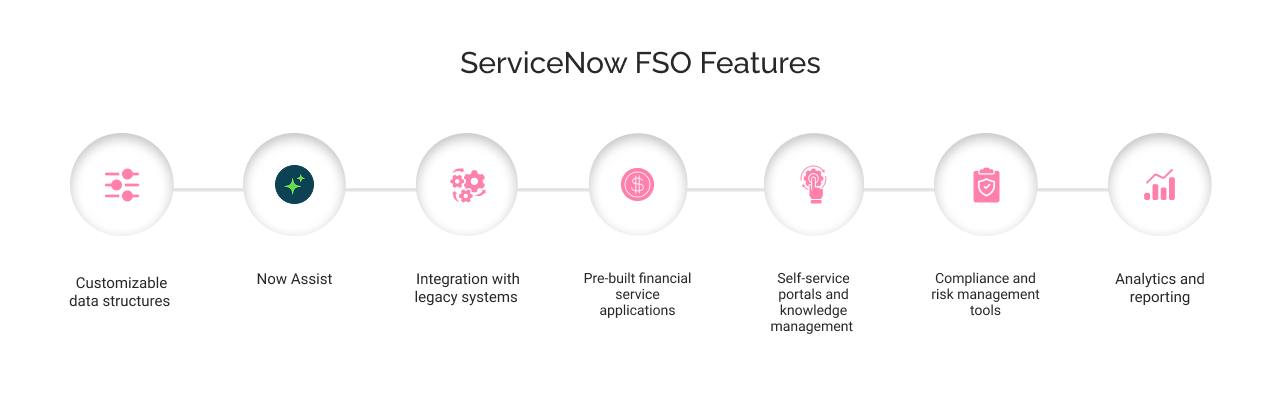
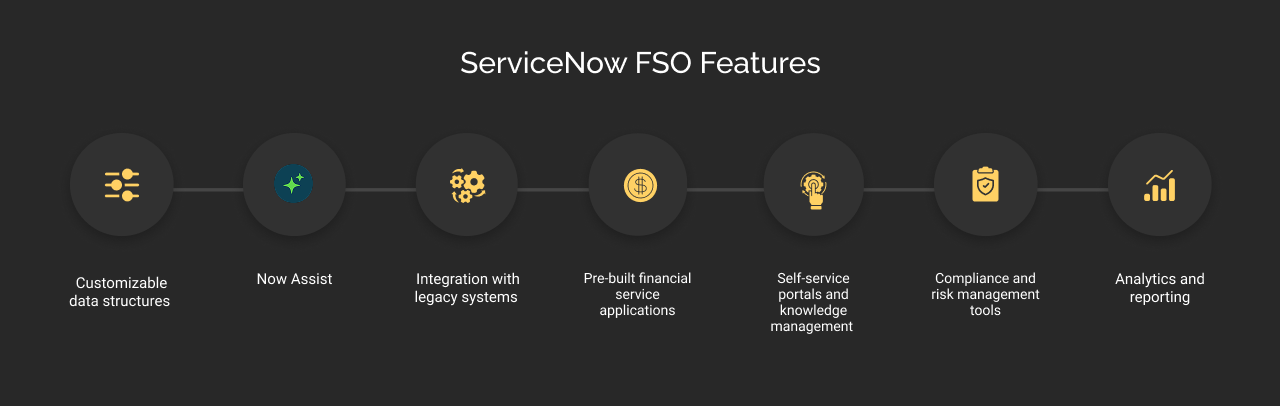
a. Customizable data structures
Every financial institution has specific business requirements. For instance, an insurance firm tracks claims and policies, while a bank manages loan accounts and transaction histories.
Hence, FSO allows financial institutions to define custom data objects, add fields to existing tables, and link them without changing the underlying platform code. Meaning, they don’t have to adjust their internal processes to match a fixed structure of the FSO data model.
b. Now Assist for Financial Services Operations (FSO)
ServiceNow FSO app offers NowAssist, which enables out-of-the-box GenAI experiences for its users. It uses predictive and agentic AI to help solve complex cases in the finance industry.
For instance, NowAssist has AI agents for ACH dispute resolution. Meaning, NowAssist proactively supports customers by answering their queries, automating dispute resolution for fraudulent transactions, unauthorized transfers, etc. In addition to this, it helps summarize cases, generate emails, and enable conversational workflows within the ServiceNow ecosystem.
c. Integration with legacy systems
Enterprises can integrate the core FSO model on top of their legacy systems using pre-built FSO connectors and spokes, enabling collaboration with external systems. Hence, they don’t need to replace their existing systems completely, which leads to gradual modernization.
d. Pre-built financial service applications
Not all financial institutions use the same FSO app outside the FSO core. For basic requirements, businesses can leverage the core FSO app using its data models, including financial accounts, financial services, insurance policies, financial transactions, and product models.
Enterprises can extend any (or all) data models to create a more specialized FSO app to solve more complex banking processes like loan processes, dispute management, insurance use cases, etc.
e. Self-service portals and knowledge management
The FSO core model provides customer-facing self-service portals and knowledge bases to enable self-help. Meaning, you can submit and review service requests independently, without requiring a human agent, which reduces contact center volume.
f. Compliance and risk management tools
ServiceNow FSO integrates compliance management directly into workflows, allowing financial institutions to maintain regulatory compliance using audit trails, SLA tracking, and real-time monitoring. For instance, FSO tracks that compliance checks are properly implemented for a new customer by identity verification, KYC documentation, and regulatory disclosures.
g. Analytics and reporting
ServiceNow FSO provides out-of-the-box dashboards that enable managers and service agents to gain visibility into operational performance, bottlenecks, and unresolved issues across various workflows.
Specialized ServiceNow Financial Services Operations Apps
As we discussed earlier, enterprises can extend the capabilities of the core FSO data model to leverage its schema, which ensures data consistency and supports other FSO applications.
For specialized use cases, financial institutions can use specialized FSO applications that extend the capabilities of the core FSO model. Let’s take a look at each:
FSO apps for banking and wealth
Let’s discover the features of FSO apps for banking and wealth:
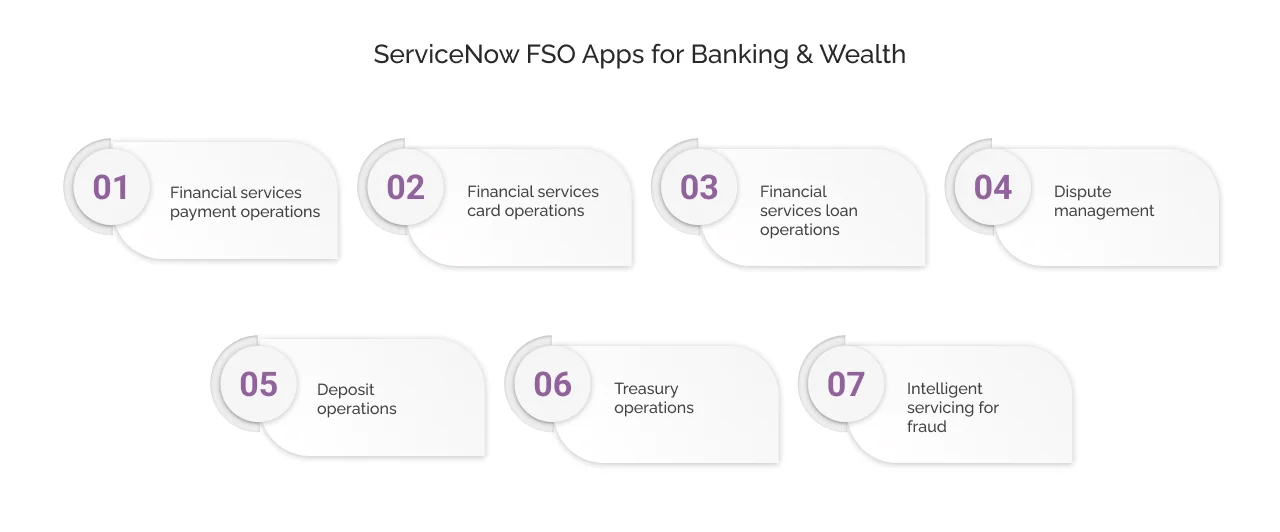
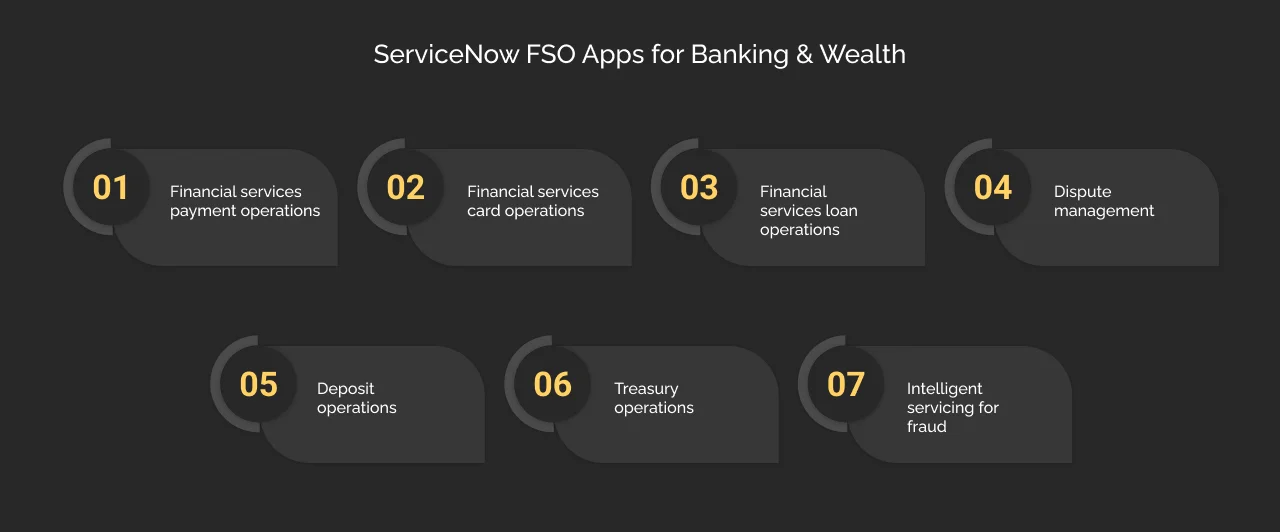
a. Financial services payment operations
Failed transactions, errors, and refund claims are some of the high-friction moments for both employees and customers, where customers expect fast resolution. The financial services payment operations app allows enterprises to deliver frictionless banking services by processing internal and external inquiries about failed payments, payment errors, and refunds against claims.
For instance, the request of a customer reporting an incorrectly processed outbound transfer will be immediately tracked by financial service agents. The agent will assist in the investigation and resolution of the request by getting a consolidated view of the customer’s account data on the ServiceNow financial services workspace.
b. Financial services card operations
Credit card agents can digitize and automate the full range of card servicing-related requests using financial services card operations.
For instance, financial agents can manage service requests related to open/close credit cards, increase/decrease card limits, block/unblock credit cards, all using pre-built playbooks and integrations on the FSO app that help streamline card operations.
c. Financial services loan operations
Managing loan requests across disjointed systems is often a complicated process. More than that, it’s time-consuming. Loan and credit agents can handle a full spectrum of loan requests using a unified workspace.
For instance, the agents can streamline personal and business loan operations efficiently using financial services loan operations. It allows agents to handle a multitude of loan service requests, including loan deferment, loan forgiveness, partial prepayment, loan drawdown, loan restructuring, and more.
d. Dispute management
Unresolved customer issues erode customer trust and create compliance-related risks. With FSO dispute management, financial institutions can manage credit, debit card, and non-card ACH transaction-related disputes.
For instance, FSO dispute management enables financial agents to get a centralized case view of card-related activities. The predefined workflows enable agents to tackle disputes concerning fraudulent activity, billing errors, unauthorized transactions, etc. On top of that, the GenAI suite NowAssist provides suggestive actions so that disputes can be resolved faster while also accelerating productivity.
e. Deposit operations
Deposit account requests can certainly be managed manually, but this creates unnecessary agent workload as well as delays. Financial Services Deposit Operations addresses this issue by streamlining and automating the end-to-end lifecycle of customer deposit accounts.
For instance, a retail bank has hundreds of deposit account closure requests that can be automated by deposit operations, as it can automate intake, routing, and resolution. Agents can automate and optimize deposit processes like account origination and closures, standing order modifications, and review account updates.
f. Treasury operations
Treasury operations are essentially a document-heavy process that is highly prone to human errors and may lead to unexpected delays when done manually. Hence, agents are shifting to ServiceNow financial services treasury operations, which leverages automation to strategically manage a company’s liquidity, cash, and financial risks. The key capabilities in treasury operations include wire transfers and Remote Deposit Capture (RDC).
For instance, financial institutions can onboard a new client for treasury operations like wire transfer and digitize the end-to-end process using pre-existing intelligent workflows in ServiceNow.
g. Intelligent servicing for fraud
Security is the most critical aspect when it comes to banking services. ServiceNow’s intelligent servicing for the fraud app can proactively identify red flags and investigate fraud alert cases highlighted in the system.
For instance, banking firms can track and manage suspicious activities for a single user by consolidating all the accounts, such as a deposit account, a loan account, and a credit card. The underlying machine learning algorithms can monitor live transaction data to analyze patterns and detect vulnerabilities that help fraud agents flag accounts ahead of financial fraud.
FSO apps for Insurance
Let’s discover the features of FSO apps for insurance:
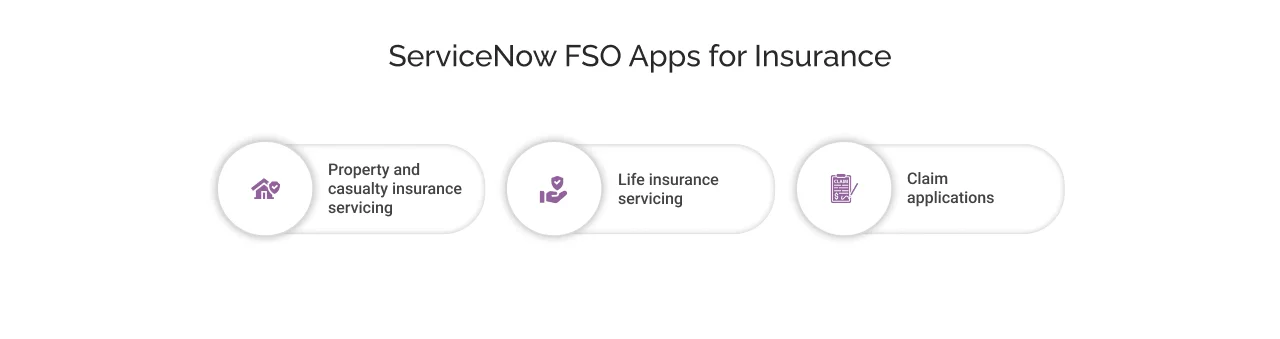
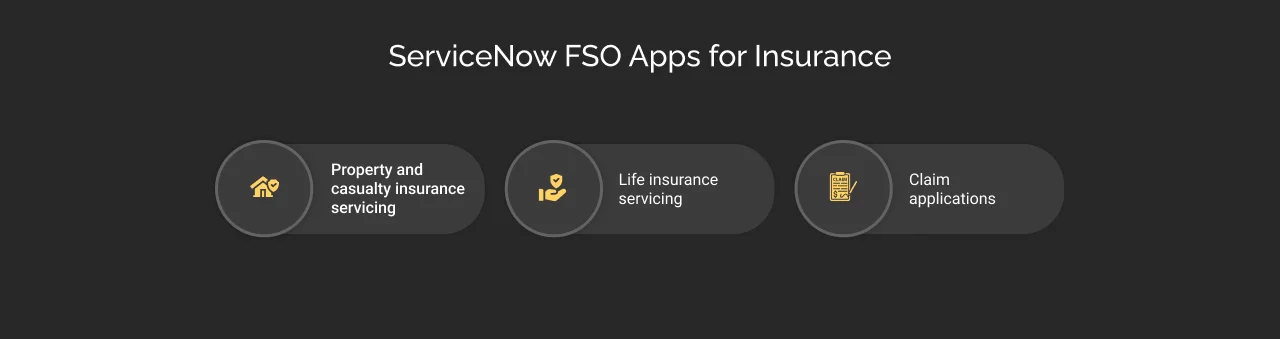
a. Property and casualty insurance servicing
Customers requesting mid-term policy changes are frequent and operationally demanding for insurance firms. Hence, the property and casualty insurance servicing app allows enterprises to create and manage personal and commercial insurance policies on a single workspace, eliminating the need to toggle between multiple disparate systems.
For instance, when a customer requests a mid-term change in a commercial property policy, the service agents can leverage the app to support end-to-end changes in the policy, with the audit trail maintained automatically. Additionally, the insurance servicing app will help in capturing revenue and offering visible process controls, enabling agents to improve compliance and eliminate administrative load.
b. Life insurance servicing
From individual insurance claims to group insurance, life insurance servicing includes layers of complexity. ServiceNow’s life insurance servicing app enables agents to manage policy changes, renewals, and service requests, all within a structured workspace that’s built on top of intelligent workflows.
For instance, when an agent is handling a group life insurance plan for a firm, they can view policyholders’ information and send an automated policy renewal request. In addition to this, life insurance servicing automatically prioritizes high-value work, eliminating the need for manual tracking of individual insurance plans.
c. Claims applications
Slow or inconsistent claim application processing leads to customer dissatisfaction and poor customer experience. ServiceNow FSO claim applications, including commercial lines claims, personal lines claims, individual life claims, and insurance claims, offer a versatile framework where initiation, processing, and evaluation of claim requests are automated with full visibility maintained at every stage.
For instance, upon submission of a personal line claim, the ServiceNow FSO claim application automatically categorizes it, assigns it to the right agent, and triggers persona-specific workflows.
Shared services applications
Let’s discover the features of common financial service applications:
a. Customer lifecycle operations
- The FSO customer lifecycle operations app allows agents to manage the entire lifecycle of a customer, starting from their onboarding, customer verification, and document identification, etc., to deliver a compliant experience.
- The customer lifecycle operations application includes the financial service client lifecycle and the financial service business lifecycle.
- The application operates on a single onboarding workflow that enables the creation and management of multiple cases.
- Allows managers to track account changes, review service requests, reports, dashboards, and SLAs on a single FSO workspace.
b. Complaint management
- FSO enables streamlined complaint resolution using the underlying intelligent workflows of ServiceNow. AI-powered agents help resolve and measure inbound complaints raised on the FSO platform.
- ServiceNow’s intelligent workflows allow agents to capture, classify, and route complaints.
c. Know Your Customer (KYC)
- AI-powered agents use Know Your Customer (KYC) and Know Your Business (KYB) processes to verify potential clients requesting banking services.
- Agents initiate the KYC/KYB process when a client requests banking services, collect required documentation, and complete verification before account activation.
- The KYC and KYB applications come integrated in a package with Financial Services Card Operations, Financial Services Loan Operations, and Financial Services Customer Lifecycle Operations.
d. Credit operations
- The credit operations application gives a centralized platform to review, manage, and process credit requests.
- Credit operations application is integrated within the Financial Services Card Operations, Financial Services Business Loan Operations, and Financial Services Personal Loan Operations applications.
How Organizations are using ServiceNow FSO?
ProAssurance reduces the computing time by 59% required for user-initiated transactions using FSO
ProAssurance, a USA-based property and casualty company, adopted ServiceNow FSO to improve insurance process workflow, improve conflict resolution, and amplify customer service efforts to improve overall satisfaction.
The adoption of ServiceNow FSO enabled the company to distinguish itself from other digitally growing native start-ups, as it helped them establish a true end-to-end claims processing environment. They modernized the original claims workspace, which led to saving 10.3K hours in the span of 8 months using agentic AI [Source].
Blackhawk Network improved conflict resolution time by 30% with ServiceNow CSM and FSO
Blackhawk Network (BHN) is an American financial technology company specializing in branded payment solutions. The company adopted ServiceNow CSM and FSO, which, when combined with Now Assist, helped BHN proactively process, sort, and manage high volumes of customer inquiries with agentic AI at the core.
Alongside the core FSO model, BHN employed the ServiceNow Disputes Management application. This application integrates with Visa and Mastercard, helping businesses reduce the need for agents to switch between multiple platforms. Consequently, the company maintained the CSAT score of 4.4 out of 5, which reflects strong customer satisfaction in dispute resolution. [Source].
Bank of Montreal (BMO) witnessed 200% year-over-year increase in self-service with FSO
BMO, a Canada-based multinational investment bank, was looking to modernize its financial service operations and reduce customer friction. Hence, BMO implemented ServiceNow CSM and FSO applications to optimize and automate financial transactions. This led the company to cater to its customers using one unified system that works on a single data model and architecture.
The company leveraged FSO’s automated financial transaction workflows and self-service capabilities. It led to an 80% reduction in development costs and a 63% reduction in case types, simplifying resolution paths for both agents and customers. [Source].
Who should adopt ServiceNow Financial Services Operations?
ServiceNow FSO is a purpose-built application for financial institutions to manage high-volume service requests, reduce case handling time, and modernize operations across fragmented systems.
Here’s a list of ideal candidates for FSO adoption-
- Retail banks
- Commercial banks
- Insurance firms (health, life, and reinsurance firms)
- Loan servicing firms
- Investment firms
- Credit unions
Wrapping up
Implementing ServiceNow FSO is only half the equation; the rest requires platform expertise to configure FSO apps. That’s where specialized implementation expertise makes the difference.
Cyntexa has certified ServiceNow experts who have helped financial institutions across banking, insurance, and capital markets implement and scale FSO modules like Account Servicing, Dispute Management, Customer Onboarding, KYC workflows, and more.
So, whether you’re looking to implement ServiceNow Financial Services Operations for the first time or optimize an existing FSO application, our ServiceNow implementation services will help you move from assessment to deployment.
Schedule a free consultation with our FSO experts today!
Don’t Worry, We Got You Covered!
Get The Expert curated eGuide straight to your inbox and get going with the Salesforce Excellence.
Shruti is a ServiceNow Consultant with 5+ years of experience across ServiceNow ITSM, AWS, Salesforce Loyalty Management, and managed services. She blends technical expertise with strategic insights to deliver transformative IT services and CRM solutions that enhance efficiency and customer satisfaction.


Cyntexa.
Join Our Newsletter. Get Your Daily Dose Of Search Know-How