




ServiceNow Integrated Risk Management (IRM): Everything You Need to Know
source on Google

Table of Contents
source on Google
Blog Summary
-
ServiceNow Integrated Risk Management (IRM) unifies governance, risk, compliance, and audit on a single AI-powered platform, enabling organizations to identify, assess, and mitigate risks proactively. This guide explores its core modules, benefits, lifecycle, and how it differs from traditional GRC to help organizations build a more resilient and compliant risk management strategy.
For modern-day organizations, risk management is no longer a quarterly task; it is now a day-to-day business priority. Yet many organizations still rely on siloed, manual processes that limit visibility, slow response times, and make it difficult to meet ever-changing compliance and resilience requirements. That is where ServiceNow’s IRM offering comes in. ServiceNow IRM is a strategic approach that unifies governance, risk, and compliance on a single AI-powered platform, allowing organizations to identify, assess, and respond to risks more effectively.
The increasing pressure of compliance and risk management is not just on the surface, but a reality. Organizations globally have been facing the same challenge amidst the ever-changing regulatory requirements. For instance, as per this survey of chief compliance officers, chief audit officers, and chief risk officers, 90% report that the breadth of their compliance responsibility had increased in the last 3 years.
These pressures expose a critical gap in traditional risk and compliance management approaches. ServiceNow IRM bridges this gap, as it moves organizations from reactive, department-specific GRC (Governance, Risk, and Compliance) to a proactive, integrated risk management strategy scaling across organizations.
As organizations look for ways to move beyond fragmented risk and compliance processes, ServiceNow IRM has emerged as a platform to bring accountability, visibility, and automation in a single ecosystem. But what exactly is ServiceNow IRM?
What is ServiceNow Integrated Risk Management (IRM)?
ServiceNow IRM is a dedicated suite of interconnected applications built on the ServiceNow AI Platform that enables a holistic, enterprise-wide risk management program. IRM is built on ServiceNow Governance Risk & Compliance (GRC) capabilities used by companies. But it expands to integrate risk management into core business workflows such as policy and compliance, change management, auditing, and operations. In simple terms, IRM is not just a compliance management solution; it is a unified approach that weaves risk awareness through IT, finance, security, operations, and more.
At its core, ServiceNow IRM provides:
- Continuous, automated monitoring- IRM is developed on the ServiceNow AI Platform. It runs on automation and even uses AI for risk assessment and control tests continuously rather than a one-time audit. For example, AI agents in IRM can identify failing controls or potential threats and automatically generate tasks or issues for the right team to address.
- Unified risk and compliance data– All the risk profiles, policies, controls, and incidents live in a single data model. This breaks down silos so that a risk identified in one area is visible to everyone.
- Integrated workflows– When a new risk appears, like a vulnerability in security operations, IRM can automatically trigger an assessment, route the task to the compliance team, and update the same on the dashboard in real-time. This makes sure risk is coordinated across every department and ensures transparency at multiple levels.
- Executive visibility and reporting– ServiceNow IRM offers role-based dashboards and heat maps so that managers and executives can see enterprise-wide risks. It helps them make fast and informed decisions.
In short, IRM turns risks into resilience, instead of reacting to situations after issues occur. It helps organizations anticipate, prioritize, and mitigate risks continuously. The solution is suitable for organizations that need to mature from GRC into a connected risk program, whether to meet regulatory requirements, foster a risk-aware culture, or improve audit readiness.
With a clear understanding of what ServiceNow IRM aims to achieve, the next step is to examine its modules and capabilities that make a connected approach to risk and compliance possible.
ServiceNow IRM Core Modules & Capabilities
ServiceNow IRM is developed with a strategic core on multiple modules and applications, each focusing on different aspects of risk and compliance management. These modules share a platform and data model, so they operate seamlessly across departments. The modules and capabilities include:
- Policy and compliance management – The organizations can define policies and link them to industry-wide regulations and internal controls. This module specifically manages the policy lifecycle, maps controls to different regulations, and automates compliance testing. IRM helps by managing a centralized governance framework, managing the full policy and control lifecycle, and automating compliance testing. For instance, if a control fails, the system automatically creates an issue and assigns it to the control owner.
- Risk management- This risk management module lets you create different types of risk profiles and score risks based on qualitative and quantitative factors. It also helps in linking the risks to business objectives. The risk register becomes stale because of periodic risk assessment instead of continuous monitoring. To resolve the issue, IRM provides a dashboard where you can track the status of risk in real time. For example, you can automate risk assessment that assigns a business impact score and a remediation task when certain conditions are met.
- Audit management- ServiceNow IRM helps you plan and execute internal audits more effectively. In most organizations, audit preparation becomes a last-minute hassle as evidence collection and issue tracking are spread across different teams. The module helps by streamlining the audit engagement lifecycle. From scoping and scheduling to evidence collection and findings remediation. The auditors can work on the platform by linking findings to root risks and tracking issues until closure, all in a single dashboard.
- Third-party vendor risk management– Third-party exposure sometimes becomes difficult to manage when supplier risk data is handled outside the core risk process. This module solves the issue by automating vendor assessment with risk scoring and questionnaires and tracks vendor issue remediation. It integrates with the risk register so that vendor risks appear in the internal risk audit. For example, if a vendor’s performance declines critically, IRM can flag this as a risk and escalate the review.
- Regulatory change management– New changes in regulations can create a compliance gap when the teams do not have structured processes for impact assessment and action. ServiceNow IRM monitors the ever-changing regulatory landscape. It ingests updates from external sources, identifies new laws and regulations, and helps you assess the impact on your policies and controls. It helps in streamlining the workflow of updating processes when regulating changes. For instance, new developments in the procurement standards from the international market are updated in the IRM workflow. The supply chain executive gets the notification of the same in real-time, helping them to make informed decisions.
- Business continuity management– Continuity planning becomes harder when disruption readiness is disconnected from risk oversight. With the business continuity management module, prepare and respond to potential disruptions in your business. IRM helps you identify critical business services, assess recovery time objectives, and maintain up-to-date continuity of operations. For instance, during the incident, you can activate plans and track recovery tasks. Since it uses CMDB data, it knows which applications and processes depend on each other, leading to better reconciliation.
- Continuous authorization and monitoring– Control checks happen only at intervals, and they can miss compliance drift between assessments. This capability continuously monitors performance analytics to detect control failures in real time. For example, if user access logs show a separation of duties violation, IRM can generate an issue instantly rather than waiting for a quarterly audit.
With the key modules and capabilities above, IRM forms a comprehensive risk platform that covers the entire risk lifecycle. It allows organizations to go beyond checklists and spreadsheets by automating processes and connecting data across multiple domains. Organizations are benefiting from the unified modules and capabilities matching their changing business needs. IRM has changed the overall risk management of organizations with more productive outcomes.
ServiceNow reports 75% reduced control attestation time and 700+ hours/year saved in risk management, showing a positive impact of IRM on internal risk management practices. This reflects the level of efficiency IRM provides as per current industry standards. The adoption of integrated risk management is at a fast pace, and global organizations are already ahead. But many of them are also facing the consequences of inefficient risk management practices because of a mismanaged IRM approach. Let’s find out what implications businesses face without an integrated risk management approach.
What Happens Without an Integrated Risk Management Approach?
As risks become more interconnected, managing audit, compliance, and operational risks through disconnected systems creates business blind spots. Without an integrated approach, organizations struggle to understand their risk posture, respond to issues quickly, and maintain compliance at scale. Leadership without a dedicated, integrated risk management approach often faces:
- Slower response to potential threats and compliance issues
- Limited visibility into enterprise-wide risks
- Duplicate efforts and siloed decision-making
- Reduced resilience and business agility
- Increasing compliance costs and operational inefficiencies
These challenges highlight why integrated risk management has become a business necessity in current times. ServiceNow IRM helps organizations by connecting governance, compliance, risk, and audit activities on a single platform by adopting a resilient approach to risk management.
The increasing challenges make one thing clear: managing risks through disconnected processes is no longer sustainable. Now organizations need a comprehensive approach to risk management that reduces human efforts, responds proactively, and creates integrated workflows for identifying and mitigating risks.
Emphasising the potential vulnerabilities of organizations identified above, let’s understand why modern-day organizations need to shift to IRM from a traditional risk management approach.
The Growing Need for an Integrated Approach to Risk Management
With increasing complexities of global compliance measures, managing risks has become a challenging task for organizations. However, many organizations still rely on manual processes, making it difficult to gain a complete overview of enterprise risk. The impact of fragmentation is clear, increasing compliance requirements, cyber threats, and operational dependencies in growth.
According to this survey, 85% of organizations says compliance requirements have become more complex and 63% struggle with fragmented data across systems and teams. As a result, organizations need a more seamless risk management approach that can benefit the business in the long term.
ServiceNow IRM focuses on the same resolution by providing benefits like:
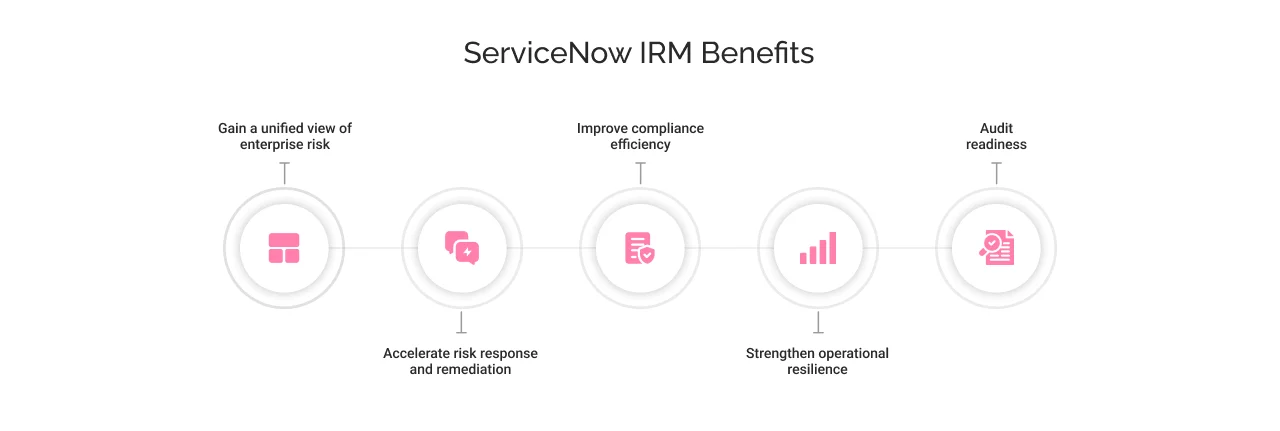
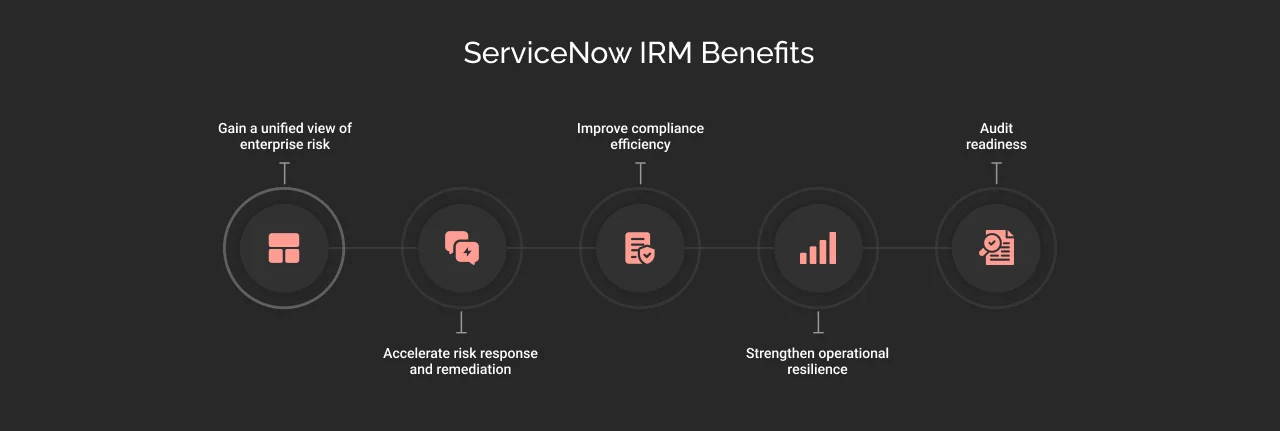
- Gain a unified view of enterprise risk– Disconnected systems usually lead to inconsistent reporting and duplicate efforts. ServiceNow IRM ensures a single source of truth for compliance, risk, and audit data, allowing teams to make informed decisions based on unified data.
- Accelerate risk response and remediation– The traditional risk processes, like GRC, are reactive and rely on periodic assessment. IRM uses automated workflows and continuous monitoring to identify issues in advance and route remediation tasks to the right team.
- Improve compliance efficiency– Managing complex compliance requirements can be a time-consuming and resource-intensive process. ServiceNow IRM automates these compliance activities, control testing, and evidence collection, and reduces overall administrative overhead.
- Strengthen operational resilience– Risks today go beyond cybersecurity and compliance; they can directly impact business continuity and customer trust. ServiceNow IRM helps businesses continuously monitor risks and respond proactively without any human intervention, improving their ability to withstand disruptions.
- Audit readiness– With continuous monitoring in place, organizations are always ready for compliance checks and system audits. IRM provides unified data of different system breakdowns, their root causes, and potential impacts, helping auditors and leaders to identify areas of improvement and ensure better visibility on compliance measures.
These benefits and capabilities of IRM are not designed to run in isolation. Together, they form an integrated framework that help orgaization identify, assess, monitor, remediate, and report risks more effectively. Let’s find out how this process works in real-life.
The IRM Lifecycle in Practice
While each IRM capability and benefit addresses a distinct business problem. A regulatory change can trigger new compliance requirements, a failure in control can lead to audit findings, and vendor mismanagement can lead to disruption. ServiceNow IRM connects these activities through an integrated lifecycle, enabling organizations to identify, assess, monitor, and respond to risks more effectively.
- Identify- Discover and register risks, as these can come from threat intel, internal audit, system alerts, or manual entry by users. In IRM, risks are usually tied to configuration items such as business services and assets in the CMDB.
- Assess– IRM lets you set up tailored assessment templates and scoring. Automated questionnaires and data feeds, such as vulnerability scans, can populate risk factors. The AI agents can provide a risk rating based on historical data that will help assess the level of risk.
- Monitor– This step uses performance analytics and automated checks to keep track of the risk factors. For example, IRM’s continuous control monitoring will detect if a control is failing and create an issue or trigger reassessment of the affected risk.
- Remediate– IRM workflows route tasks to the right security team along with recommended actions. The issue tracking is built in so that remediation actions can be documented and used in the future for potential failures.
- Report– IRM provides customizable reports and dashboards for different audiences. Executives get high-level heat maps while auditors see control test results and evidence. Most importantly, reporting in IRM is data-driven and real-time, which means no longer relying on manual spreadsheet consolidation.
This continuous loop means the IRM is proactive, and one team’s risk mitigation automatically feeds back into the system for re-assessment.
As the lifecycle demonstrates, ServiceNow IRM is designed to deliver continuous visibility and action across the risk landscape. This raises an important question: how does this approach differ from the traditional GRC model that many organisations are familiar with? Let’s find out.
Why Organisations Are Moving from GRC to ServiceNow IRM
ServiceNow IRM is often described as the evolution of the next generation of traditional GRC (Governance, Risk, and Compliance) approach. Understanding the core difference can help organizations in deciding between the Traditional GRC and IRM.
| Aspect | Traditional GRC | ServiceNow IRM |
|---|---|---|
| Scope | Focused on classic GRC domains such as policy and audit. Often limited to compliance tasks within siloed departments. | Enterprise-wide risk focus where it covers operational, strategic, IT, and cyber risks in one program. |
| Integration | Modules often act as standalone applications. Typically require deep integration for manual efforts or custom work. | Specifically built for integration, where pre-built connectors link IRM with security, ITRM, HR, and other apps. For example, vulnerabilities in SecOps can automatically create IRM risks. |
| Automation and AI | Automates basic workflows where there is little to no built-in AI available. | Uses advanced automation and AI with features like AI-driven risk identification, automated response orchestration, and predictive analytics. Continuous monitoring replaces periodic audits. |
| User experience | Primarily focused on GRC professionals. Interfaces may not be intuitive for business users. | Role-based and intuitive dashboards for all users. Non-technical users can see risks in real-time. There is embedded guidance, and Now mobile makes IRM accessible for everyone. |
| Continuous monitoring | Periodic assessment and audit, where risk review schedules are reviewed quarterly or annually. | Continuous and event-driven approach. Here, the users are able to monitor risks on a continuous basis, and events can be triggered based on potential risk identification. |
| Platform | There is a set of separate applications or legacy tools where integration depends on manual setup. | It is a part of the ServiceNow single cloud platform, where there is a shared CMDB and data with other ServiceNow modules. |
| Reporting | Standards reports available on compliance status, risk register, and audit findings. It may require manual data gathering. | Advanced analytics and dedicated dashboards available with real-time heat maps, predictive modelling, and drill-down reports. |
| Deployment | It can be deployed in a real location or in the cloud and often licensed per module. It may have higher maintenance overhead. | Delivered as a cloud service with multiple IRM components. It leverages the scalable architecture of the ServiceNow AI Platform with benefits from regular upgrades and low-code extensibility. |
Both have scaled and evolved, assessing the changing needs of the industry. A key takeaway is that ServiceNow IRM extends the capabilities of GRC rather than discarding them. During the transition, an organization may run GRC and IRM side-by-side depending on the ever-changing requirements. Modern organizations ensure priority to ServiceNow IRM because of its advanced capabilities, which are an added advantage to GRC.
As organizations face growing regulatory demands, operational complexity, and evolving risk landscapes, the need for a unified risk management framework becomes clear. This is where ServiceNow IRM delivers its greatest value.
Final Thoughts
In the current environment of expanding regulations and cybersecurity threats, organizations can not afford fragmented and reactive risk processes. ServiceNow IRM provides modern solutions by bringing AI-powered, continuous risk management to enterprises. By unifying compliance, risk, audit, and resilience in one platform, IRM helps businesses move faster, respond proactively to potential risks, and make data-driven decisions based on real-time data.
Realizing these benefits, capabilities, and outcomes depends on more than implementing the technology itself. The success of the platform requires an appropriate risk framework, integration, governance structure, and automation strategy aligned with your business objectives.
Whether you’re evaluating ServiceNow IRM, planning an implementation, or looking to optimize your current setup, Cyntexa’s ServiceNow experts can help you build a risk management framework that delivers measurable business outcomes. From assessments & roadmap development to implementation & optimization, we help organizations transform IRM into a strategic business enabler rather than just another compliance initiative. Leverage Cyntexa’s ServiceNow consulting services to tailor ServiceNow IRM to your organization’s unique governance, risk, and compliance requirements.
Schedule a consultation call today.
Don’t Worry, We Got You Covered!
Get The Expert curated eGuide straight to your inbox and get going with the Salesforce Excellence.
Shruti is a ServiceNow Consultant with 5+ years of experience across ServiceNow ITSM, AWS, Salesforce Loyalty Management, and managed services. She blends technical expertise with strategic insights to deliver transformative IT services and CRM solutions that enhance efficiency and customer satisfaction.


Cyntexa.
Join Our Newsletter. Get Your Daily Dose Of Search Know-How