




ServiceNow Knowledge26 Day 1 Keynote: The Agentic Era Just Got a Control Tower
source on Google
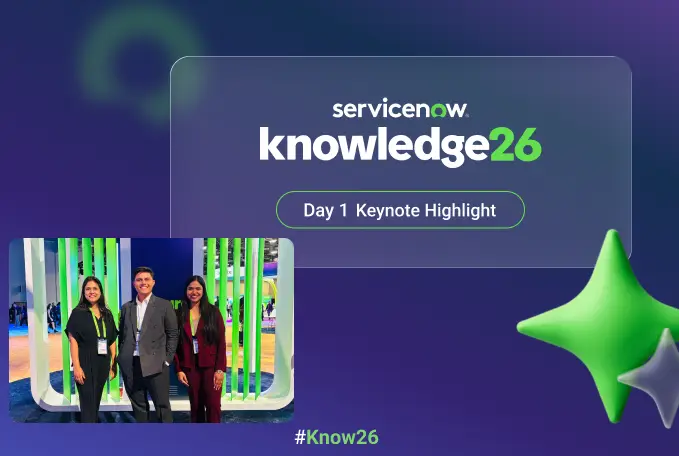
Table of Contents
source on Google
If you have been following ServiceNow’s trajectory over the last two years, Knowledge 2026 Day 1 was the moment the company stopped talking about AI potential and started showing what governed AI execution actually looks like in production. The keynote covered the launch of Otto, the expansion of AI Control Tower, 20 new Autonomous Workforce specialists, and Action Fabric.
Day 1, currently taking place in Vegas, began with a very clear focus: AI chaos is real, and a lot of enterprises are living in it. Most enterprises have already deployed AI agents. The honest reality is that most of them have no idea what those agents are doing, what they are costing, or whether they are delivering anything worth measuring. In his opening keynote, Bill McDermott opened the Knowledge 26 stage by naming that problem directly, and every announcement that followed was built around solving it.
This blog breaks down what was announced on Day 1, what each product actually changes, and what it means if you are trying to scale AI without things falling apart.
ServiceNow Knowledge 2026 Day 1 Keynote Highlights
Bill McDermott (Chairman and CEO, ServiceNow) was joined by Amit Zavery (President, COO, and CPO, ServiceNow) and Jensen Huang (CEO, NVIDIA) to deliver the keynote on day 1 of Knowledge 2026. In his keynote, he highlighted the need for deploying AI systems with complete governance and visibility already built in.
Zavery, in his keynote, said, “Enterprises need AI that senses, decides, and acts securely in accordance with organizational guardrails“. In his statement, he highlighted that most enterprises today deploy AI agents across dozens of systems with no central visibility, no accountability, and no clear way to measure what it’s actually delivering.
With ServiceNow at the center, the next phase of enterprise AI will be governed, where agents can work autonomously at scale. Hence, the keynote focused on the expansion of AI Control Tower from a governance layer into a full enterprise AI command center
What Was Announced At The Knowledge 2026 Day 1 Keynote
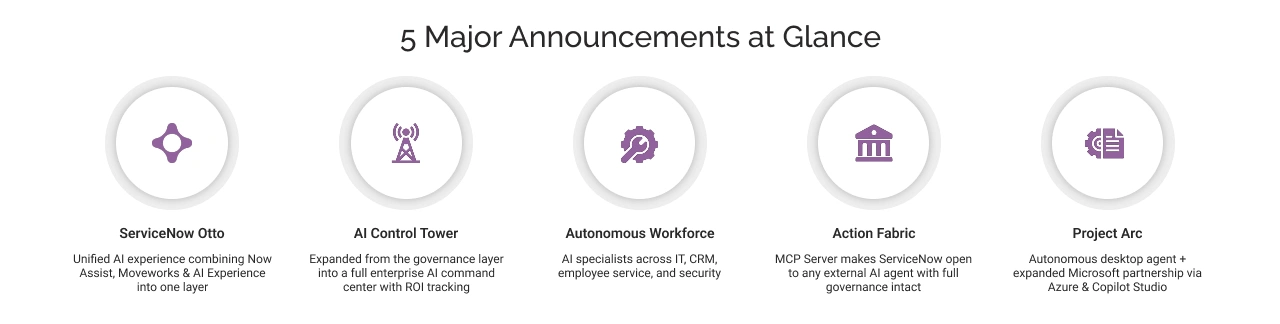
The keynote covered a lot of announcements on the product side, including:
- ServiceNow introduced Otto, which is a new AI experience that brings Now Assist, Moveworks, and AI Experience together into one.
- Autonomous Workforce rolled out 20 new AI specialists across IT, CRM, employee service, and security and risk.
- AI Control Tower will act as a command center for the entire ServiceNow platform to bring AI governance already built in, not an add-on.
- Action fabric allows ServiceNow workflows to be connected to any external AI agent through a generally available MCP Server.
- The expansion of the Microsoft partnership, which will bring AI Control Tower governance across Azure and Copilot Studio.
- Introduction of Project Arc, which is an autonomous desktop agent built on NVIDIA’s OpenShell sandboxed runtime environment. Enterprises can govern it through ServiceNow’s AI Control Tower.
ServiceNow Launches Otto to Unify AI Across the Enterprise
On day 1 of Knowledge 2026, ServiceNow announced the launch of Otto, which is the new enterprise experience layer that combines conversational AI, autonomous workflows, and enterprise search into a single experience.
How Does ServiceNow Otto Work?
ServiceNow Otto is designed to handle end-to-end processes from initiation to execution. It does not execute actions in isolation. Instead, it works across the entire enterprise to complete tasks inside existing approval chains and audit trails.
ServiceNow Otto understands context, user intent, and accordingly, routes work to the right agent. It means employees no longer need to switch between systems to get one thing done; everything is now under one unified experience.
AI Control Tower Reimagined As An Enterprise Command Centre
ServiceNow has already been working with the AI Control Tower to ensure AI governance across the platform. At Knowledge 2026, the AI Control Tower is presented as more than a visibility layer. It will now govern the entire AI lifecycle by acting as a full command centre, irrespective of the enterprise systems or cloud it is running on. Enterprises can govern the AI lifecycle across every model, agent, identity, asset, and dataset they’re working with.
What Can Enterprises Govern Through AI Control Tower?
The expanded AI Control Tower includes discovery across 30+ enterprise integrations. It also includes automated risk and compliance controls, real-time observability into how the agent behaves, as well as a financial dashboard that will give enterprises complete control over their AI spend. It means ServiceNow’s AI Control Tower does not offer governance alone; it now operates like a central nervous system of enterprise AI.
ServiceNow Extends Autonomous Workforce Across Every Major Business Function
ServiceNow announced a major expansion of its Autonomous Workforce, where it introduced 20 new AI specialists who will work across CRM, IT, employee services, security, and risk. These AI specialists are designed to handle end-to-end processes alongside humans, unlike task-based AI tools or agents that only perform isolated actions.
Why Zavery Said Advisory AI Has Run Its Course
By saying ‘Advisory AI has run its course’, Amit Zavery highlights the gap that persisted in AI agent actions. Most enterprises today have AI that can summarise, recommend, and search information, but it still leaves gaps for humans to do the actual work. This is why enterprises need AI that does more than advising.
Hence, the Autonomous Workforce has role-scoped AI specialists, who are embedded in the ServiceNow workflows, enabling enterprises from intake through case resolution, with governance built in from the start. This shift will help ServiceNow users handle end-to-end execution autonomously without adding any new tools, new governance, or new vendors on top of what they are already using.
ServiceNow Action Fabric Opens the Platform to Any AI Agent, Anywhere
Knowledge 2026 answers one of the most practical questions that enterprises may have: How to scale AI without replacing the existing infrastructure?
ServiceNow solves this through Action Fabric, which was one of the major announcements on day 1 at Knowledge 2026. It opens the entire ServiceNow system to any AI agent, irrespective of where it is built. Enterprises can execute secure and governed enterprise actions using a generally available Model Context Protocol (MCP) server, exposing the agents to perform actions headlessly.
It means that enterprises no longer need to switch between the systems, as any external agent can trigger actions inside ServiceNow while still operating within the governance and approval rules of the platform. For instance, agents running on Claude or Microsoft Copilot can now trigger ServiceNow workflows directly, without going through a traditional UI.
ServiceNow Gives Enterprises Full Visibility Into AI Performance and Value
The opening day included one of the most practical demonstrations at Knowledge 2026. It highlighted that the expanded AI Control Tower will give enterprises direct visibility into the value and performance of every AI system they are running.
How to Evaluate AI Performance using AI Control Tower?
Until now, most enterprises had no reliable way to measure what their AI investments were actually returning. But with AI Control Tower, a dedicated financial and performance dashboard comes built directly into the platform. Here is what it tracks and what that means for enterprises:
- Check productivity gains: The dashboard will highlight exactly how much time and money each AI system is saving, broken down by capability.
- Net AI returns after costs: In addition to the gross output, enterprises can also see their actual ROI after AI consumption costs are deducted.
- Value breakdown by AI system: Enterprises can look into the specific AI capabilities that are delivering the most value. Hence, they can identify what is working, what is underperforming, and where to invest next.
- Log of AI actions: Enterprises can analyze how much autonomous work the platform is actually executing, as every AI action taken across the period will be logged and counted inside the dashboard.
- Visibility into security and compliance: AI Control Tower flags risks and governance issues inside the same dashboard. These issues can be related to security threats, unauthorized AI activity, inactive agents, etc.
Project Arc: ServiceNow and NVIDIA Bring Governed Agents to the Desktop
Jensen Huang joined McDermott on stage for the third consecutive year, and not just as a partner. NVIDIA runs its own employee workflows on ServiceNow. Its configure-price-quote system for supercomputers used to take five days to generate. It now takes five minutes.
The partnership announcement is Project Arc, an autonomous desktop agent that thinks, writes code, executes, and adapts when things do not go as expected, all without requiring pre-built workflows. Every action runs inside NVIDIA OpenShell, a sandboxed runtime that keeps activity contained and auditable. AI Control Tower governs what the agent can see, do, and log.
Huang put it simply on stage: “You have human agents and AI agents, and they basically govern the same way.” Project Arc is available as an early preview.
For businesses, this means an AI agent that lives on your employee’s desktop and handles complex multi-step work across your existing tools, with your security team able to audit every single action it takes.

Bottom Line: ServiceNow Knowledge 2026 Key Takeaways
Scaling AI is one thing. Doing it without replacing existing infrastructure is another, and that is exactly what ServiceNow addressed at Knowledge 2026. The announcements at the ServiceNow Knowledge 2026 addressed three core problems that have been holding enterprises back: AI agents working in isolation, governance deployed as an additional layer rather than being built in, and measuring AI investments.
If Knowledge 2026 has you rethinking your ServiceNow AI strategy, now is a good time to evaluate your existing ServiceNow setup. Cyntexa’s ServiceNow consultants work with enterprises to assess AI readiness, and we can help you build toward the kind of autonomous execution ServiceNow demonstrated this week.
So if you’re looking to scale responsibly, connect with our team, reach out now! We will continue these conversations at ServiceNow World Forum London on October 20, 2026.
Don’t Worry, We Got You Covered!
Get The Expert curated eGuide straight to your inbox and get going with the Salesforce Excellence.
Co-founder and CTO at Cyntexa also known as “VJ”. With 10+ years of experience and 22+ Salesforce certifications, he’s a seasoned expert in Salesforce Data Cloud & AI Products, Product Engineering, AWS, Google Cloud Platform, ServiceNow, and Managed Services. Known for blending strategic thinking with hands-on expertise, VJ is passionate about building scalable solutions that drive innovation, operational efficiency, and enterprise-wide transformation.


Cyntexa.
Join Our Newsletter. Get Your Daily Dose Of Search Know-How