



ServiceNow vs Ivanti: Which One to Choose in 2026
Table of Contents
When it comes to enterprise IT service management, ServiceNow and Ivanti are two powerhouses, each with a distinct focus. ServiceNow is like a city planner, designing and managing the entire enterprise infrastructure, ensuring all departments, workflows, and systems operate in harmony.
Ivanti, on the other hand, is like a specialist technician, optimizing and securing individual endpoints to maintain daily operations efficiently. While both of them aim to improve IT efficiency and user experience, they differ in their approaches, architecture, and core strengths.
Let us understand that comparison through this blog and help you evaluate which platform fits best with your organization’s requirements.
So, without further ado, let’s begin!
ServiceNow & Ivanti Overview
ServiceNow is a cloud-based enterprise platform designed to streamline and automate workflows across various departments, including IT, HR, customer service, and security. It is built on the ServiceNow AI Platform. It offers a unified architecture that supports low-code development and AI-powered automation embedded in workflows.
Ivanti is a unified IT platform that combines ITSM, endpoint management, and security automation under one roof. It strengthened this position after acquiring Cherwell Software in 2021. The platform is powered by the Ivanti Neurons Platform (cloud technology platform), which helps organizations streamline device control, patching, and IT support across hybrid environments (cloud or on-premises).
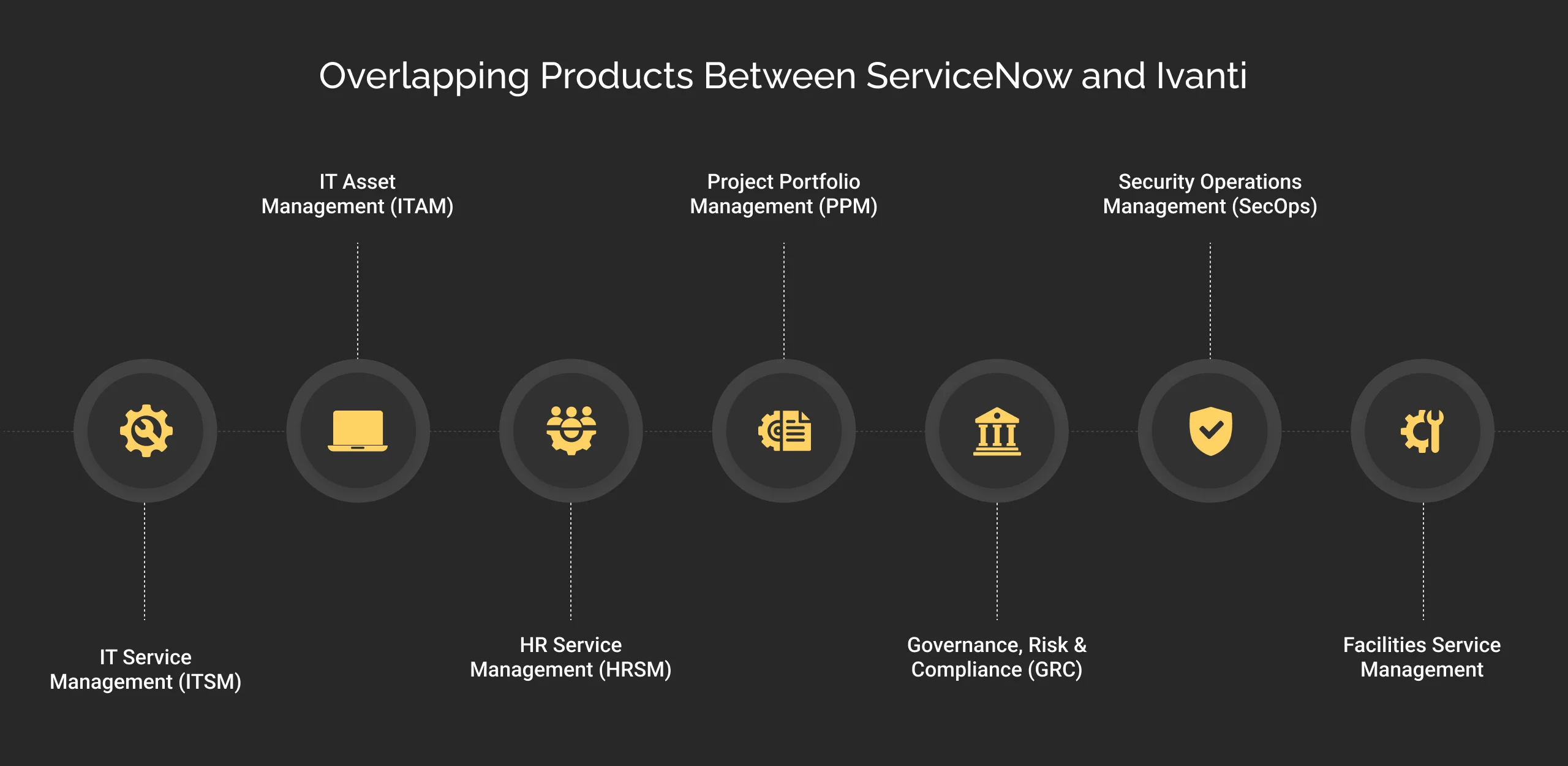
Overlapping Products b/w ServiceNow & Ivanti
ServiceNow and Ivanti both have a range of core enterprise offerings that help organizations streamline operations and improve efficiency. Here are some of the common offerings by both platforms:
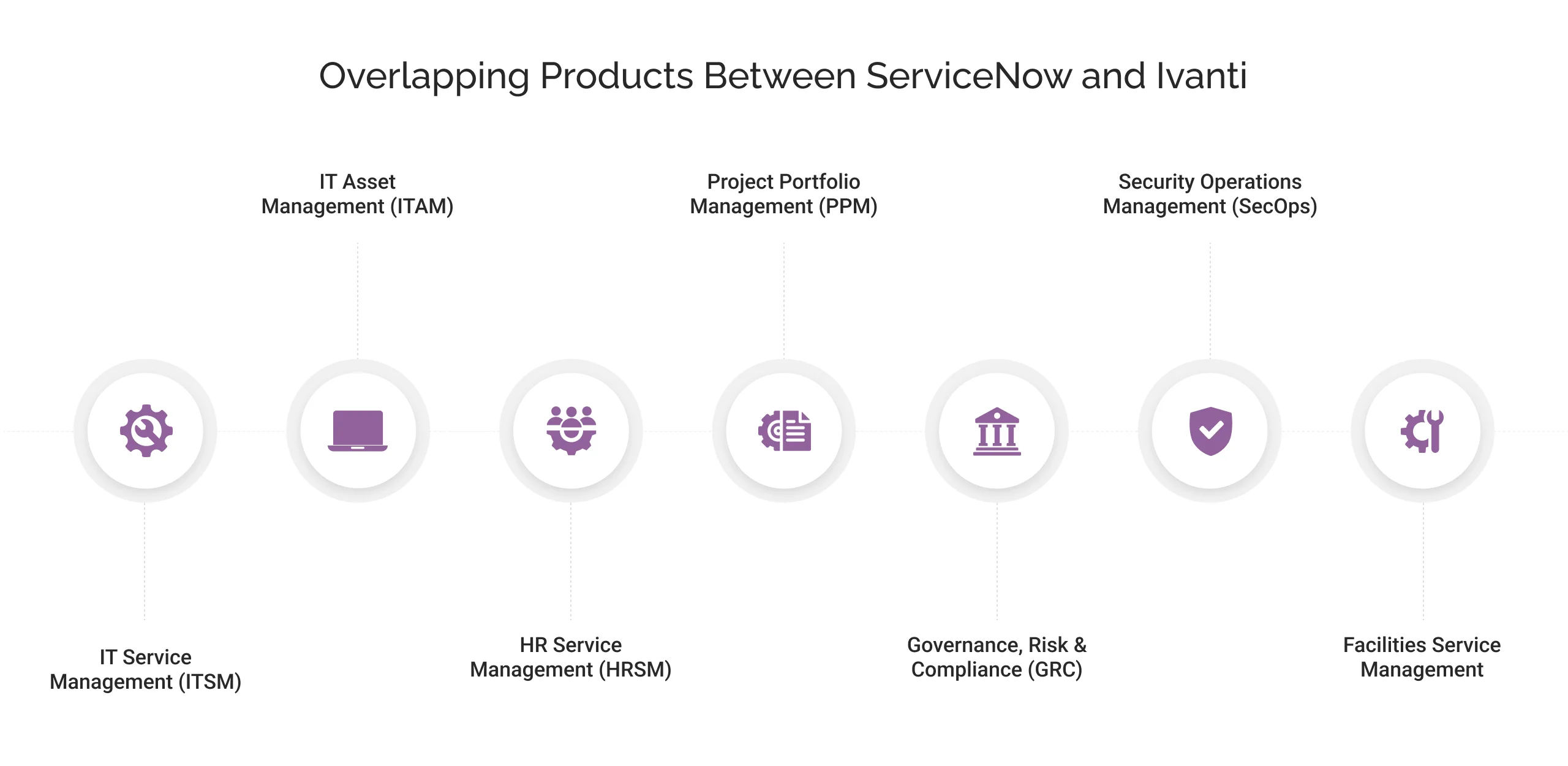
- IT Service Management (ITSM)
- IT Asset Management (ITAM)
- HR Service Management (HRSM)
- Project Portfolio Management (PPM)
- Governance, Risk & Compliance (GRC)
- Security Operations Management (SecOps)
- Facilities Service Management
Let’s take a closer look at each of these product categories and see what both platform’s offerings provide.
ServiceNow ITSM vs. Ivanti ITSM
| Capabilities | ServiceNow ITSM | Ivanti ITSM |
| Incident management capabilities | The platform supports enterprise-wide incident tracking along with AI-assisted problem routing and escalation. This is possible with centralized CMDB, predictive intelligence, and an Integration Hub for monitoring tools. | Supports endpoint-focused incident automation with self-healing. As the endpoint telemetry, scripts auto-resolve issues before human intervention. |
| Knowledge management capabilities | It has a centralized knowledge base, AI search capabilities, and contextual recommendations. | The knowledge base articles are converted into automation workflows via Ivanti Neurons for Healing. |
| Change management capabilities | It is fully ITIL-aligned with advanced change risk scoring and CAB (Change Advisory Board) workflows. Widely used for managing enterprise-level compliance. | Provides streamlined change tracking with emphasis on endpoint-level changes such as patches and software updates. |
| Request management capabilities | Offers service catalogs with advanced workflow orchestration. Backed by Flow Designer, which allows drag-and-drop automation across IT and business services. | Provides request catalogs focused on device and software management (password reset, software delivery, license requests). It also automates provisioning by linking directly with Ivanti Endpoint Manager. |
| Problem management capabilities | Offers ITIL-aligned problem identification, root-cause analysis, and trend detection across the enterprise. | Supports rule-based detection and automated resolution using Neurons for healing, along with a focus on immediate endpoint issues. |
| AI and automation capabilities | Uses Predictive AI, Now Assist (GenAI), and Automation Engine for cross-platform process automation. Can automate approvals, workflows, and even anomaly detection across various departments like HR, IT, and Security. | Built around Ivanti Neurons, a real-time automation fabric for endpoints. Uses sensor-based automation that continuously scans devices for misconfigurations or vulnerabilities and executes predefined remediation actions instantly. |
| Third-party integration capabilities | Offers Integration Hub with 1,000+ connectors (Slack, Microsoft Teams, Zoom, AWS, etc.). It is often used as the orchestration layer across enterprise IT and business. | The platform provides connectors mainly in security, patching, and endpoint tools. Though it has strong ties with vendors like Microsoft, SCCM, and security scanners. |
| Pricing | The platform offers different editions that can be customized: ITSM standard ITSM professional (ITSM Pro) ITSM enterprise | The platform offers a wide range of quota-based and customized pricing tiers: ITSM Professional ITSM Enterprise ITSM Premium ITSM Enterprise Premium |
ServiceNow ITAM vs. Ivanti ITAM
| Capability | ServiceNow ITAM | Ivanti ITAM |
| Platform overview | The platform intends to manage an organization’s IT assets from procurement to retirement. It is built on Now Platform, which is why it integrates with ITSM, CMDB, and financial management. | The platform intends to manage an enterprise’s full lifecycle of hardware, software, and virtual assets; it integrates with ITSM, security, and procurement. |
| Asset discovery and inventory management | It has the ability for auto-discovery of the IT infrastructure. Along with that, it tracks ownership, location, and usage of the asset in consideration. | It facilitates automatic discovery of hardware/software assets. Further, it has centralized inventory management; location-based tracking. |
| Software license management | Its software asset management module enables compliance monitoring, optimization, and lifecycle tracking. Along with license reconciliation and cost control. | The platform efficiently tracks the assets’ license compliance, usage, and renewals. This process being automated enables optimization and cost reduction. |
| Hardware lifecycle management | For the hardware management, its module manages lifecycle management with procurement, assignment, maintenance, and disposal of the asset and is eventually linked to CMDB. | It tracks procurement, deployment, maintenance, and retirement of the asset. Further, it integrates with work orders and ITSM. |
| Analytics and reporting capabilities | It has performance dashboards, KPIs, and analytics for proper visibility into aspects like compliance and asset utilization. | It has dashboards for asset health, utilization, and compliance of the asset. It also gives alerts for under-/over-utilization of the organization’s assets. |
ServiceNow HR Service Delivery (HRSD) vs Ivanti HR Service Management (HRSM)
| Capability | ServiceNow HRSD | ServiceNow HRSM |
| Platform overview | It is built on the ServiceNow AI Platform and is a centralized hub for all HR tasks. | It is integrated with the Ivanti Neurons platform and Ivanti Neurons for ITSM for HR efficiency. |
| Employee journey and case management | Provides end-to-end employee lifecycle management (onboarding, offboarding, transitions, promotions, leave) via a centralized workspace. Along with that, the Alumni Service Center keeps former employees engaged. | Automates onboarding, transitions, and return-to-work processes with batch case management and role-based workflows. |
| AI and automation assistance for self-service capabilities | AI-powered Now Assist and AI Agents for HRSD streamline case routing, auto-resolve routine queries, guide employees through multi-channel self-service, and support decision-making. Further, it also offers a comprehensive knowledge base for employee queries. | Smart automation resolves frequent HR related issues and results in rapid issue resolution through Neurons and endpoint integrations. |
| Example | When an employee raises a query about a payroll issue, ServiceNow automatically routes it to the right HR specialist, provides relevant knowledge articles in the employee portal, and tracks resolution metrics in real time. | If multiple employees face login issues, Ivanti automatically identifies the trend, pushes a fix to affected systems, and updates the knowledge base. |
ServiceNow GRC vs Ivanti GRC
| Capability | ServiceNow GRC | Ivanti GRC |
| Platform overview | It is a cloud-native GRC solution built on Now Platform. It integrates risk, compliance, audit, and policy management. It is intended to connect security and IT operations. | It is a platform that centralizes risk and compliance processes across IT, security, and operations. It leverages the Ivanti Neurons platform for automation and integration. |
| Risk management capabilities | The platform continuously assesses operational and IT risks; it prioritizes remediation using dashboards and analytics. | It identifies, tracks, and prioritizes risks accordingly. It has automated workflows for mitigation and remediation. |
| Compliance and policy management capabilities | It automates policy distribution, attestation, and monitoring of regulatory compliance. | It tracks regulatory policies, audits, and compliance status. Further, it also generates reports for internal/external stakeholders. |
| Audit management capabilities | The platform automates audits, evidence collection, and reporting. Further, it connects findings to risk and compliance frameworks. | The platform streamlines audit planning, execution, and reporting; it links audit findings to risks and corrective actions. |
| Reporting and analytics capabilities | It has performance dashboards, KPIs, and heatmaps for risk, compliance, and audit activities. | It has dashboards for risk exposure, compliance status, and remediation progress. |
ServiceNow SecOps vs Ivanti SecOps
| Capability | ServiceNow SecOps | Ivanti SecOps |
| Platform overview | It is built on ServiceNow AI Platform (Now Platform); it intends to bridge IT and security silos; it orchestrates and automates workflows with SOAR principles. | It is built on the Ivanti Neurons platform (ITSM, ITAM), a centralized process for threats and vulnerabilities. It integrates with DevOps tools (Jira, Azure DevOps). |
| Incident management | Its Security Incident Response (SIR) module manages the lifecycle from detection to resolution; it integrates threat feeds and logs. | It automatically or manually assigns vulnerabilities/incidents; links events to platforms like ITSM, operations, and DevOps. |
| Vulnerability management | Its Vulnerability Response (VR) module identifies, prioritizes, and remediates vulnerabilities using CMDB correlation. Further has AI-driven prioritization. | The platform tracks vulnerabilities, assigns remediation tasks to teams, and integrates with Risk-Based Vulnerability Management (RBVM). |
| Reporting and analytics capabilities | It offers performance analytics for MTTD/MTTR; security posture control; proactive monitoring and compliance tracking. | It offers live dashboards, reporting, and visibility into status and remediation activities. |
| Integration capabilities | The platform integrates SIEM, EDR, firewalls, and threat intelligence feeds; workflow-centric with a data fabric for real-time insights. | It’s OOTB integrations with ITSM, DevOps, and security tools via REST APIs. |
ServiceNow Workplace Service Delivery vs Ivanti Facilities Service Management
| Capability | ServiceNow WSD | Ivanti Facilities Service Mgt. |
| Platform overview | It’s a cloud-based platform that has a suite of applications to plan, design, and optimize workplace experiences. | Integrated with the Ivanti Neurons platform (ITSM, HR), this is a platform that automates facilities service management and workflows. |
| Self-service capabilities | Its Workplace Reservation Management module is a self-service portal for desks, rooms, and services; it manages recurring reservations and additional requests. | It has an employee self-service portal for requests, room reservations, and consumables; a knowledge base for common questions. |
| Work order and maintenance management | Its workplace maintenance module offers preventive and urgent maintenance; automated cases for assets/spaces. | Its work order lifecycle management takes care of logging of time, costs, and receipts; recurring maintenance; and mobile and web access. |
| Workspace and visitors’ management capabilities | For workspace management, it has indoor mapping, reservations, and utilization insights. There is visitor management for check-ins, Wi-Fi, and policies. Further, there is a Workplace Concierge for employee info on occupancy, resources, and hybrid schedules. | It offers extended location tracking, space assignment, and access management. It also supports remote, in-person, and hybrid models; sanitation scheduling; and access management. |
| Reporting and analytics capabilities | For reporting and analytics, it has Workplace Central, which acts as a single source of truth. It has dashboards for occupancy, maintenance, leases, and move management. | It has role-based dashboards for real-time operational performance, project cost, and productivity analysis. |
ServiceNow PPM and Ivanti PPM differences
ServiceNow Project Portfolio Management is a platform that aligns organizational strategy with work execution. It helps them prioritize investments, manage projects. Along with that, it assists in optimizing resources across agile, traditional, or hybrid methods. It does this by centralizing the project’s demand, enabling roadmap planning, tracking all work in a single platform, and offering real-time resource insights with KPI and goal monitoring.
Ivanti Neurons for Project Portfolio Management provides real-time visibility into projects and programs. It prioritizes and manages initiatives across IT, HR, facilities, and security by consolidating requests, using scoring matrices, and providing role-based dashboards for efficient resource optimization and reporting.
Understanding the core differences
Here’s how you can understand the overall core differences between the platforms:
ServiceNow is a comprehensive, enterprise-wide orchestrator, while Ivanti excels at endpoint-focused efficiency
The ServiceNow Platform is designed as a cross-departmental orchestrator that unifies multiple department workflows, such as IT, HR, customer service, etc., in one single cloud-native platform. It is trusted by enterprises like Coca-Cola and Siemens to standardize their operations across hundreds of processes.
The Ivanti platform is ideally built for systematically streamlining endpoint-centric IT operations. Its strength lies in Unified Endpoint Management (UEM) and hybrid deployments, making it ideal for organizations managing diverse device landscapes.
ServiceNow offers strategic predictive insights for long-term planning, while Ivanti delivers tactical, hyper-automated problem resolution
ServiceNow uses AI and machine learning (Now Intelligence) to analyze enterprise-wide data, predict outages, and recommend workflow optimizations. This helps in strategic and long-term future planning. For instance, ServiceNow’s AI can help you with questions like, based on the current incidents, which business service is most likely to have an outage in the next quarter?
On the other hand, Ivanti’s AI (Ivanti Neurons) is tactical and domain-focused. It uses “hyper-automation” bots to solve immediate, high-frequency IT problems at the source. It also automates patching, device health checks, and self-healing. Also offers a conversational AI-powered service desk agent that automates the resolution of employee questions, issues, and requests quickly, similar to ServiceNow’s employee self-service portal. For example, its automation can help you solve immediate problems like how to automatically detect and patch a critical vulnerability on 10,000 laptops immediately.
ServiceNow supports a vast integration ecosystem across enterprises, while Ivanti leverages strong native capabilities for endpoint control
ServiceNow Integration Hub is vast because its value comes from its ability to connect to and manage workflows across hundreds of other enterprise systems. It doesn’t need to do everything itself, as long as it can control everything. So basically, it’s like the central nervous system to connect and manage your entire technology stack.
With Ivanti’s native strengths in UEM, endpoint security, patch management, and remote support, it provides a unified approach to device control and maintenance, reducing the need for separate, disconnected tools. However, if one wants to extend the capabilities, one can do it as Cherwell’s (formerly known before the acquisition) catalog can be extended through integrations with third parties like AWS, etc., for quicker resolutions.
ServiceNow offers a polished, enterprise-wide UI, while Ivanti focuses on functional endpoint workflows
ServiceNow’s Polaris design system ensures a polished, consistent interface across departments, critical for cloud-first enterprises seeking a unified service portal. Its UI experience is ideal for “cloud-first” organizations aiming to provide a single, modern portal for all employee service needs.
Ivanti provides a functional, workflow-focused UI optimized for IT teams and endpoint management. The interface is designed for speed and efficiency on device-level tasks, allowing IT teams to quickly resolve issues and manage endpoints without unnecessary complexity.
ServiceNow standardizes enterprise workflows, while Ivanti enables rapid, hybrid, or on-prem deployment
ServiceNow being cloud-native, deployment ensures standardization and control across large enterprises, but the implementation timeline can be longer because of complex cross-department processes and approvals.
Ivanti’s native support for hybrid and on-prem deployments provides organizations with the flexibility to operate within regulatory requirements or leverage existing infrastructure investments. Its deployment versatility is ideal for enterprises that need a robust solution to manage a distributed IT environment spanning on-prem data centers and multiple clouds.
ServiceNow & Ivanti Working Approach Differences
Let’s understand the difference between the platform’s working approach with the help of an example. There’s an organization “A” that experiences a recurring issue where its employees are unable to access an internal app due to expired certificates on endpoint devices.
Here’s how ServiceNow works
Problem discovery: The issue will be flagged by monitoring tools integrated into the Now Platform. A ticket will get auto-created with context from CMDB, including device history and user impact. Later, predictive intelligence would suggest probable root causes of the issue.
Problem routing: The AI Search and Virtual Agent would triage the ticket, route it to the right team based on impact analysis. Above all, that would notify affected users of the current status updates.
Problem resolution: The assigned technician would use orchestration workflows to push a certificate renewal script. However, if the issue is detected to be widespread, then a change request will be initiated with CAB approval.
Reports and feedback: The dashboards would update in real-time. Lastly, this incident would get linked to problem records to suggest preventive actions in case a similar problem appears in the future.
Here’s how Ivanti works
Problem discovery: Ivanti Neurons detects the expired certificate via endpoint telemetry. A ticket would then get generated with device-level diagnostics and remediation options already attached.
Problem routing: The ticket would get routed using rule-based automation. If configured, Ivanti would auto-prioritize it based on device criticality or user role.
Problem resolution: The Neurons for Healing will auto-execute a remediation script directly on affected endpoints. This means no human intervention would be required. The systems would confirm the resolution and close the ticket.
Reports and feedback: Eventually, the Endpoint health scores improve. The system logs the fix and updates the device compliance status, all with minimal human intervention.
ServiceNow vs Ivanti: Which one to choose
So, we can conclusively say that both these platforms are built for serving different strategic needs.
One can choose ServiceNow when:
- When you need enterprise-wide digital transformation across all departments.
- When you need a platform that supports project strategic governance and resource planning.
- When you need a platform that can manage enterprise risk, compliance regulations, and audits well.
One can choose Ivanti when:
- When you need endpoint-centric automation (laptops, servers, mobile devices).
- When you need flexibility to deploy on-premises or hybrid infrastructure.
- When you need quick deployment and a fast time to market.


Conclusion
This was a brief comparison of both the capable platforms for an enterprise’s IT solutions. The comparison only intends to provide a talking point regarding the selection of the platform that best meets your organization’s needs. Ultimately, the final decision is yours. Be sure to consider best practices and relevant scenarios in your selection process.
If you need help deciding the right platform for your business, you can also schedule a consultation call with Cyntexa.
Don’t Worry, We Got You Covered!
Get The Expert curated eGuide straight to your inbox and get going with the Salesforce Excellence.
AUTHOR
Shruti
ServiceNow, Sales Cloud
Shruti is a ServiceNow Consultant with 5+ years of experience across ServiceNow ITSM, AWS, Salesforce Loyalty Management, and managed services. She blends technical expertise with strategic insights to deliver transformative IT services and CRM solutions that enhance efficiency and customer satisfaction.


Cyntexa.
Join Our Newsletter. Get Your Daily Dose Of Search Know-How