




What is Claudeforce? Everything You Need to Know
source on Google
Table of Contents
source on Google
Claudeforce is the result of the Salesforce and Anthropic partnership that brings Claude’s AI reasoning together with Salesforce’s data, workflows, business rules, and actions. It helps users work with Salesforce information through Claude and turn AI-driven insights into governed business actions.
This partnership is already making waves across the ecosystem, and in this blog, we break down what it means, how it differs from Agentforce, features, how it works, and how to implement it in your business. Let’s get started.
What is Claudeforce?
Claudeforce brings Claude’s intelligence and reasoning together with Salesforce’s trusted data, workflows, business logic, actions, and governance. Its first product is Salesforce in Claude, a plugin with 37 prebuilt sales skills that lets sellers and agents work with live Salesforce context and take governed actions directly from Claude.
As Marc Benioff explained, the partnership combines AI reasoning with the trusted data, workflows, and governance businesses already rely on.
What is the need for Claudeforce?
The problem with traditional CRM is that if the team wants to know why a deal is slowing down, they need to inquire in several places. So instead of checking records, emails, Slack conversations, and previous meetings, simply ask Claude to identify the reasons. The problem is solved within seconds.
Claude brings intelligence, judgment, and real-time reasoning, and Salesforce brings rules, and workflows required for judgment to turn into real business action. Neither company can do this alone. Claude alone doesn’t have access to enterprise CRM data. Salesforce alone couldn’t offer this level of reasoning. Together, they complete each other.
This is also the core idea highlighted by Dario Amodei: Claude brings frontier intelligence and reasoning, while Salesforce provides the customer information and business context needed to apply that intelligence to real business work.
Claude can use the available Salesforce context to surface important opportunities, explain why they need attention, and support the next action through Salesforce.
How is Claudeforce different from Agentforce?
This is probably the biggest question for professionals. If Salesforce already has Agentforce, why does it need Claudeforce? Let’s understand it first.
Agentforce is Salesforce’s own platform for building and running AI agents. It lets businesses create custom AI agents that work within the environment using its own AI capabilities.
Claudeforce is the broader partnership that brings Claude’s reasoning into Agentforce and other Salesforce products and also brings its data and workflows into Claude itself.
| Agentforce | Claudeforce |
|---|---|
| Salesforce’s platform for AI agents | Strategic Salesforce + Anthropic partnership |
| Build, deploy and manage AI agents | Connects Claude with Salesforce capabilities |
| Designed around workflows and business processes | Combines Claude’s reasoning with Salesforce’s enterprise context |
| Can use different AI models | Includes Claude as a reasoning model |
| Focuses on agentic experiences | Extends AI experiences across Claude, Salesforce, and Slack |
Claude is already part of Agentforce; it serves as a reasoning model for Atlas Reasoning Engine and is available in Agent Builder. Agentforce gives a platform for customers to build and run agents.
Claudeforce brings Anthropic’s Claude capabilities into that ecosystem and extends its reach where users may already be working. So, rather than viewing them as direct competitors, it is more accurate to see them as different layers of the same evolving AI ecosystem.
Features of Claudeforce
This new technology brings powerful features designed to help enterprises work smarter:
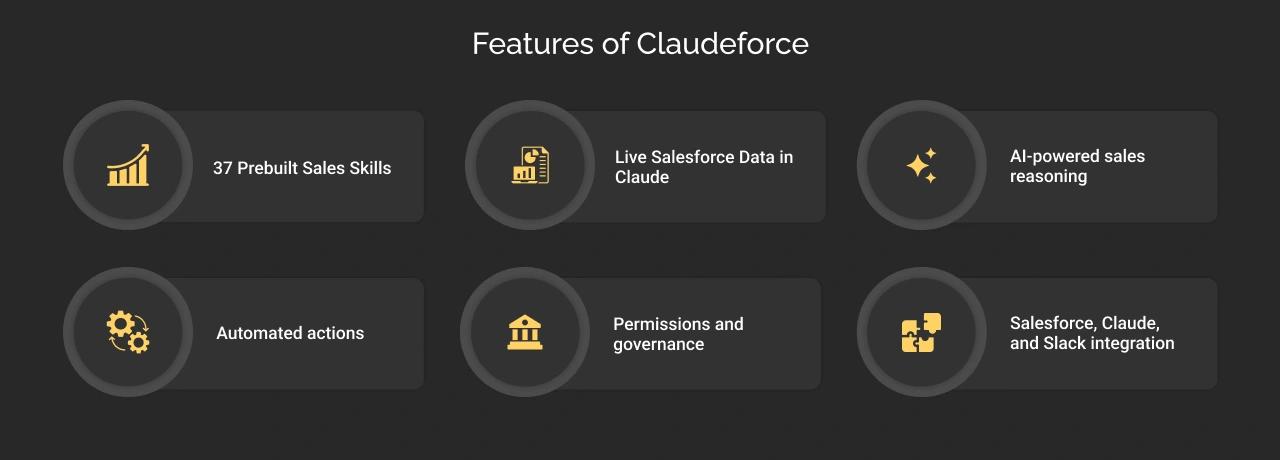
• 37 prebuilt sales skills
Salesforce in Claude launches with these skills designed specifically for sales flow. These include meeting preparation, deal health review, pipeline review, and other activities across the revenue cycle.
• Live Salesforce data in Claude
It can access relevant data and business context, helping users get the information they need without constantly switching between them.
• AI-powered sales reasoning
Can analyze business information, identify important insights, and help sellers understand which deals, accounts, or pipeline activities need attention.
• Automated actions
It can go beyond providing answers by performing actions, such as updating pipeline information and completing business tasks.
• Permissions and governance
It works with existing permissions and business rules, helping organizations control what users and AI can access or change.
• Salesforce, Claude, and Slack integration
Claudeforce allows users to access business context and take actions within their existing workflow.
How does Claudeforce work?
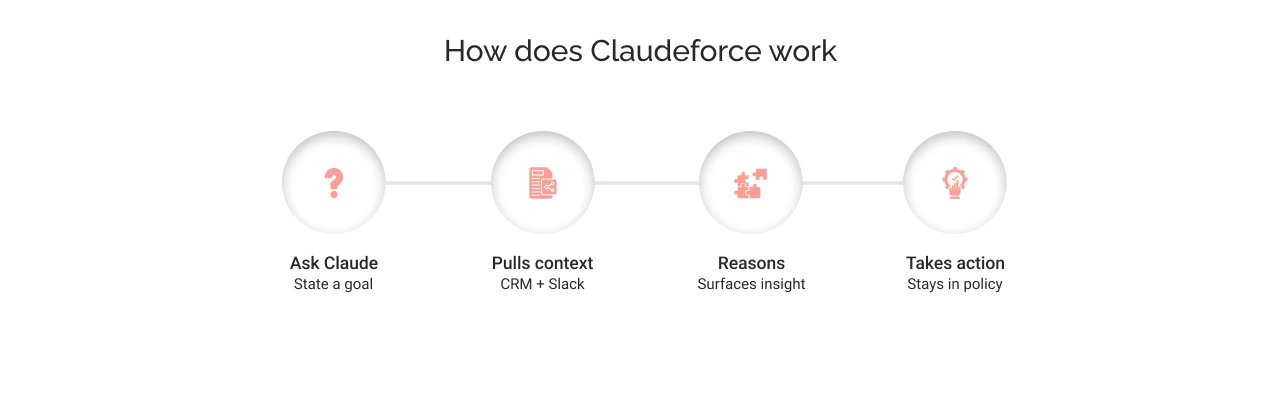
Claudeforce connects Claude’s AI reasoning with CRM data, workflows, and business context. It allows users to get insights and take actions without searching multiple systems.
Earlier, a salesperson might need to open the CRM system, review opportunities, check recent activities, scan emails and Slack, identify at-risk deals, and then update records. With Claudeforce, they can simply ask Claude “Give me my sales priorities for today.” Claude can analyze, highlight the opportunities, and support the next action within existing Salesforce permissions and business rules.
This shifts the workflow from searching for information to asking AI to understand the context and help take action.
Technical foundation behind Claudeforce
Claudeforce is built around a broader set of Salesforce and Anthropic technologies that connect AI models with enterprise data, agents, and workflows. Several key technologies work together to make this possible.
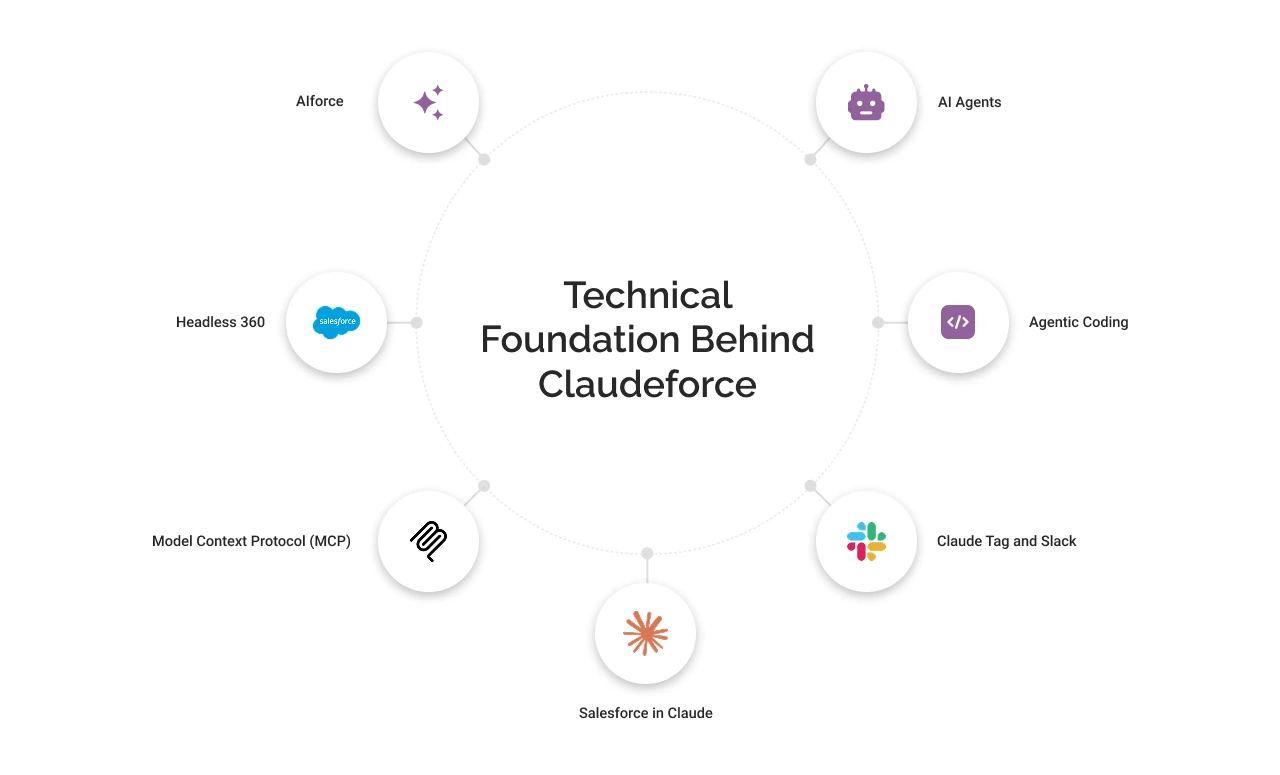
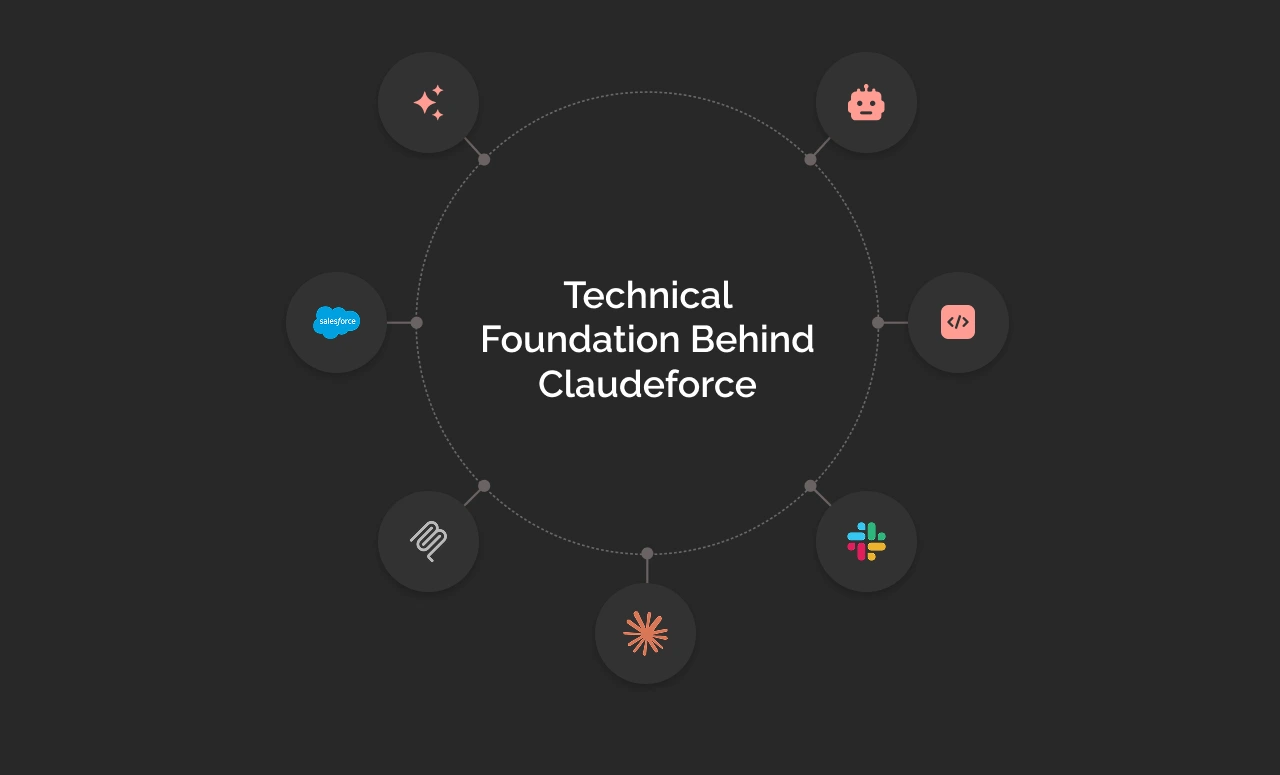
• AIforce: AIforce is Salesforce’s trusted enterprise harness that connects business data and workflows to AI agents through MCP servers, APIs, and CLI tools. It provides the foundation and helps agents access Salesforce capabilities without requiring complex, custom integrations.
• Headless 360: Headless 360 makes Salesforce capabilities available to authorized AI agents outside the traditional Salesforce UI. Instead of requiring an agent to navigate Salesforce screens, it can discover and use Salesforce capabilities such as data, workflows, and business operations directly.
• Model Context Protocol (MCP): MCP is the open standard that allows AI agents to connect with external tools and data sources. Salesforce uses MCP servers to expose trusted Salesforce capabilities to AI agents, allowing them to discover, understand, and invoke those capabilities.
• Salesforce in Claude: It is the first product launched from the Claudeforce partnership. It brings Salesforce data, permissions, and business rules into Claude and launches with 37 prebuilt sales skills covering activities such as prospecting, pipeline management, and other sales workflows. It is currently available to select pilot customers, with open beta planned for September 2026.
• Claude Tag and Slack: Claudeforce also builds on Salesforce and Anthropic’s existing work across Slack. Claude Tag acts as an AI teammate inside Slack, using channel context to support collaborative tasks and automate workflows. Salesforce also identifies Claude as a launch partner for Slack Code, where people and coding agents can collaborate on software development.
• Agentic Coding: It extends AI from simply generating code to working with people on development tasks. With Slack Code, developers can bring coding agents such as Claude Tag into dedicated code channels, where teams can review code, provide feedback, and approve work before it ships.
• AI Agents: At the center of this architecture are AI agents that can reason about a request, discover the capabilities they need, and take actions within the permissions and rules of the business.
Together, AIforce and Headless 360 provide the Salesforce foundation, MCP connects AI agents to Salesforce capabilities, and Salesforce in Claude brings these capabilities into Claude for real-world business tasks.
What does Claudeforce mean for businesses?
Claudeforce moves more business interactions from traditional application screens toward conversational, AI-driven experiences. However, if your data is incomplete, outdated, duplicated, or poorly structured, AI will not magically fix it. Therefore, keeping your data clean, secure, and well-managed is now more important for your business.
Key benefits for Salesforce businesses
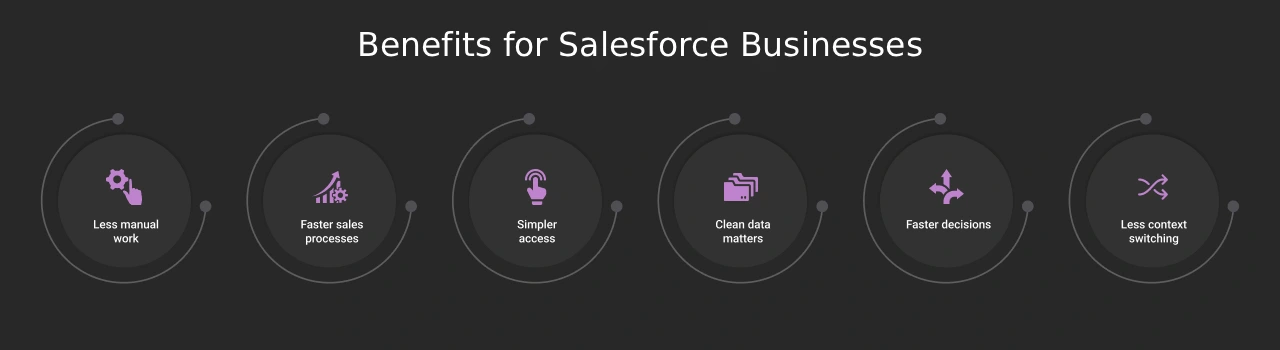
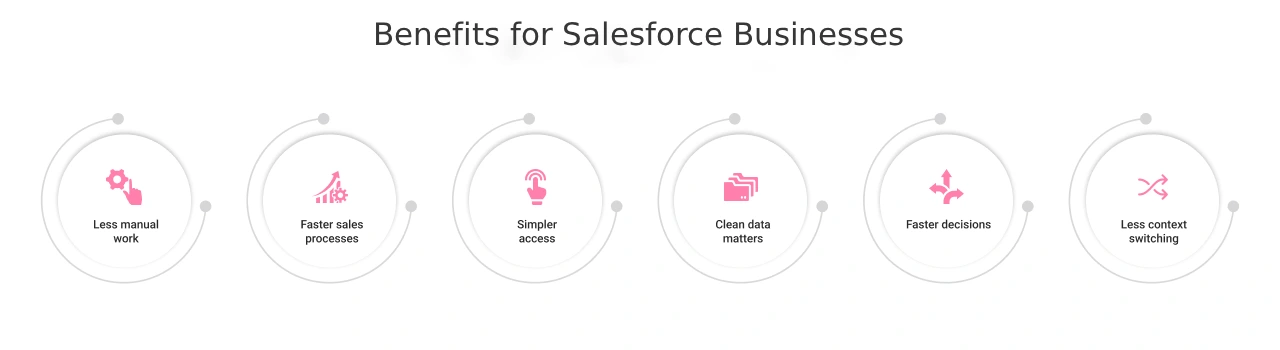
- Less Manual Work: Users can ask to analyze data and complete approved tasks without navigating CRM screens.
- Faster Sales Processes: 37 prebuilt skills help sellers with pipeline reviews, meeting preparation, deal health, and other sales tasks.
- Simpler Access Management: Admins connect CRM once, while Claude follows existing user permissions and security rules.
- Clean Data Matters: It depends on your data and backend rules, so poor data quality or permissions can create bigger problems
- Faster decision-making: Claude can analyze context and highlight crucial information, helping you make faster and more informed decisions.
- Reduces context switching: It helps users work across their tools without constantly switching between different applications.
For Salesforce teams, the opportunity is not just adopting this change but identifying where agentic AI can deliver measurable value across sales, service, marketing, and other workflows. This requires a strong Salesforce data foundation, well-defined processes, appropriate governance, and an implementation strategy.
How to start using Claudeforce in your business?
Businesses do not need to build a new AI infrastructure from scratch to use it. Salesforce in Claude is designed as a ready-made plugin that connects Claude with Salesforce data, workflows, and business context while using existing permissions and business rules.
Steps involved:-
- Connect Salesforce in Claude: Just connect Salesforce in Claude once, rather than setting up access for each user individually.
- Use Existing Permissions: Claude follows the organization’s existing Salesforce permissions and business rules, with no new permissions model required.
- Access Business Context: Claude can work with relevant Salesforce, Slack, and email context to understand the current state of the business.
- Use Prebuilt Sales Skills: Teams can start with the 37 prebuilt sales skills covering activities such as prospecting, pipeline reviews, deal health, and meeting preparation.
- Take Governed Actions: Claude can perform approved actions, such as updating Salesforce records and running workflows, while Salesforce continues to enforce business rules.
- Expand to More Use Cases: Salesforce plans to extend Claudeforce beyond Sales into areas including Service, Marketing, Commerce, Revenue, Field Service, Tableau, and Data 360.
The approach can be expanded across business workflows as more Claudeforce capabilities become available. To get reliable results, businesses should first ensure that their Salesforce data is clean and well-structured and that permissions, workflows, and business rules are clearly defined.


Conclusion
Claudeforce marks an important step toward making AI a more natural part of how businesses work with Salesforce. By combining Claude’s reasoning with Salesforce’s trusted data, workflows, actions, and governance, businesses can reduce manual work.
At the same time, it does not replace Agentforce. Agentforce remains Salesforce’s platform for building and running AI agents, while Claudeforce expands how Claude can work with Salesforce capabilities and business context. Together, they give businesses more options for bringing AI into everyday workflows.
Of course, more options also means more decisions where to start, what to automate first, and how Claudeforce and Agentforce fit into your existing setup. That’s exactly where we come in. Through our Salesforce and AI implementation services, we help you identify the right use cases, prepare your Salesforce ecosystem, build and optimize AI-powered workflows, and create a clear implementation roadmap. Connect with us today and discover how AI capabilities can scale your business.
Don’t Worry, We Got You Covered!
Get The Expert curated eGuide straight to your inbox and get going with the Salesforce Excellence.
Co-founder and CTO at Cyntexa also known as “VJ”. With 10+ years of experience and 22+ Salesforce certifications, he’s a seasoned expert in Salesforce Data Cloud & AI Products, Product Engineering, AWS, Google Cloud Platform, ServiceNow, and Managed Services. Known for blending strategic thinking with hands-on expertise, VJ is passionate about building scalable solutions that drive innovation, operational efficiency, and enterprise-wide transformation.


Cyntexa.
Join Our Newsletter. Get Your Daily Dose Of Search Know-How
Frequently Asked Questions
Claudeforce was announced in August 2026 as part of the Salesforce and Anthropic partnership. Availability may depend on the specific Claude and Salesforce capabilities being rolled out.
Yes. Claudeforce costs extra, billed separately by Salesforce (API usage) and Anthropic (Claude tokens), though exact prices haven't been published yet.
No. Agentforce is Salesforce’s platform for building and running AI agents, while Claudeforce brings Claude’s reasoning capabilities into the Salesforce ecosystem.
No. Claudeforce is designed to work with existing Salesforce permissions and business rules, helping organizations control what users and AI can access or change.